
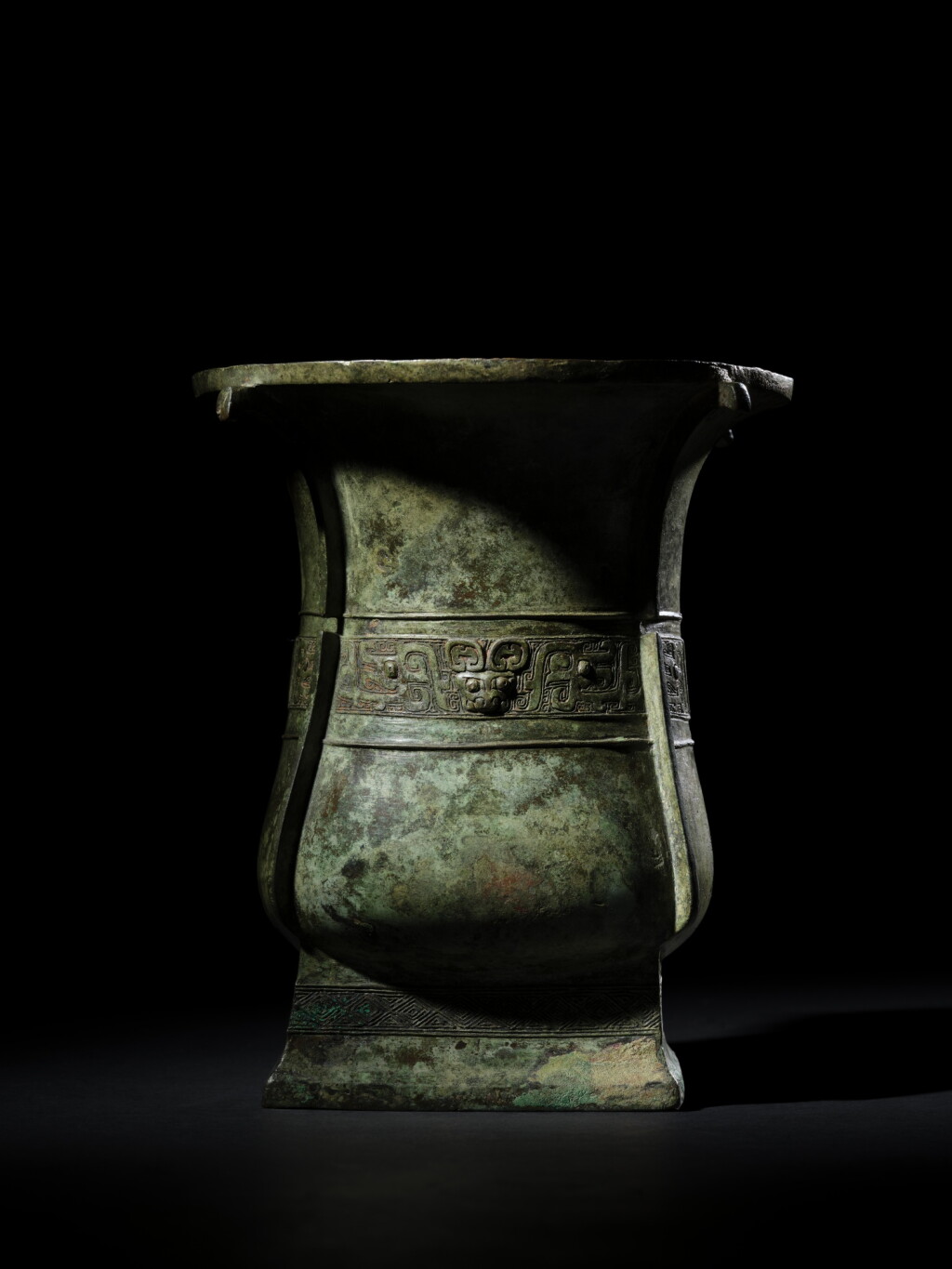
The Fu Ding Fang Zun, An extremely rare and possibly unique archaic bronze royal ritual wine vessel, Zun, Early Western Zhou dynasty | 西周早期 作父丁方尊
Premium Lot
Estimate
6,000,000 - 12,000,000 HKD
Premium Lot
Lot Details
Description
cast to the interior of the vessel with a seven-character inscription reading Zuo Fu Ding Bao Zun Yi Jian Ma
銘文:
乍父丁寶尊彝豜馬
18.4 cm
First record by Fang Junyi (d.1899) in Yangzhou, Jiangsu, during the Guangxu period (1875–1908), as recorded in Zhuiyi zhai yi qi kao shi completed in 1894
Collection of Yu Xingwu (1896–1984), before 1939
C. T. Loo (1880–1957), inventory no. 81835, 1939-1941, Paris and New York
Collection of Dr. Anton Philips (1874–1951), a member of the founding family of Royal Philips Electronics, the Netherlands, since 28th November 1941
Collection of Mrs. A. E. C. Otten-Philips; thence by descent in the family
Christie’s London, 5th November, 2013, lot 385
“An Exhibition of Ancient Chinese Ritual Bronzes Loaned by C. T. Loo & Co.” Detroit Institute of Arts, Detroit, 18th October – 10th November 1940, no. 26
“Ancient Chinese Bronzes and Chinese Jewelry: an exposition of Chinese craftsmanship in the field of metal-work”, Toledo Museum of Art, Toledo, 9th February – 2nd March 1941, no. 21
“Exhibition of Chinese Arts: New York. Special Sale”, New York, 1st November 1941 – 30th April 1942, no. 45
Fang Junyi, Zhuiyi zhai yi qi kao shi (Studies of Vessel Inscriptions from the Zhuiyi Studio), completed in 1894, published in 1935, 17.26.2
Luo Zhenyu, Zhen song tang ji gu yi wen bu yi (Collected Ancient Inscriptions from the Zhensong Hall, Supplementary Volumes), 1931, 1.22.2
Liu Tizhi, Xiao jiao jing ge jin shi wen zi (The Bronze and Stone Inscriptions of the Xiaojiaojingge Studio), 1935, 5.24.1
Luo Zhenyu, San dai ji jin wen cun (Bronze Inscriptions from the Three Dynasties), 1937, 11.25.3
John C. Ferguson, Li dai zhu lu ji jin mu (Catalogue of the Recorded Bronzes of Successive Dynasties), 1939, 100b & 107b
Yu Xingwu, Shuang jian yi gu qi wu tu lu (Shuangjianyi Antique Catalog), 1940, 1.12; reprinted in 2009, pp.29-30
C. T. Loo & Co., An Exhibition of Ancient Chinese Ritual Bronzes Loaned by C. T. Loo & Co.: October 18 to November 10, 1940, New York: William Bradford Press, 1940, no. 26, pl.XII
Toledo Museum of Art, Ancient Chinese Bronzes and Chinese Jewelry: an exposition of Chinese craftsmanship in the field of metal-work, catalogue, 1941, no. 21
C. T. Loo & Co., Exhibition of Chinese Arts: New York. Special Sale, November 1, 1941 to April 30, 1942, New York: William Bradford Press, 1941, no. 45
Rong Geng, Shang Zhou yi qi tong kao (The Bronzes of Shang and Chou), Beijing, 1941, 396:40, pl.984
Luo Fuyi, San dai ji jin wen cun shi wen (Text Annotation for Bronze Inscriptions from the Three Dynasties), manuscript completed in 1941, published in Hong Kong, 1983, 11.17b-18a, no.2327
Wang Xiantang, Guo shi jin shi zhi gao (The Manuscript of Bronzes and Stones for National History), manuscript completed in 1945, published in Qingdao, 2004, vol. 1, chapter 2, no. 131, p.182
Chen Mengjia, Zhongguo tong qi zong shu (General Study of Chinese Bronzes), manuscript completed in 1947, published in Beijing, 2019, chapter 14, p.350
Chen Mengjia, Mei di guo zhu yi jie lue de wo guo Yin Zhou tong qi ji lu (A Corpus of Our Country’s Shang and Zhou Bronzes Looted by American Imperialists), Beijing, 1962; Matsumaru Michio, ed., In Shu seidoki bunrui zuroku (A Corpus of Chinese Bronzes in American Collections), Tokyo, 1977; Chen Mengjia, Mei guo suo cang Zhongguo tong qi ji lu (Catalogue of Chinese Bronzes in American Collections), Beijing, 2019, vol.2, p.642, A453, R378
Zhou Fagao, San dai ji jin wen cun zhu lu biao (Tables of Bronze Inscriptions from the Three Dynasties), Taipei, 1977, vol.2, p.411, no.2327
Zhou Fagao, San dai ji jin wen cun bu (Complement to Bronze Inscriptions from the Three Dynasties), Taipei, 1980, p.33, rubbing p.38, rubbing 378
Sun Zhichu, Jin wen zhu lu jian mu (Concise Catalogue of Recorded Bronze Inscriptions), Beijing, 1981, no. 4354
Yan Yiping, Jin wen zong ji (Collection of Bronze Inscriptions), Taipei, 1983, vol.6, no. 4767
Hayashi Minao, In Shu jidai seidoki no kenkyu: In Shu seidoki soran 1 (Studies on Ritual Bronzes of the Yin and Zhou Periods: Conspectus of Yin and Zhou Bronzes), Tokyo, 1984, p.239, Shikei-son 7
Institute of Archaeology, Chinese Academy of Social Sciences, Yin Zhou jin wen ji cheng (Compendium of Yin and Zhou Bronze Inscriptions), Beijing, 1984-1994, vol.11, no. 5898
Institute of Archaeology, Chinese Academy of Social Sciences, ed., Yin Zhou jin wen ji cheng shi wen (Text Annotation for Compendium of Yin and Zhou Bronze Inscriptions), Hong Kong, 2001, vol. 4, no. 5898
Liu Yu, Shang Zhou jin wen zong zhu lu biao (Complete List of Recorded Shang and Zhou Bronze Inscriptions), 2008, no. 6437
He Jingcheng, Shang Zhou qing tong qi zu shi ming wen yan jiu (A Study of Clan Emblems in Shang and Zhou Bronze Inscriptions), Jinan, 2009, p.682, B451
Wu Zhenfeng, Shang Zhou qing tong qi ming wen ji tu xiang ji cheng (Compendium of Inscriptions and Images of Shang and Zhou Bronzes), Shanghai, 2012, vol. 21, no. 11719
來源
清光緒年間(1876–1908年)見於揚州古肆,1894年以前(據方濬益《綴遺齋彝器考釋》)
于省吾(1896–1984年)舊藏,1939年以前(據于省吾《雙劍誃古器物圖錄》)
盧芹齋(1880–1957)舊藏,藏品編號81835,1939–1941年(據盧芹齋紐約存貨檔案卡)
荷蘭皇家飛利浦電子公司創辦家族成員安東‧菲利浦斯(1874–1951),1941年11月28日
奧騰.菲利浦斯夫人收藏,後為家族所藏
倫敦佳士得2013年11月5日,編號385
展覽
《盧芹齋公司借展中國古代青銅禮器展》,密西根州底特律美術館,1940年10月18日至11月10日,第26號
《中國古代青銅器與中國珠寶:一場中國金屬工藝技術的闡釋展》,俄亥俄州托雷多美術館,1941年2月9日至3月2日,第21號
《中國藝術品特展》,盧芹齋,紐約,1941年11月1日至1942年4月30日,第45號
出版
方濬益,《綴遺齋彝器考釋》,1894年定稿,1935年刊印,17.26.2
羅振玉,《貞松堂集古遺文補遺》,1931年,上22.2
劉體智,《小校經閣金石文字》,1935年,5.24.1
羅振玉,《三代吉金文存》,1937年,11.25.3
福開森,《歷代著錄吉金目》,1939年,頁100下、107下重出
于省吾,《雙劍誃古器物圖錄》,1940年,上12;2009年新版,卷上,頁29-30
盧芹齋,《盧芹齋公司借展中國古代青銅禮器展,1940年10月18日至11月10日》,紐約,1940年,第26號,圖版XII
美國俄亥俄州托雷多美術館,《中國古代青銅器與中國珠寶:一場中國金屬工藝技術的闡釋展圖錄》,托雷多,1941年,第21號
盧芹齋,《中國藝術品特展圖錄》,紐約,1941年,第45號
容庚,《商周彝器通考》,1941年,396:40,圖984
羅福頤,《三代吉金文存釋文》,1941年定稿,1983年刊印,11.17下–18上,第2327號
王獻唐,《國史金石志稿》,1945年定稿,2004年刊印,第1冊,卷2,第131號,頁182
陳夢家,《中國銅器綜述》,1947年定稿,2019年刊印,第14章,頁350
陳夢家,《美帝國主義劫掠的我國殷周銅器集錄》,1962年;松丸道雄改編:《殷周青銅器分類図錄》,1977年;陳夢家,《美國所藏中國銅器集錄(訂補本)》,2019年,中冊,頁642,A453,R378
周法高,《三代吉金文存箸錄表》,1977年,下冊,頁411,第2327號
周法高,《三代吉金文存補》,1980年,頁33,拓片頁38,拓片378
孫稚雛,《金文著錄簡目》,1981年,第4354號
嚴一萍,《金文總集》,1983年,第6冊,第4767 號
林巳奈夫,《殷周時代青銅器の研究—殷周青銅器綜覽1》,1984年,圖版,頁239,觶形尊7
中國社會科學院考古研究所:《殷周金文集成》,1984-1994年,第11冊,第5898號
中國社會科學院考古研究所編:《殷周金文集成釋文》,2001 年,卷4,第5898號
劉雨,《商周金文總著錄表》,2008 年,第6437號
何景成,《商周青銅器族氏銘文研究》,2009年,頁682,B451
吳鎮烽,《商周青銅器銘文暨圖像集成》,2012年,卷21,第11719號
Unparalleled Majesty: A Unique Relic of the Early Western Zhou
Of striking form, timeless patina, rare inscription and unparalleled provenance, the Fuding Fangzun is a unique relic of the early Western Zhou dynasty. Poised upon a gently splayed rectangular base, the soft curves of its body rendered sharp and imposing with the addition of four crisp flanges rising to a generous rim, the form of the present vessel is exceedingly rare and appears to be unique among all recorded Chinese bronzes.
At its most essential, the present two-section form is derived from smaller bronze zhi beakers, which similarly consist of two rounded rectangular components. That said, in its larger size, combination of rounded and square components and prominent flanges, the present vessel is nothing short of unique. Generally termed a zun or fangzun (‘square zun’) due to its larger proportions, the vessel immediately captures one’s attention with a form at once fluid and austere. The creation of this vessel, combining non-uniform shapes through the preparation of complex clay moulds, would have required specialised skills which appear to be rarely attested in the period and which surely imply the patronage of a particularly wealthy or powerful source.
Invaluable in identifying this power source is the inscription adorning the centre of the interior. Literally translated, the six-character inscription reads “a precious honourable sacrificial vessel made for Father Ding,” and represents a fairly formulaic dedication typical of the Late Shang and Western Zhou periods. Far rarer and more important, however, is the clan insignia inscribed below. Depicting a man above a pig and flanked by two horses, the present clan sign is rare but well attested in the archaeological record. As scholar Wang Entian notes, this sign represents an important example of a compound clan insignia. Composed of subcomponents, each representing individual historic clans, compound clan signs like the present represent the union of smaller powerful families over successive generations, joined together through marriage and alliance; see Wang Entian, “‘Jinwenbian. Fulu’ zhong suojian de fuhe zuhui [Compound clan signs in the ‘Appendix to the compendium of bronze inscriptions’]’, Gudai Wenming, vol. 3, 2004, pp. 257-302. Wang initially divides the present sign (examples illustrated ibid. pp. 283-4) into two subcomponents, namely jian and ma, which are both attested individually on Late Shang and early Western Zhou bronzes: the latter represented by a pair of horses and the former by the man and swine. The jian clan, which may itself be a combination of two earlier clans represented by da 大 (or tian 天) and shi 豕 insignia, appears to have been a close ally of the late Shang Kings and deployed by them to attack foreign nations; compare references in oracle bone inscriptions in Zhong Lin, ed. Jinwen jiexi da zidian, Xi’an, 2017, p. 1278, where the author also proposes the jian pronunciation adopted here.
Further examples bearing the same Jian-Ma insignia are almost all now preserved in public institutions and include: a matching you and zun of related Father Ding dedication, unearthed in Zhengjiawan, Yingshang County, Anhui Province and illustrated in ‘Anhui ying shang xian chutu yi pi Shang Zhou qingtongqi [A batch of Shang and Zhou bronze vessels unearthed in Yingshang county, Anhui]’, Kaogu, 1984:12, pp. 1132 and 1133, where they are attributed to around the reign of King Zhao of Zhou (r. ca. 977–957 BCE), the drooping belly and decorative band of the you closely related stylistically to the present; a zun of closely related band design and dimensions but far more conventional in form with rounded foot and without flanges, preserved in the Jilin University Museum of Archaeology and Art, Jilin, illustrated in Jilin Daxue Kaogu Yu Yishu Bowuguan cang wenwu congshu: Qingtongqi juan [Collection of cultural relics from the Jilin University Museum of Archaeology and Art: Bronze ware volume], Shanghai, 2021, pl. 43; and a liding of related Father Xin inscription preserved in the Taipei Palace Museum (accession no. gutong-2206), the inscription illustrated in Zhang Li, ‘Yi zhu chengjia - tan jia zi ji qi xiangguan ziyi de yanbian [Starting a family with pigs: On the evolution of the character jia and its related meanings]’, Gugong Wenwu Yuekan, 2019:2, p. 21, fig. 1. A zhi from the collection of Somerset de Chair, apparently inscribed with a minimalist interpretation of the same mark, similarly adorned with a decorative band against a plain ground, was sold at Christie’s London, 7th June 1993, lot 86. For other Jian-Ma examples recorded by inscription, see Wang Xinyi, ed., Shang Zhou tuxing wenzi bian [Dictionary of the pictograms from the Shang and Zhou dynasties], Beijing, 2007, no. 736, pp. 301-303.
The illustrious ownership of the present vessel did not, however, end in antiquity. By the late nineteenth century, the Fuding Fangzun had already emerged as a rare and important vessel, first recorded and discussed by the famous epigrapher Fang Junyi (d. 1899), who saw the piece in Yangzhou, Jiangsu. Later entering the collection of the scholar-philologist Yu Xingwu (1896-1984) and reaching the hands of famous dealer-collector C. T. Loo (1880-1957), with each generation the present vessel continued to be treasured and recorded in catalogues and compendia, beloved for its rare form and inscription. In C. T. Loo’s publication of the piece, he further notes that the vessel was once owned by “the Ting [sic] Family, who were eminent scholars of the late Manchu [sic] Dynasty,” though the identity of this family has yet to be identified. Following its tour of America in the early 1940s, the vessel was sold to the founder of Royal Dutch Philips Electronics Limited, Dr Anton Philips (1874-1951), who purchased it from Loo in November 1941 and bequeathed it to his family.
曠世奇珍:西周早期吉金重器
「父丁」方尊形制奇絕,銅鏽蒼雅,銘文罕見且傳承顯赫,堪稱西周早期獨一無二之吉金重器。本品下承微撇之長方底座,器身曲線柔和流暢,四道挺拔之扉稜自下而上直抵寬闊口沿,使原本圓潤之器身頓顯剛勁雄渾、峻拔莊嚴。此等形制極為罕見,於目前著錄所見之中國青銅器中幾近孤例。
就其基本結構而言,本品之上下兩段式形制源於體量較小之青銅「觶」,兩者皆由圓角長方形構件組成。然本品體量碩大,巧妙結合圓與方之造型,加之扉稜挺拔突出,誠屬獨創。因其形體較大,故通常定名為「尊」或「方尊」;其形制圓方交融,兼具流暢與肅穆之美,引人矚目。鑄造本品需運用繁複之陶範工藝,以契合形態不一之構件,所需技藝極為精湛。此等高超工藝於當時實屬罕見,足見其背後必有財力雄厚或權勢顯赫之貴族鼎力贊助。
本品內底中央所鑄銘文,對考證其背後之權勢背景極具價值。其六字銘文為「作父丁寶尊彝」,意謂為父丁所鑄之珍貴祭器,乃商代晚期至西周早期頗為典型之銘文套語。相較之下,銘文下方所鑄之族徽則更為罕見且重要。該族徽描繪一人立於一豕之上,兩側各伴一馬;此類族徽雖罕見,然於考古資料中確有明證。誠如學者王恩田所指,此符號乃「複合族徽」之重要例證。複合族徽由若干代表不同單一古氏族之子徽構成,反映若干勢力家族歷經數代聯姻與結盟而結合之歷史(見王恩田撰,〈《金文編·附錄》所見的複合族徽〉,載於《古代文明》,2004年第3期,頁257–302)。王氏將本品之族徽(圖例見同上引文,頁283–284)初步拆分為「豜」(由「大」與「豕」組成)與「馬」兩部分,兩者皆曾單獨見於商代晚期及西周早期青銅器:後者以雙馬為形,前者則由人與豕構成。「豜」族本身或由更早期以「大」(或「天」)與「豕」為徽之兩氏族合併而成;該族似與商代晚期諸王關係密切,常奉王命出征討伐外族。相關甲骨文考證可參閱鍾林主編之《金文解析大字典》(西安,2017年,頁1278),該書作者亦提出將此字釋讀為「豜」(jiān),本圖錄遂從其說。
迄今所見鑄有相同「豜馬」族徽之器物,幾乎皆由公立機構珍藏,其中包括:安徽省潁上縣鄭家灣出土之一組「父丁」卣與「父丁」尊,著錄於〈安徽潁上縣出土一批商周青銅器〉(《考古》,1984年第12期,頁1132–1133),該文將其斷代為周昭王時期前後(約公元前977–957年),其中卣之垂腹造型及紋飾帶與本品風格尤為接近;吉林大學考古與藝術博物館藏有一件尊,其紋飾帶設計與尺寸與本品相近,然器形較為傳統,下承圈足且無扉稜,著錄於《吉林大學考古與藝術博物館藏文物叢書:青銅器卷》(上海,2021年,圖版43);台北故宮博物院藏有一件「父辛」鬲鼎(館藏編號:古銅-2206),其銘文拓片見張莅撰〈以豬成家——探「家」字及其相關字義的演變〉(《故宮文物月刊》,2019年第2期,頁21,圖1)。此外,索默塞特·德·謝爾(Somerset de Chair)舊藏一件觶,銘有極簡化之同款族徽,器身素面飾一周紋飾帶,後於1993年6月7日倫敦佳士得拍出(編號86)。其他具「豜馬」族徽銘文之器物實例,可參閱王心怡編《商周圖形文字編》(北京,2007年,編號736,頁301–303)。
本品之顯赫傳承並未止步於古代。至十九世紀末,「父丁」方尊已躋身珍稀重器之列,著名金石學家方濬益(卒於1899年)於江蘇揚州得見本品,並為其作最早之著錄與考述。此後,本品先入學者兼古文字學家于省吾(1896–1984年)珍藏,後經著名古董商盧芹齋(1880–1957年)遞藏。歷經數代名家流傳,本品始終備受珍視,屢見於各類圖錄與文獻著述,其罕見形制與珍貴銘文尤為藏家所重。盧芹齋於著錄本品時曾提及,其曾為「清末顯赫書香世家丁氏家族(Ting Family)」舊藏,惟該家族之確切身分至今尚待考證。1940年代初,本品於美國巡迴展出後,由荷蘭皇家飛利浦電子公司創辦人安東·飛利浦博士(Dr. Anton Philips,1874–1951年)於1941年11月自盧芹齋處購得,其後遺贈家族後人,代代相傳至今。
You May Also Like


