
Property of a Gentleman 士紳收藏
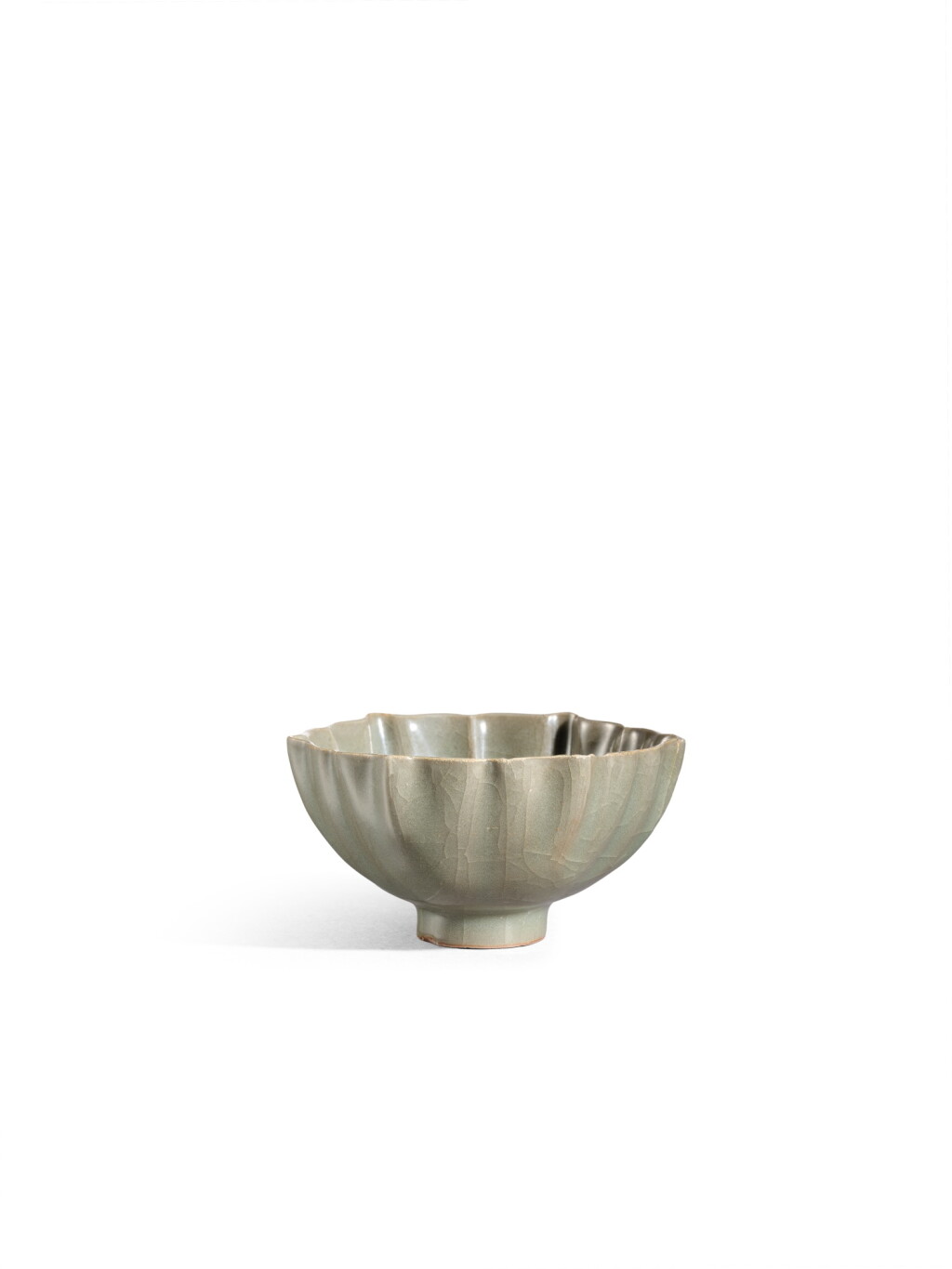
The Riesco bowl, An important and very rare small official black-bodied celadon-glazed lobed bowl, Southern Song dynasty | 南宋 黑胎青瓷花口小盌
Premium Lot
Estimate
5,000,000 - 10,000,000 HKD
Premium Lot
Lot Details
Description
10.2 cm
Collection of Sir Alfred Chester Beatty (1875–1968).
Sotheby’s London, 23rd October 1953, lot 5.
Collection of Raymond F.A. Riesco (1877–1964), no. 103c.
Christie’s Hong Kong, 27th November 2013, lot 3104 (acquired after the sale).
On loan to the Asian Civilisations Museum, Singapore, 2015–2026.
London Borough of Croydon, Riesco Collection of Chinese Ceramics Handlist, Croydon, 1987, p. 6, no. 41.
來源
切斯特比特爵士(1875-1968年)收藏
倫敦蘇富比1953年10月23日,編號5
里埃斯科(1877–1964年)收藏,收藏編號103c
香港佳士得2013年11月27日,編號3104(拍賣後購入)
展覽
借展於新加坡亞洲文明博物館,2015年至2026年
出版
倫敦克羅伊登自治市編,《里埃斯科珍藏中國陶瓷名錄手冊》,克羅伊登,1987年,頁6,編號41
The Riesco Bowl: A Masterpiece of Southern Song Celadon
Exquisitely potted and enveloped in a mesmerising, luminous glaze, the present bowl is an exceptional and exceedingly rare example of Southern Song dynasty ‘black-bodied’ celadon. Small in size yet monumental in its tactile and visual appeal, the bowl is delicately moulded with lobed sides resting on a neat footring, rising to an elegantly indented rim that evokes the organic form of an opening mallow or lotus flower. The thick, unctuous greyish sea-green glaze, suffused with a matrix of subtle, translucent crackles, pools beautifully in the recesses of the lobes, creating a captivating depth of colour. Where the glaze stops neatly above the foot, the dark, iron-rich body is revealed, providing a striking contrast to the ethereal glaze.
The precise kiln origin of this exquisite bowl remains a fascinating subject of scholarly discussion, sitting at the tantalising intersection of Southern Song imperial Guan wares and the finest black-bodied Longquan celadons. Following the Song court's relocation to Lin’an (present-day Hangzhou), imperial kilns such as Xiuneisi (Laohudong) and Jiaotanxia were established to produce Guan “Official” wares characterised by their dark bodies and thickly applied, crackled glazes. Concurrently, select kilns in the Longquan region, most notably Xikou and Xiaomei, began producing exceedingly high-quality black-bodied celadons made specifically to match these fabled imperial wares. The attractive jade-like glaze of these pieces is particularly thick as it was applied in multiple layers requiring successive firings, which is a sophisticated method most probably borrowed directly from the imperial kilns. The subtle web of crackles was similarly achieved through a well-controlled cooling process after the final firing.
Discussing Longquan celadon wares of this specific type, the eminent scholar Zhu Boqian notes in Celadons from Longquan Kilns ,Taipei, 1998, pp. 37-39, that two distinct types were made: those with a dark body and a thick glaze, such as the present piece, and those with a light grey body. Zhu illustrates two dark-bodied Longquan cups of round shape with a crackled glaze excavated in Huzhou, Zhejiang province, see ibid., pls. 141 and 142. The present bowl, with its thin dark body, 'iron foot', and rich crackled glaze, exhibits the absolute zenith of this shared aesthetic, leaving its exact attribution, whether a product of the Jiaotanxia imperial kilns or a Longquan 'guan' masterpiece an open and intriguing possibility that only adds to its scholarly and collecting appeal.
Bowls of this delicate lobed form and exceptional glaze quality are exceptionally rare, though a few closely related examples have appeared in prominent collections. Two cups of this elegant floral form and size, formerly in the Arthur M. Sackler and Else Sackler collections, were sold together at Christie's New York, 20-27 March 2018, lot 44. Another cup from the collection of Mrs. Alfred Clark, with more defined petals, was sold at Sotheby's London, 25 March 1975, lot 60; and a further example from the Kwan Collection was exhibited in Song Ceramics from the Kwan Collection, Hong Kong Museum of Art, 1994, cat. no. 65, and later sold at Sotheby's London, 12 November 2003, lot 78. A related Longquan leaf-shaped cup from the John D. Rockefeller 3rd Collection is currently housed in the Asia Society, New York. For imperial Guan comparisons, see two slightly larger Guan cups of this form, covered in a lighter crackled glaze, in the Palace Museum, Taipei, which were included in the museum’s landmark exhibition Precious as the Morning Star: 12th-14th Century Celadons in the Qing Court Collection, Taipei, 2016, cat. no. II-33.
Beyond its intrinsic beauty and historical importance, the present bowl boasts an impeccable and illustrious provenance. It was first in the collection of Sir Alfred Chester Beatty (1875–1968), the renowned American-British mining magnate and one of the most significant collectors of the 20th century. Following its sale at Sotheby's London in 1953, it was acquired by Raymond F.A. Riesco (1877–1964). Riesco formed a formidable collection of Chinese ceramics, much of which was later acquired by the London Borough of Croydon. The appearance of the Riesco Bowl on the market, after being on long-term loan to the Asian Civilisations Museum in Singapore for over a decade, presents a remarkably rare opportunity to acquire a masterpiece of Song dynasty ceramics with an impeccable mid-20th century British provenance.
里埃斯科藏南宋黑胎青瓷花口小盌
此件小盌形制精巧,釉色瑩潤如玉,乃南宋黑胎青瓷中極為罕見之傑作。本品盈盈一握,然氣韻非凡。器身精緻,呈花瓣式,下承修整規矩之圈足,口沿微斂,宛若一朵含苞待放之葵花或蓮花。通體滿施灰青色釉,釉層肥厚溫潤,釉面佈滿若隱若現之金色冰裂開片。釉汁於花口凹陷處積聚,呈現出迷人的色澤層次。底足露胎處可見深邃之灰褐色胎骨,與清雅的青釉形成強烈對比。
此件精美小盌之確切窯口歸屬,至今仍是學界探討之迷人課題,其特徵恰好介於南宋御用官窯與最頂級之龍泉黑胎青瓷之間。南宋皇室南渡臨安(今杭州)後,設立修內司(老虎洞)與郊壇下等御窯,專門燒造以黑胎、厚釉、開片為特徵之官窯瓷器。與此同時,龍泉地區的部分窯口,尤以溪口、小梅窯為代表,亦開始燒造極高品質的「黑胎」青瓷,刻意仿效官窯之神韻。此類器物之所以能呈現如玉般醇厚的釉感,乃因其採用了多次施釉、多次焙燒的複雜工藝,此技法極有可能是直接借鑒自杭州官窯。而其表面迷人的網狀開片,亦是透過最後一次焙燒後精準控制冷卻過程所致。
著名學者朱伯謙在《龍泉窯青瓷》,台北,1998年,頁37-39,中探討此類龍泉青瓷時指出,當時主要燒造兩種截然不同的類型:一種如本品般具備黑胎與厚釉,另一種則為白灰胎。書中亦著錄了兩件出土於浙江湖州、帶有開片的龍泉黑胎圓盌,見同上著錄,圖版141及142。本盌胎骨纖薄深沉,具「鐵足」特徵,且釉面開片肥潤,完美展現了此一時期最高的美學成就。其究竟是杭州郊壇下官窯之御物,抑或龍泉窯仿官之絕頂佳作?這種窯口歸屬的開放性與多種可能性,無疑為本品增添了更深層次的學術探討空間與收藏魅力。
此類器形優美、釉色絕佳之花口小盌存世極罕,然有少數相類之例曾見於重要私人珍藏。兩件尺寸與形制相近之花口小盃,原為亞瑟·賽克勒及艾爾莎·賽克勒伉儷舊藏,後於紐約佳士得2018年3月20至27日合併拍出,拍品編號44。另一件花瓣特徵更為明顯之例,為阿爾弗雷德·克拉克夫人舊藏,售於倫敦蘇富比1975年3月25日,拍品編號60;另有一例出自關善明「沐文堂」珍藏,曾展於香港藝術館1994年《關氏所藏宋代陶瓷》特展,編號65,後於倫敦蘇富比2003年11月12日售出,拍品編號78。紐約亞洲協會約翰·洛克菲勒三世舊藏中亦有一件相類的龍泉窯花口盃,可作參考。若以宮廷官窯作比對,台北故宮博物院藏有兩件尺寸稍大、釉色較淺之南宋官窯花口盌,曾展出於2016年重要特展《貴似晨星:清宮傳世12至14世紀青瓷特展》,台北,2016年,編號II-33。
除卻其非凡之藝術與歷史價值,本品更具備顯赫之遞藏歷史。此盌早年為美國裔英國礦業巨頭、二十世紀最重要之收藏家之一切斯特・比特爵士(1875-1968)所珍藏。1953年於倫敦蘇富比釋出後,由雷蒙德・里埃斯科納入樞藏。里埃斯科所建立之中國陶瓷收藏蔚為大觀,其中大部分後由倫敦克羅伊登自治市購藏。此「里埃斯科珍藏」之青瓷小盌,曾於新加坡亞洲文明博物館借展長達十餘年,如今再現拍場,實為購藏來源顯赫之宋代單色釉瓷器絕佳良機。
You May Also Like


