
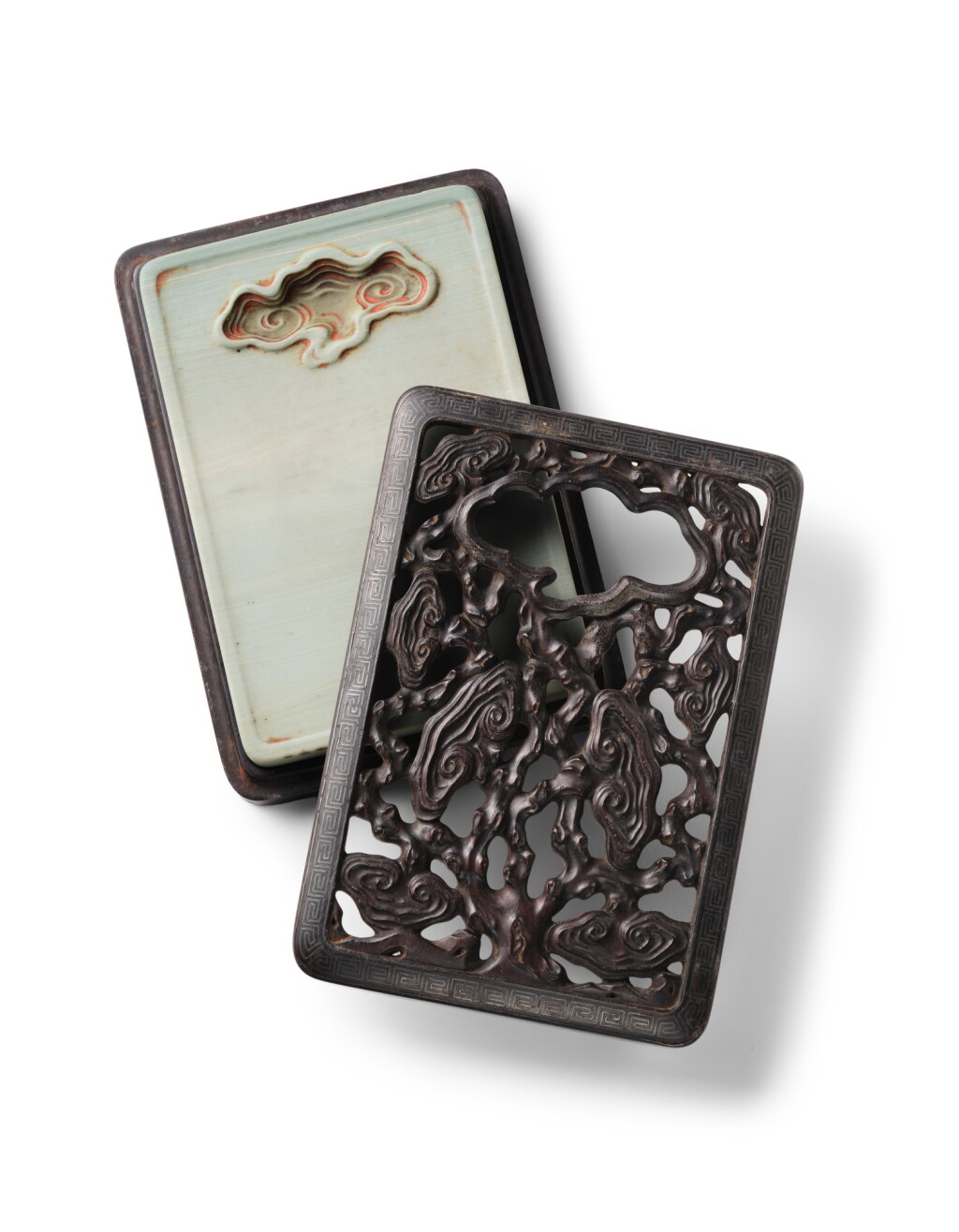
An imperially inscribed songhua inkstone with original zitan fitted box, Qing dynasty, Kangxi period | 清康熙 御銘松花石「九如」硯 「康熙」、「御銘」印 原配紫檀透雕靈芝如意紋硯盒
Estimate
1,500,000 - 2,500,000 HKD
Lot Details
Description
inkstone 14.7 cm;
box 16.3 cm
Nicolas Chow, The Literati Aesthetic, Hong Kong, 2018, no. 11.
出版
仇國仕,《無盡意》,香港,2018年,編號11
不能銳,因以鈍為體。
不能動,因以靜為用。
惟其然,是以能永年。
——出自北宋文人唐庚〈家藏古硯銘〉
The brush is sharp and short-lived;
the ink flows and fades;
only the inkstone, dull and still, endures.
— Northern Song literatus Tang Geng’s “Inscription on an Heirloom Inkstone”
For the Manchu emperor who made antiquity his mirror, the Song dynasty was not merely a style but a state of mind. Kangxi’s court returned, again and again, to the Northern Song because it offered a lexicon of restraint: a monochrome palette, measured forms, and an aesthetic of inward radiance rather than outward display. For a conqueror-emperor consolidating a new dynasty, the Song provided a Han cultural anchor that was scholarly, civil, and morally legible: a way to rule through refinement as much as through force.
The inscription that crowns this longing is deceptively simple: “以靜為用,是以永年”. It comes from the Northern Song literatus Tang Geng’s Inscription on an Heirloom Inkstone, a text that reads the scholar’s tools as a parable of life. The brush is sharp and short-lived; the ink flows and fades; only the inkstone, dull and still, lasts. To carve these words on an imperial inkstone is to make the object speak its own philosophy: the mandate’s endurance belongs not to those who act, but to the one who abides through being acted upon.
The inkstone is the one constant in the scholar’s daily ritual, the silent witness to every stroke, every revision, every act of governance rendered in ink. Kangxi, who personally commissioned songhua inkstones, turned the object into a mirror for the ruler himself. The message is precise: stillness is not passivity but power; dullness is not deficiency but durability. In a world of restless brushes and evaporating ink, the stone’s virtue is to remain—unshaken, unblunted, unbroken.
For Kangxi, the appeal is at once aesthetic and existential. The Northern Song sensibility offered a visual language of calm authority; Tang Geng’s words offered an ethical language of self-cultivation. Together, they form a single proposition: to rule is to outlast not by striking, but by being struck and remaining. In choosing Northern Song words for a Qing object, he binds his reign to that earlier civil ideal, turning copying into continuity and antiquity into authority. The inkstone, then, is more than a tool. It is a throne in miniature, where the emperor learns, day after day, that true power is the grace to absorb every stroke of fate and remain enthroned.
You May Also Like


