
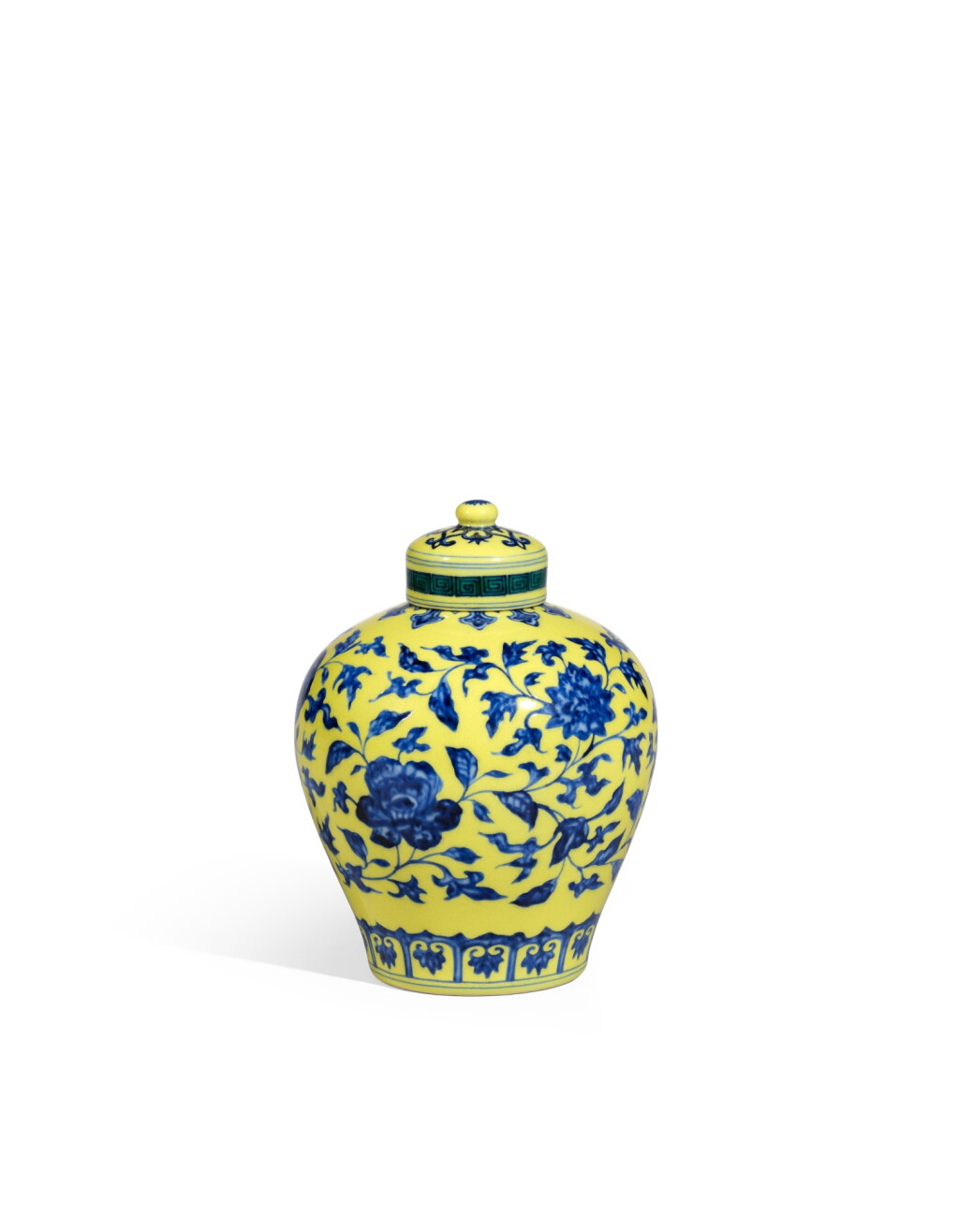
A fine and very rare yellow-ground and underglaze-blue 'floral' jar and cover, Mark and period of Yongzheng | 清雍正 黄地青花纏枝花卉紋蓋罐 《大清雍正年製》款
Premium Lot
Estimate
6,000,000 - 12,000,000 HKD
Premium Lot
Lot Details
Description
jar h. 13.5 cm; overall h. 15.5 cm
An old Japanese collection.
來源
日本舊藏
This magnificent jar represents the very essence of Yongzheng imperial porcelain. Potted to perfection with a stately foot, subtly curving voluptuous shoulder and a simple yet refined cover, the present jar exemplifies the commensurate skill of imperial potters during the High Qing period, and their striking of a delicate balance between fineness and a robust weight. However, it is not just the potting here that delights — rather it is in the design and decoration of this jar, executed to perfection, that one gains an insight into the spectacular vision of these wares; made to order for the court of the Yongzheng Emperor (r. 1723-1735) in tribute to the past.
Featuring scrolling blossoms and leaves between formal bands, the sumptuous design of the present jar is essentially a product of the early Ming dynasty. Perfected during the reigns of the Yongle (1403-1424) and Xuande (1426-1435) Emperors, the fifteenth century gave rise to some of the most celebrated porcelains ever produced in Chinese history, particularly beloved of the Yongzheng emperor and his court. Rightfully seen as a zenith of porcelain production for its spellbinding forms, recognition of negative space and rich underglaze blue pigmentation, every aspect of the Early Ming design philosophy makes an appearance on the present jar: from the shape of the blossoms to the intentional shading of the brushwork in imitation of the misfired ‘heaped and piled’ pigment effects so often found on early porcelains.
Indeed even the present combination of yellow enamels with underglaze blue designs appears to derive from this perceived golden age of porcelain production. As early as the Xuande reign, potters began to apply thin coats of yellow enamel to classical blue-and-white dish designs, carefully enamelling around the underglaze blue motifs, likely in an attempt to accentuate the vibrancy of the pigments. This technique remained exceedingly rare in the early fifteenth century— compare a Xuande dish featuring the technique in the British Museum, London (accession no. PDF,A.755), illustrated in Margaret Medley, Illustrated Catalogue of Ming Polychrome Wares in the Percival David Foundation of Chinese Art, London, 1978, cat. no. 2. However, by the turn of the sixteenth century and the Hongzhi and Zhengde reigns, this combination had soon developed into a staple feature of the imperial canon with yellow enamels refined to be brighter and brighter and cobalt pigments blended to a perfectly contrasting rich grey-blue.
This technique was eventually adapted for use on a very small number of upright forms later in the Ming dynasty, most notably a small group of vases of double-gourd form during the Jiajing period (1522–1566). Compare one such vase in the Metropolitan Museum of Art, New York (accession no. 91.1.379), illustrated by Suzanne G. Valenstein in Oriental Ceramics. The World's Greatest Collections, vol. 11: Metropolitan Museum of Art, Tokyo, 1981, col. pl. 21. However, beyond these notable instances, the wholesale application of yellow enamels to upright forms appears largely to have been a Qing dynasty innovation, perfected but still extremely rare in the Yongzheng period.
Under the guidance of kiln superintendent Tang Ying (1682–1756), this staple of Ming imperial design was transformed into a uniquely Qing statement of magnificence and artistic splendour. Developing twelve distinct yellow glazes during the brief Yongzheng reign, Tang Ying and his chemists devoted themselves to refining new colours and techniques to enrich the conventions inherited from three hundred years prior. The present jar, for example, is generously enrobed in a soft ‘lemon yellow’ enamel derived from antimoniate oxide, which appears to have been a personal favourite of the Yongzheng Emperor and results in a captivating finish that contrasts boldly with the Ming-inspired blue below. In a deliberate attempt to simulate the covering of blue by yellow, the present jar also features the subtle use of green enamel around the edge of the cover, a deliberate feature apparently rarely replicated in blue-and-white pieces re-enamelled in modern times.
Like their Ming predecessors, the potters of the Yongzheng court used yellow enamels almost exclusively for more practical flat forms which directly reference Ming antecedents. Compare, for example, handled cups like the one sold in our New York rooms, 20th September 2023, lot 515, produced after Xuande originals like one included in Imperial Porcelain of the Yongle and Xuande Periods Excavated from the Site of the Ming Imperial Factory at Jingdezhen, Hong Kong Museum of Art, Hong Kong, 1989, cat. no. 47. This Yongzheng revival of Ming blue-and-yellow designs is perhaps most famously exemplified by dishes of classical fifteenth-century floral spray designs. Compare, for example, two Yongzheng variations on the Yongle and Xuande period ‘lotus bouquet’ design in Geng Baochang, ed., Gugong bowuyuan cang Ming chu qinghua ci [Early Ming blue-and-white porcelain in the Palace Museum], vol. 2, Beijing, 2002, pls 195 and 199, featuring a related green band around the inner and outer rims; and reverse decorated ‘gardenia’ dishes of yellow designs on a blue ground, including one from the Kennedy collection included in Regina Krahl, Chinese Ceramics from the Meiyintang Collection, London, 1994-2010, vol. 4, cat. no. 844, sold in these rooms, 3rd April 2012, lot 48.
While these flat forms are themselves exceedingly rare, upright examples such as the present are rarer still, and appear to be almost always unique. Indeed, no other related examples of the present form appear to have been published, let alone one retaining its cover. For other upright forms, compare: a moonflask of Ming-inspired floral design in The Complete Collection of Treasures of The Palace Museum. Blue and White Porcelain with Underglaze Red (III), Hong Kong, 2000, pl. 233; a quatrefoil moonflask of related floral design from the Idemitsu Museum of Art, sold at Christie’s Hong Kong, 30th November 2011, lot 2944; and a flattened vase sold at Christie’s Hong Kong, 27th May 2008, lot 1575. For other examples of yellow-and-blue designs from the Yongzheng period, compare a remarkable assemblage in the Fondation Baur, Geneva, in John Ayers, Chinese Ceramics in the Baur Collection, vol. 2, Geneva, 1999, pp 88-95: including a covered jar of particularly close scrolling floral design, cat. no. 209; a bowl of closely related floral design with similar use of green enamel to highlight framing bands of conventional scrollwork, cat. no. 210; and a faceted vase directly after a beloved fifteenth-century prototype, similarly with a green leiwen band, cat. no. 212.
You May Also Like


