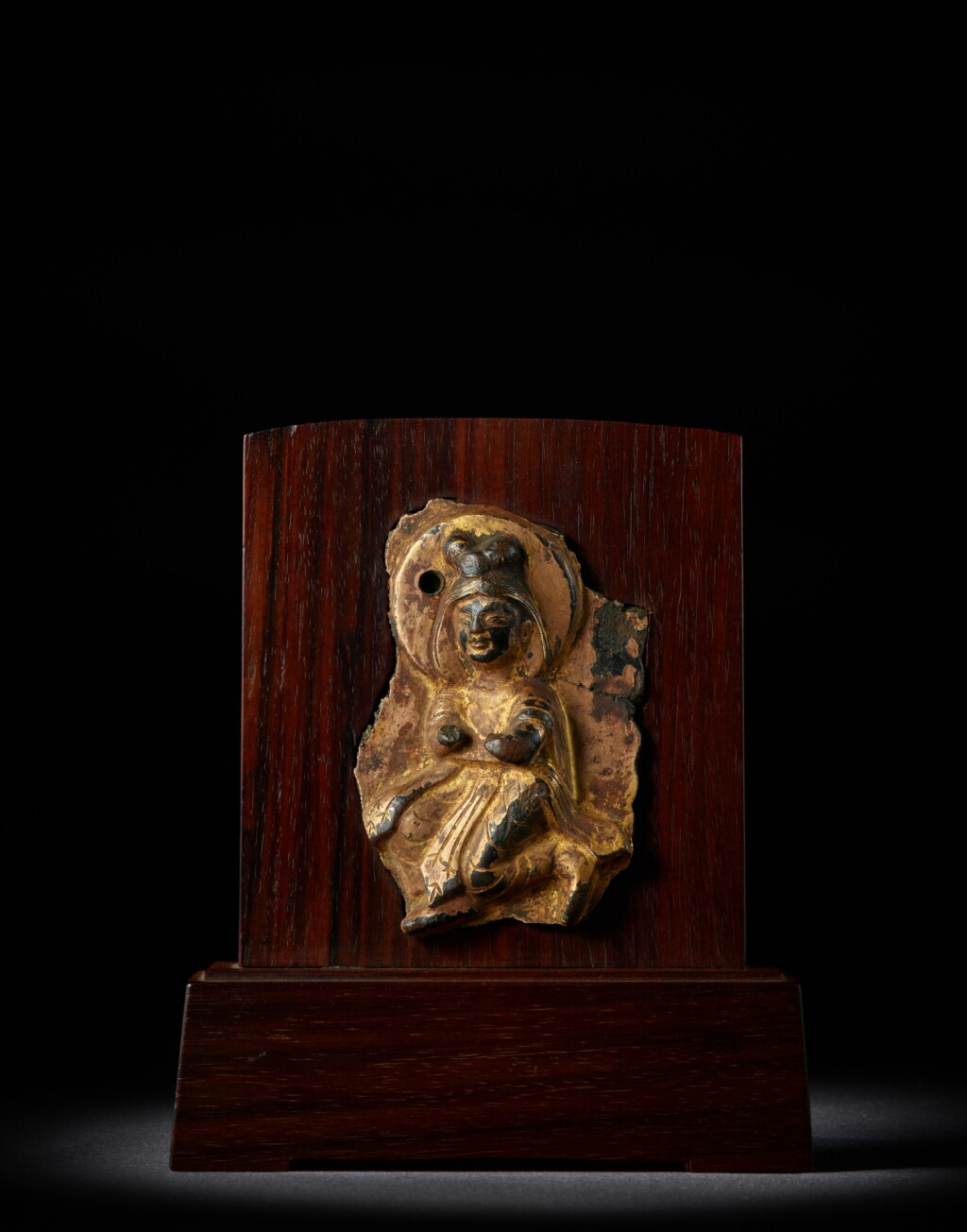
A gilt-bronze fragment of an apsara, Northern Wei dynasty | 北魏 銅鎏金供養天女
Live auction begins on:
October 30, 02:00 AM GMT
Estimate
200,000 - 400,000 HKD
Lot Details
Description
overall 16cm.
mounted wood stand
Collection of Sato Gengen (1888-1963)
Collection of Sakamoto Gorō (1923-2016)
Sotheby's Hong Kong, 5 October 2016, lot 3213
來源
佐藤玄玄(1888–1963年)收藏
坂本五郎(1923–2016年)收藏
香港蘇富比2016年10月5日,編號3213
Figures of apsarases descending to scatter flowers or to play heavenly music were used to enliven and animate votive altars, Buddhist triad groups and cave niches. The principal registers of the Buddha with attendant bodhisattvas and luohans were strictly controlled in their depiction and iconography by source texts and sutras. In contrast, the depiction of the peripheral elements in sculptures of various media and cave paintings was seized upon by artisans to show their prowess and experiment with the boundaries of pictorial convention.
This delicate and striking fragment was likely a fitting from a monumental gilt-bronze ensemble or a substantial altar piece. It exhibits close stylistic affinities with the monumental stone carvings of the Yungang grottoes of the Northern Wei dynasty. The apsaras is depicted in a position of dynamic motion, combining the linear emphasis characteristic of Wei sculpture with a deeply spiritual resonance. Compare a related gilt-bronze kneeling apsaras in the Nelson-Atkins Museum of Art, Kansas City (acc. no. 34-48, acquired in 1934 from Huang Ku Shan Fang, Beijing), illustrated in Hugo Munsterberg, Chinese Buddhist Bronzes, Tokyo, 1967, pl. 97.
飛天或散花,或奏樂,常見於佛教造像、祭壇及石窟龕楣之中,為莊嚴的佛殿增添靈動之氣。主尊佛像、菩薩及羅漢之造像與圖像特徵,皆須嚴格遵循佛經儀軌;相比之下,工匠在處理如飛天等邊緣元素時,則享有較大之創作自由,得以展現其精湛技藝並突破傳統圖像之界限。
此類銅製飛天殘件尺寸較大,推測其原應為大型銅鎏金造像群或大型祭壇上之重要構件。其風格與北魏雲岡石窟之造像特徵極為相近。雖為殘件,本品仍不失為一件精緻動人之雕塑傑作。天女姿態靈動,線條流暢,充分展現了魏代雕塑注重線條美感與深邃精神內涵之特色。比較一相類銅鎏金跪姿飛天例,藏於堪薩斯城納爾遜-阿特金斯藝術博物館(館藏編號34-48,1934年購自北京皇姑山房),錄於慕滿德,《Chinese Buddhist Bronzes》,東京,1967年,圖版97。
You May Also Like