Property from the MQ Collection 莫勸齋珍藏
An inscribed limestone votive stele with Buddhist triad, Tang dynasty | 唐 廉玄意鐫石灰石雕刻銘造像碑
Live auction begins on:
October 30, 02:00 AM GMT
Estimate
250,000 - 650,000 HKD
Lot Details
Description
h. 34 cm
Li Yin Oriental Art, Taipei, 1998.
銘文共一百三十六字
背面
造石浮圖博士龍門□鳳停府
旅帥廉玄意鐫
願□主□師意一心供養
慈州昌寧□明樂鄉樊石村
范賓旅壹拾貳生□今為
七世父母見存父母合家大小
一心供養
正面
三衛劉元湊一心供養
錄軍范賓旅一心供養
軍士重師捻一心供養
掖文榮一心供養
右側
范□〔一心供養〕
張元勣一〔心供養〕
重師度一〔心供養〕
掖行敏〔一心供養〕
皇甫□〔一心供養〕
左側
趙禽兒一心供養
王仁友一心供養
重山威一心供養
來源
禮瀛東方藝術,台北,1998年
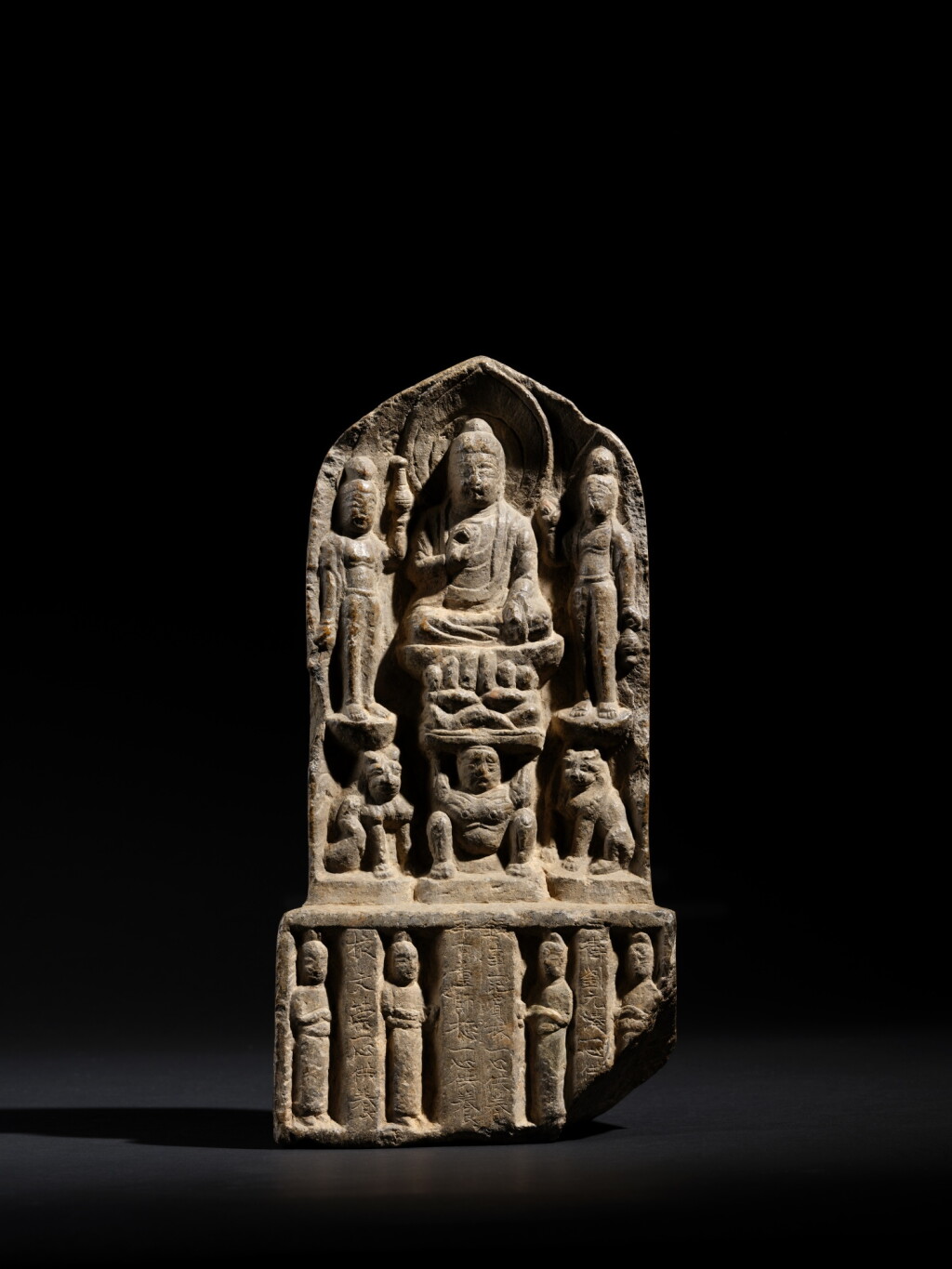
This stele centres on a seated Buddha, whose composed presence conveys both dignity and serenity. His tranquil face is defined by gently lowered brows and downcast eyes, while his raised right hand forms the gesture of fearlessness (abhaya mudra), exemplifying the refined elegance of Buddhist sculpture in the Tang dynasty.
Flanking him are two standing bodhisattvas, slender in figure and rounded in face. Their elongated brows impart a gentle, contemplative expression, while the purification vases they hold symbolise the cleansing of worldly afflictions. Falling in graceful, flowing folds, their celestial robes enliven the composition and heighten its devotional presence.
Below the central triad, a guardian crouches beneath a boshan censer, supporting it with his powerful body. Robust in physique and commanding in pose, he demonstrates the Tang sculptor’s remarkable ability to convey movement and dynamic force. On either side, lions stand as fierce protectors, lending the composition an added sense of authority and grandeur. Across the sides and reverse of the stele, intricate honeysuckle motifs unfold in elegant, curling forms. Symbolising vitality and eternity in Buddhist teachings, these patterns are rendered with meticulous care and contribute to the monument’s solemnity and refinement.
Bringing together the Buddha, bodhisattvas, guardian, lions, and censer within a single, carefully balanced composition, the stele is an exceptional example of Tang religious sculpture. Its richness of imagery, quality of carving, and integration of diverse symbolic elements are rarely encountered in such detail.
Of particular importance are the inscriptions carved on all four sides of the stele. Whereas Buddhist steles generally record the names of donors, this example uniquely identifies the artisan, Lian Xuanyi, whose titles include ‘Stone Stupa Master’ 造石浮圖博士 and ‘Commander of the Fengting Prefecture of Longmen’ 龍門鳳停府旅帥.
The title ‘Stone Stupa Master’ suggests a prestigious position connected with the design and production of Buddhist stone carvings, underscoring the religious and artistic significance of the work.
The title ‘Commander of the Fengting Prefecture of Longmen’ points to a military appointment, possibly involving the oversight of regional forces. Additional titles mentioned in the inscriptions, including ‘The Third Guard’ 三衛 and ‘Recording Officer’ 錄軍, likewise correspond to military structures. Taken together, they suggest that the sponsorship of the stele may have been connected with military-affiliated circles.
Exceptionally rare among surviving independent Buddhist steles is the inscription’s direct reference to ‘Longmen’ 龍門. Tang-dynasty inscriptions at the Longmen Grottoes occasionally mention ‘Longmen’ or ‘Longmen Mountain’, but such an explicit reference is seldom encountered on an independent Buddhist stele. This feature lends the work considerable epigraphic importance.
The inscription’s naming of the artisan Lian Xuanyi is equally significant, allowing the maker and production background of the stele to be identified with remarkable clarity.
On stylistic grounds, the stele may be dated to the period extending from the reign of Emperor Gaozong through the Wu Zhou era. Rich in imagery and finely carved, it brings together religious devotion, regional identity, and a military-social context, making it an important work for the study of Tang Buddhist art, epigraphy, and society.
For a comparable example, see a Buddhist tablet on a rectangular pedestal dating to the era of Empress Wu Zetian, inscribed and dated to the third year of Chang’an (703 CE), h. 23 cm, now in the collection of the Freer Gallery of Art, Washington, D.C. (accession no. F1909.79), illustrated in Matsubara Saburō, Chūgoku Bukkyō chōkokushiron / History of Chinese Buddhist Sculpture, vol. III, Tokyo, 1995, cat. no. 640a.
See also an inscribed Buddhist triad stone stele of the Tang dynasty, dated to the seventh year of the Kaiyuan era (719 CE), h. 48 cm, handled through Yamanaka & Co., Ltd and Mineo Hata, sold in these rooms, 29th October 2024, lot 2009.
此碑主尊坐佛居中,面容端莊安詳,眉目低垂,神態慈悲肅穆,右手施無畏印,體現唐代佛教造像之典雅風格。兩側侍立菩薩,身形修長,面相圓潤,眉目細長,神情和煦,身著天衣,衣紋流轉飄逸。兩菩薩各持淨瓶,象徵淨化眾生業障,雕刻細節精緻生動,增添宗教象徵意義。
下方力士蹲坐托舉博山爐,形體雄壯,呈現唐代雕刻對動態之掌控與表現力。兩側護法獅形態威猛,作護衛姿態,增添威儀氣韻。碑之側面及背部刻有忍冬紋,象徵佛教教義中生命繁茂與永續,紋飾雕工精緻,線條流暢,增添莊重典雅之美感。
本件碑像型制豐富,集佛、菩薩、力士、護法獅於一體,為唐代宗教藝術之佳作,罕有可見。
銘文四面鐫刻,尤為珍貴。一般佛教碑像多載供養人姓名,本件碑文特提及匠師廉玄意,官銜為「造石浮圖博士」及「龍門鳳停府旅帥」。造石浮圖博士乃掌管佛教石雕造像之官職,負責造像設計及監造,具重要宗教與藝術地位。旅帥則為唐代軍中職銜,或掌管地方軍務,統領部眾。碑上銘文頭銜更提及「三衛」、「錄軍」等字樣,與旅帥呼應,或為軍隊供養團體,佐證此像可能源自軍事背景之供養。
此碑銘文中罕見刻有「龍門」二字,尤為難得。雖唐代龍門石窟造像題記中偶見以「龍門」或「龍門山」標示地望者,然就傳世獨立碑形造像而言,銘文中直接標舉「龍門」者極為罕見,具重要金石文獻價值。碑文並明確記載匠師廉玄意之名,使其製作背景與工匠身份得以考察。結合造像風格觀察,
風格上觀,應屬高宗至武周時期。本品題材豐富、布局嚴謹、技法精湛,兼具宗教供養、地域標識與軍事社會背景,實為研究唐代佛教造像、宗教信仰與社會文化不可多得之重要珍品。
華盛頓佛利爾美術館藏一例,可資比較,為唐代武周時期長安三年銘(703年)石灰岩三尊佛龕像,高23公分,館藏編號:F1909.79,載錄於松原三郎,《中国仏教彫刻史論》,卷3,東京,1995年,圖版640a。
另可參考唐開元七年(719年)石雕銘文菩薩三尊像龕,高48公分,經山中商會及秦峰男遞藏,售於香港蘇富比2024年10月29日,編號2009。
You May Also Like