
Ultimate Guide to Buying an Emerald Cut Engagement Ring
Explore how to choose an exceptional emerald cut engagement ring, from clarity and proportions to carat weight, length-to-width ratio and rarity.
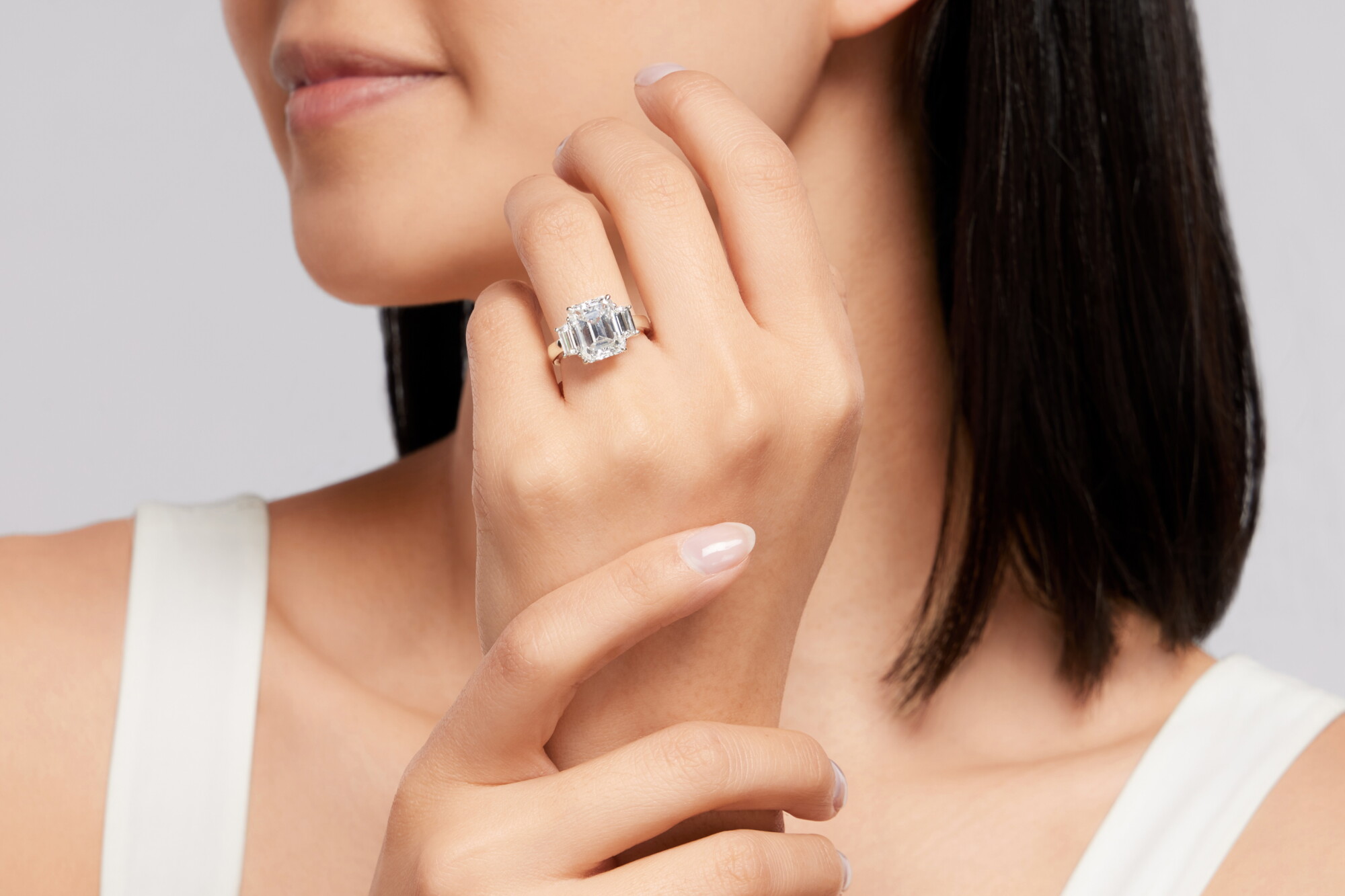
An emerald cut diamond stands apart for what it reveals rather than how intensely it sparkles. Its broad table and linear step facets create the distinctive flashes of light often described as a “hall of mirrors” effect, placing greater emphasis on clarity, transparency, proportions and the quality of the diamond itself. The elongated rectangular silhouette can also create significant presence on the hand, particularly at larger carat weights. For collectors considering an emerald cut engagement ring, understanding how color, clarity, length-to-width ratio, carat weight and setting work together is essential to choosing an exceptional stone.
| Factor | What to Know |
|---|---|
| Cut Style | Emerald cuts use broad step facets that create a distinctive “hall of mirrors” effect rather than brilliant-cut sparkle. |
| Clarity | The open table can make inclusions easier to see, so transparency and inclusion placement are especially important. |
| Color | Body color can be more apparent in an emerald cut than in many brilliant cuts, particularly at larger carat weights. |
| Proportions | Length-to-width ratio determines whether the diamond appears more square or elongated; there is no single ideal ratio for every buyer. |
| Carat Weight | Emerald cuts can offer substantial face-up presence, but actual dimensions and depth should be considered alongside carat weight. |
| Settings | Solitaires and three-stone designs with tapered baguettes or step-cut side stones complement the emerald cut’s geometric lines. |
| Collector Appeal | Exceptional examples combine strong transparency, balanced proportions, attractive color and clarity and a compelling overall appearance. |
The emerald cut takes its name from the gemstone it was originally developed to shape. Because emeralds are comparatively fragile and frequently included, cutters used broad, stepped facets and truncated corners to reduce pressure on the stone while emphasizing its color. The same basic cutting style was later adapted for diamonds, where its large table and parallel step facets created a very different optical effect from the sparkle of a brilliant cut.
By the early 20th century, the emerald cut had become closely associated with Art Deco jewelry, whose emphasis on symmetry, geometry and clean lines complemented the rectangular shape. That architectural quality remains central to the cut today: rather than breaking light into countless small flashes, an emerald cut produces broader reflections that draw attention to the diamond’s transparency, proportions and internal character.
Unlike round, oval or cushion brilliant diamonds, emerald cuts are designed around long, parallel step facets rather than numerous smaller facets intended to maximize sparkle. Light moves through the stone in broader flashes, producing the characteristic “hall of mirrors” effect. The result is a cleaner, more architectural appearance that places greater emphasis on the diamond itself.
That openness is also what makes emerald cuts particularly demanding. Inclusions can be easier to see through the broad table, body color may be more apparent and subtle differences in proportions can noticeably affect how the diamond performs. A well-cut emerald diamond should display an appealing sequence of light and dark reflections without appearing overly glassy, dull or dark through the center. For buyers, visual balance and transparency can therefore be just as important as the grades listed on a diamond report.
The 4Cs remain the foundation for evaluating an emerald cut diamond, but their importance can look different than it does for a round brilliant. The broad table and step facets reveal more of the stone, making clarity, color and proportions particularly noticeable. Carat weight, meanwhile, should be considered alongside the diamond’s actual dimensions, since two emerald cuts of the same weight can have very different face-up appearances.
Clarity deserves particular attention in an emerald cut because its broad table and open step facets provide fewer places for inclusions to hide. Yet the clarity grade alone does not determine how clean or attractive the diamond will appear. The type, size, color and location of inclusions matter: an inclusion beneath the center of the table may be considerably more noticeable than one positioned near a corner or edge. Transparency is equally important. An exceptional emerald cut should appear crisp and open, allowing the pattern of its step facets to remain clearly defined rather than looking cloudy or hazy.
At larger carat weights, these qualities become even more apparent. A Graff Platinum, 8.50-Carat Emerald Cut Diamond and Diamond Engagement Ring, currently offered on Sotheby’s Buy Now marketplace, centers an 8.50-carat diamond graded I color and VVS2 clarity, flanked by tapered baguette diamonds totaling approximately 0.55 carat. The combination of substantial size, high clarity and a signed Graff setting illustrates why collectors should consider the appearance of the diamond alongside its grading specifications rather than relying on a predetermined clarity threshold alone.
Color can be more noticeable in an emerald cut than in many brilliant cuts because its broad step facets do less to disguise the diamond’s underlying body color. The effect can become increasingly apparent as carat weight rises, although shape, proportions, setting and the individual stone all influence how much color is visible face-up. This makes blanket recommendations such as choosing H color or better less useful than evaluating how a particular diamond actually presents.
Collectors should instead consider color alongside the rest of the stone. A higher color grade may be desirable when the goal is an especially icy, colorless appearance, while a diamond further down the near-colorless range can still be compelling when it has strong transparency, attractive proportions and exceptional overall presence. Metal choice can also affect perception: platinum and white gold tend to emphasize contrast with any warmth in the diamond, while yellow gold can make subtle warmth feel more intentional within the finished design.
Because emerald cut diamonds do not receive an overall cut grade from GIA, evaluating proportions requires more than looking for a single number on a grading report. Table size, depth, symmetry and the relationship between the step facets all influence how effectively light moves through the diamond. A well-proportioned stone should show a balanced pattern of bright and dark reflections across its facets, creating the hall-of-mirrors effect without large areas that appear consistently dark, dull or overly transparent. Two emerald cuts with similar carat weights and grading specifications can therefore look remarkably different in person.
Length-to-width ratio determines the overall silhouette. A ratio around 1.30 to 1.50 is common for a traditionally rectangular emerald cut, while lower ratios create a squarer appearance and higher ratios produce a more elongated stone. There is no universally ideal ratio, however. Some collectors prefer the stronger geometry of a shorter rectangle, while others favor the finger coverage and more dramatic proportions of an elongated cut. Rather than treating a particular ratio as a benchmark for quality, buyers should use it to narrow their preferred shape and then compare the facet pattern, symmetry and overall visual balance of individual diamonds.
Emerald cut diamonds can offer substantial face-up presence because their elongated shape and broad table distribute much of the visual weight across the surface of the stone. Carat weight alone, however, does not determine how large an emerald cut will appear. Two diamonds of the same weight can have noticeably different length and width measurements depending on their depth and proportions, and a stone that carries excessive weight below the girdle may appear smaller than expected. Collectors comparing stones should therefore consider actual dimensions, proportions and visual presence alongside the carat number.
At larger sizes, the emerald cut’s broad facets and architectural pattern become increasingly pronounced. A Platinum, 10.01-Carat Emerald Cut Diamond and Diamond Engagement Ring, currently offered on Sotheby’s Buy Now marketplace, centers a 10.01-carat G color, VS1 clarity diamond accented by baguette-cut diamonds totaling approximately 1.06 carats. The substantial center stone demonstrates why emerald cuts can be particularly striking at scale, when both the elongated silhouette and step-cut facet pattern have greater visual presence.
Most diamonds contain trace amounts of nitrogen, but Type IIa diamonds have no measurable nitrogen or boron impurities and represent a very small proportion of natural diamonds. They are often associated with exceptional chemical purity and can occur in highly colorless material, although Type IIa classification alone does not guarantee superior color, clarity or overall quality. For collectors, it is an additional rarity characteristic that becomes particularly noteworthy when combined with substantial carat weight and exceptional grading.
Large Type IIa emerald cut diamonds can be especially impressive because the cut places such emphasis on transparency and the internal character of the stone. In 2022, Sotheby’s sold a 33.13-carat emerald cut Type IIa diamond ring for CHF 2.8 million. The result illustrates the collector interest that can surround an emerald cut when exceptional size and rare diamond type come together, although each of those qualities should still be evaluated as part of the diamond as a whole.
The clean geometry of an emerald cut works particularly well with settings that reinforce rather than overwhelm its step-cut structure. A solitaire keeps the focus on the center diamond, while tapered baguettes or other step-cut side stones can extend its linear proportions in a three-stone design. Settings with pavé diamonds offer greater contrast and brilliance, but the center stone should remain visually dominant. At larger carat weights, the setting also plays an important structural role, making secure prongs and protection for the diamond’s corners especially important.
Natural fancy colored diamonds offer a rarer alternative to a traditional colorless emerald cut. Yellow diamonds are more commonly encountered, while natural pink, blue and green diamonds are considerably rarer. Color is evaluated differently from white diamonds, with hue, tone, saturation and evenness of color playing important roles in determining quality and rarity.
Emerald cuts are also less commonly chosen to intensify color than shapes such as cushions, radiants and pears, making exceptional fancy colored examples particularly distinctive. Sotheby’s sold a 7.37-carat Fancy Intense Orangy Pink corner-cut emerald cut diamond for $1.7M USD in 2023, demonstrating the rarity that can result when significant size, unusual color and the architectural character of a step cut come together.
The best emerald cut diamonds balance clarity, transparency, color and proportions rather than excelling in only one grading category. Look beyond carat weight to the diamond’s actual dimensions and facet pattern, paying particular attention to how evenly light and dark reflections move through the stone. Length-to-width ratio can help narrow the preferred silhouette, but visual balance ultimately matters more than achieving a specific number.
For important stones, the grading report provides essential information, but an emerald cut should also be assessed for how it performs to the eye. Consider the diamond together with its setting, particularly when evaluating a signed or vintage jewel where maker, design and craftsmanship can add significance beyond the center stone itself. The strongest examples combine impressive specifications with the crisp transparency and architectural character that make the emerald cut distinctive.
Facet pattern, transparency and proportions can distinguish stones with otherwise similar grading reports. Compare how evenly the diamond displays light and dark reflections and whether the center remains lively rather than glassy or persistently dark.
There is no single ideal ratio. Approximately 1.30 to 1.50 produces a traditionally rectangular silhouette, but collectors should prioritize balanced proportions and an attractive facet pattern over a specific number.
Not necessarily. Their open facets can make inclusions more visible, but inclusion placement and transparency matter alongside the grade. An eye-clean stone with strong transparency may be preferable to a higher-graded diamond with less attractive visual performance.
Depth and proportions determine how weight is distributed. A deeper stone may carry more weight below the girdle, while a well-spread emerald cut can have greater face-up dimensions at the same carat weight.
Type IIa classification adds rarity, particularly in large, exceptional diamonds, but does not guarantee superior quality or value. Color, clarity, size, proportions and overall appearance remain essential to evaluating the stone.
Whether you're a seasoned collector or new to fine jewelry, Sotheby’s offers a trusted, seamless way to buy and sell diamond jewelry on the secondary market.
Trust our worldwide network of leading jewelry specialists from a globally renowned auction house established in 1744.


