How a Montana Rancher Became the Dinosaur Cowboy
Clayton Phipps was a cowboy working in Montana when he caught the dinosaur-hunting bug. Now, as Jodi the Nanotyrannus comes to auction, we caught up with the man who is changing the fossil industry.

T he man known as the Dinosaur Cowboy did not grow up dreaming about Jurassic Park. Clayton Phipps, who discovered the Dueling Dinosaurs (a fossil of a Tricerotops fighting a Nanotyrannus) on a ranch in Montana and who helped bring Jodi the Nanotyrannus to market (in New York on 27 October), got into fossil prospecting for the treasure.
Phipps grew up in Montana, hunting and fishing on the weekends, learning his father’s trade: ranching. Though the very first Tyrannosaurus Rex was found about 20 miles from where he lives, he didn’t have any special affinity for the gargantuan creatures. As a young man, he worked as a cowboy, “for cowboy wages,” he says, “barely making ends meet.” But one day, someone came to the ranch where he was working and asked the landowner if he could look for dinosaur bones. “It piqued my interest,” says Phipps, who chatted with the guy about the worth of fossils. “I thought, wow, there might be something to this.”
After his encounter with “that guy” on the ranch, Phipps embarked on a journey of self-teaching that involved visiting as many local museums as possible and training his eye to look for things in the ground that might be out of the ordinary, a skill he first learned searching for arrowheads in his (limited) childhood free time.
One day, he set out to fix a hole in a fence—“I had to patch it so the cows didn’t get out”—and when he was done, he decided to go for a walk. “I started picking up fragments pretty quick and soon, my pockets were full of broken fragments of fossil.” It’s not so hard to find a fragment, he says, particularly in the Hell Creek region of Montana (erosion makes finding complete skeletons challenging, though not impossible). “That was, in a nutshell, the first day of my fossil-hunting career.”

It took him a few years to make a higher-value discovery, one that would allow him to make fossil prospecting a bigger priority in his life. That find was a Stygimoloch skull, the sale of which earned Phipps a year’s wages (after he paid the people who prepared it, the broker, the landowner and “everything that goes along with it”). Then: “I told my wife I was going to quit my job as a cowboy.” It’s been a couple decades now and he’s still looking for dinosaurs in Montana.
“I like to say we’re saving dinosaurs from the second extinction: natural erosion.”
The field is split on how it feels about dinosaur prospecting in general, with some doubting the idea that a regular guy like Phipps could ever find anything, let alone anything of value. As he progressed in his journey as a prospector and found more fossils, the science community essentially chose sides. After Phipps found the Dueling Dinosaurs, for example, “there was a guy in Montana, an academic, who denied they even existed, even after there was a newspaper article about it. He was a world-leading paleontologist…it was frustrating.” But there were others who welcomed him into the fold. “I like to say we’re saving dinosaurs from the second extinction: natural erosion,” says Phipps. “It’s a lot easier now than it used to be to get help figuring out what the heck we just found.”
In 2019, Phipps changed the game entirely by helping to pass legislation that would clarify the rightful ownership of fossils. The discovery of the Dueling Dinosaurs created a maelstrom of legal disputation between the owners of the surface rights and the owners of the mineral rights of the property. The Montana House Bill 229 formalized what had long been informal in the paleontology world: dinosaur fossils belong to whomever holds the surface rights to the land, and not to whomever owns the mineral rights. As a result, Phipps and the Murrays (the surface landowners) were able to sell the incredible fossil to the North Carolina Museum of Natural Sciences for $6 million.

While Phipps still has no formal training, he does have a specialty: getting dinosaurs out of the ground. The life cycle of dinosaur prospecting has many stages: discovery, excavation, transportation, cleaning and preparation, etc. “I'm good at finding them and getting them out of the hills,” says Phipps. “And, actually, with the Dueling Dinosaurs, Dr. Robert T. Bacher, the famous paleontologist, said ‘there's few academic crews in the world that could have done what you did with the Duelers and how you got them out.’ That made me feel good.” This is where his ranching skills have come in handy. “You're out here basically by yourself getting things done. You don't have, you know, a team of people to help you. If you run into a problem, you’ve got to take care of it.”
Phipps has gotten particularly good at taking dinosaurs out of the field in jackets, the blocks of stone and land where they were found. Scientists prefer this because it allows them to study the positioning of the bones in more detail. “I like to see them in situ,” he says. “I hope they never take the Dueling Dinosaurs out of the matrix.”

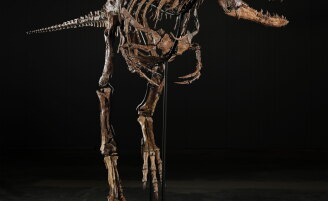
Jodi—named for Phipps’s cousin Jodi, who discovered her—has shed her jackets and been prepped and mounted in advance of the Sotheby’s sale. “I still remember the day that she drove into the yard with the pieces that she'd found, and how excited she was, and how excited I was to see them.” These pieces would turn out to be the second most complete Nanotyrannus in the world (second only to “Bloody Mary” the Nannotyrannus of the “Dueling Dinosaurs”). “It’s been a rare, special, blessed event in my life.”
Phipps’ neighbors and family members have joined the quest. His brother gives tours of the area and hosts digging sessions for families. “When they find something cool, like Jodi, they call me and I can help and be a part of it.” Dinosaurs have become his whole life.
He’d like to see even more change, and hopes that the science community will continue to come around to his way of seeing things. “There’s just not enough crews out there saving dinosaurs.” At the moment, he can only prospect on private land once the landowner has given permission. Public land is completely off-limits to private crews. “It’s frustrating to me because I can’t protect them, or save one and donate it to a museum. Turn me loose,” he says. “I’ll find more.”