Noble & Private Collections including Property from the Earl of Home22 May 2025 • 2:00 PM BST • London
T
his auction offers a curated selection of fine furniture and decorative arts from notable collections, including heirlooms from the collection of the Earl of Home with an array of precious objects, many with a storied provenance. Contents from the collections of the Earls of Clarendon as well as from a distinguished Belgravia residence, and other notable aristocratic and private collections, will showcase a varied selection of Georgian, French, and other continental furniture. Another highlight includes a Meissen monteith from the 'Swan' Service, formerly part of the renowned collection of Nelson & Happy Rockefeller.
by David Macdonald, Sotheby’s Scotland and Special Collections
There is always a sense of excitement, through the anticipation of a discovery, when working with any historic collection. It is more enjoyable still when outside a group of objects consigned for sale there is a find which gives colour and depth to these pieces.
Exploring the archive of the Earl’s of Home and coming across a tattered envelope inscribed ‘James Home’s Drawings of Contents of Big Cabinets & Small Cabinets…’ was one of those moments. It contained a series of remarkable drawings by James Archibald Home (1837–1909), son of the 11th Earl of Home. Each card in this naïve hand captures a breathtaking treasury of riches arranged in a series of cabinets at his childhood home, The Hirsel. Excitingly, some of these cameos, precious boxes and object d’art depicted neatly in silvery-grey ink, feature in the collection offered here today.
The notion of heirlooms in the truest sense was brought to life for me by these sketches. This was a group worthy of recording in the early 1900s, a recognition of something special by Lord James. An artistic process undertaken not just for practical reasons but pleasure.
But where from had these treasures come? A further find in the archive helped, the 1904 inventory was to reveal all1. In red ink, in a clear copperplate hand, possibly that of Maria, Countess of Home (1849–1919), there is keenness to make clear how these treasures had come into the family, the first page is annotated thus:
‘The contents of the cabinets in the saloon… formed part of a collection that is believed to have been chiefly made by a Lord Monthermer, only son of George, last Duke of Montagu. Lord Monthermer died before his father and on the Duke on Montagu’s death his only daughter Elizabeth wife of Henry, 3rd Duke of Buccleuch became his heiress. She gave the collection to her second Son Lord Montagu who placed it at Ditton Park which came to him with half the Montagu property, on his widow Lady Montagu’s death in 1859, the greater part of the collection passed to their eldest daughter who moved it to 6 Grosvenor Square [The London town house of the Earl of Home] when the lease of that house was sold in 1903 the collection was bought to the The Hirsel’.
A magnificent inheritance indeed. John, Marquess of Monthermer (1735–1770) died young but not before building a considerable collection of his own.2 He acquired much on his grand tour and spent £2000 on works over nine years from 1751, ‘…he was also a knowledgeable collector, and patronised good dealers in particular Thomas Jenkins in Rome. His purchases ranged from small intaglios to marble busts, from portrait miniatures to large seascapes’3. His parents, Lady Mary Montagu, Duchess of Montagu (1712–75) and George, 3rd Duke of Montagu (1712–90) were quite simply, even for their wealth and status, molte importante patrons, and art collectors. They sought the best, and acquired Leonardo da Vinci’s, The Madonna of the Yarnwinder4 and Rembrandt’s, Old Women Reading. The family has form as collectors of note. On Marquess John’s death from consumption in 1770, his sister Lady Elizbeth Montagu (1743–1827) became a great heiress, for she was to inherit these masterworks along with countless other incredible objects, the Montagu estates, the family’s London house and famously Boughton House in Northamptonshire. The Montagu properties and treasures became part of another magnificent family inheritance that of the Douglas Scott’s, for Lady Elizabeth was to marry Henry, 3rd Duke of Buccleuch and Queensberry (1746–1812) in 1767.
Considering this, it would appear, that Duchess Elizabeth wanted to preserve a permanent sense of Montagu lineage. The family included Montagu in the Douglas Scott name and perhaps by giving her youngest son Henry (1776-1845), the title of ‘Lord Montagu of Boughton’, a surviving peerage from her own family, there was a sense of continuity. Another Montagu property, Ditton Park became his, and an array of heirlooms, composed of notable silver and European works of art collected by his Montagu uncle and forebears. Henry’s collection passed to his wife and ultimately his daughter, Lucy Montagu-Scott (1805–1877), who married Cospatrick, 11th Earl of Home. It is this group which features in those evocative drawings of Lord James.
In June of 1919, some treasures from the Montagu inheritance were sold by the 13th Earl of Home at Christie’s to settle inheritance tax from his father, who had died the previous year5. However, pictures, better objects of vertu, miniatures and inscribed items were retained6. The most important pieces of silver and works of art were to leave the collection7. The lots are astonishing and their appearance on the London market caused a sensation. A great cistern by Philip Rolles made £1183 16s 8d, S. J., Philips acquired a Charles I tazza for £3400, an important mother of pearl ring said to have belonged to Elizabeth I made over £1000, and other treasures followed, amongst them works carved from rock crystal and amber, Limoges enamels and a large 16th century tower clock8.
The lots offered here today are more personal, their portable scale and inscriptions make them intimate, so understanding their retention in 1919 is obvious, but they do bask in the splendour of the Montagu collection as a whole and are a part of a truly magnificent inheritance and storied lineage.
1. A. W. Chisholm, Inventory of Antique Silver, Miniatures, Curious &c. belonging to the Right Hon. The Earl of Home [etc…], Edinburgh, February 1904.
2. The descent of titles in the Montagu family is confusing, due to successive female heirs. John Montagu (1735-1770) as son of the Earl of Cardigan was born Lord Brudenell, the family later adopted the family name of Montagu through his mother, daughter of the Duke of Montagu. This Dukedom was revived in 1766 with his father adopting the title of his father-in-law (he is often referred to as the 3rd Duke but was technically 1st Duke of the second creation) at this point Lord Brudenell adopted the Montagu family subsidiary title of Marquess of Monthermer. On his death in 1770 the Dukedom would become extinct on his father’s death and his sister was to become heiress.
3. Richard, Duke of Buccleuch and Queensberry, Boughton, The House, its People and its Collections, Hawick, 2016, pp. 32-33.
5. Messrs Christie, Manson & Woods, London, Old English & Foreign Silver, Objects of Art and Vertu, Porcelain, Old English & French Furniture, The Property of the Rt. Hon. The Earl of Home and removed from Bothwell Castle, Douglas Castle and The Hirsel, June 17, 1919.
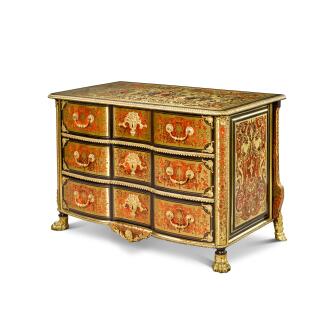
6. Along with two great Boulle bibliothèques (the other pair from the group of four are at Bowhill and in the collection of the Duke of Buccleuch and Queensberry).
7. The greatest pieces were exhibited in London by the South Kensington Museum in 1862 (now the V&A).
8. Christie’s, op. cit. June 1919 and two days following, lots 15, 16, 131, 138-139, 154.
Read Less
Read More
The Earls of Clarendon: A History through Objects
There have continually been Earls of Clarendon ever since 1776, and their rich collection of fine and decorative arts reflects this long history, but the roots of the family are even deeper than that: the Villiers family, of whom the Earls of Clarendon form one branch, have been a powerful family in British royal and parliamentary politics for centuries. Indeed, the family line of the current Earls of Clarendon can be traced directly back to the brother of George Villiers, 1st Duke of Buckingham (1592–1628), the beautiful favourite of James I whose life was recently dramatised in the series Mary & George.
The Earls of Clarendon as they exist today began with the 1st Earl (born 1709), continuing to the present with the 8th Earl (born 1976). The family have always been close to power, starting with the 1st Earl (1709–1786), who served as Envoy Extraordinary to the courts of Augustus the Strong of Saxony, Maria Theresa of Austria and Frederick the Great of Prussia. This is the Earl who acquired The Grove in Hertfordshire, the seat of the family until the twentieth century, and it is also his wife who is thought to be the sitter in the portrait included as lot 37 of this auction.
Lot 37: Circle of Godfrey Kneller, Portrait a Lady, traditionally identified as Lady Catherine Villiers, Duchess of Queensberry (1700–1777), oil on canvas.
The 2nd Earl of Clarendon (1753–1824) was a Member of Parliament and never married, leaving his brother John to become the 3rd Earl of Clarendon (1757–1838). The 3rd Earl was also a politician who benefited well from his university friendship with Pitt, and the box that is being offered as lot 38 of this auction includes a portrait miniature of his wife Maria Eleanora. Descriptions of the 3rd Earl from the period can be back-handed, though: Wraxall writes that he “possessed no parliamentary ability, but his figure was tall and elegant, his features noble, and set off by a profusion of light hair”, while a diplomat would later write that he “has all his life been doing nothing; a mere courtier, famous for telling interminably long stories”.1 As ever, it is often the catty remarksthat survive the ravages of history.
Detail of the 4th Earl of Clarendon in the The Congress of Paris, Edouard Louis Dubufe, oil on canvas. Image via Wikimedia.
The 4th Earl (1800–1870), by contrast, was highly regarded as a politician and citizen, and this in spite of his father George Villiers (brother of the 3rd Earl) having fallen from royal darling to disgrace and debts to the Crown of £280,000.2 The 1911 edition of the Encyclopedia Britannica is glowing in its praise of the 4th Earl, writing that “he had received from nature a singularly handsome person, a polished and engaging address, a ready command of languages, and a remarkable power of composition.”3 He served three times as Foreign Secretary and also as Lord Lieutenant of Ireland from 1847, when he will have acquired the gold box engraved with his arms made in Dublin in 1847 that forms lot 40 of the sale. Well-known and well-respected, ‘the great Lord Clarendon’ can be seen in several commemorative group portraits of the early Victorian era (see above). The porcelain vase from Berlin that forms lot 44 in this auction was a diplomatic gift given to the 4th Earl from the Prince of Prussia, celebrating the marriage of the future Frederick III of Prussia to the Princess Royal of England in 1858.
Lot 40: The gold box from Dublin dated 1847 (left) and lot 44: the Berlin (K.P.M.) Royal portrait vase and stand, circa 1850 given by the Prince of Prussia.
The subsequent Earls of Clarendon have had similarly successful careers, with both the 5th Earl (1846–1914) and 6th Earl (1877–1955) holding the role of Lord Chamberlain of the Household. This is the highest position in managing the Royal family including their state visits and weddings, and in this capacity the 5th Earl was probably the one who organised the funeral of Queen Victoria.
3Encyclopedia Britannica, New York, 11th ed., 1911, vol.VI, p.434.
Read Less
Read More
Viennese Silver-Mounted Rock Crystal and Hardstone Masterpieces
A collection in this sale, from a charitable foundation, perfectly illustrates the revival of the renaissance style in Austria, encouraged, or perhaps even instigated by the opening of the Imperial Royal Austrian Museum of Art & Industry in 1864. At the same time Vienna was undergoing major improvement works including the development of the Ringstrasse. Together with the opening of significant cultural venues such as the State Opera House in 1869, this ushered in a wealthy clientele for artists and retailers of luxury goods.
Perhaps the most celebrated champion of this revivalist style was the silversmith and jeweller Hermann Ratzersdorfer (1819-1894). He achieved great success at the 1873 Exhibition in Vienna and was awarded a diploma for his display of, in the words of the jurors "…des coupes, des coffrets, des cabinets de cristal de roche, des hanaps ornés de délicieuses peintures sur émail très-fines, imitant la belle époque de la Renaissance allemande."
The Golden Age of English clockmaking is generally regarded to begin in the mid-seventeenth century with the advent of the development of the pendulum as a more accurate means of regulating timekeeping. With clockmaking in London being closely governed by the Worshipful Company of Clockmakers, the City became a hotbed of horological innovation. Improvements in timekeeping continued with the anchor escapement and complications such as repeating quarter striking and chiming gave greater choice to the discerning client. This sale includes a fine collection of clocks from that period with examples by John Hilderson, Henry Jones, Daniel Delander and George Graham. Among others from later in the eighteenth century we have an alarm timepiece by George Graham’s successors, Thomas Barkley and Thomas Colley and two very fine longcase clocks from the workshops of Thomas Mudge and William Dutton.
Threads of Time: Styling Tapestries into Modern Interiors
Four seaport tapestries in this sale, formerly from the collections of Albert Freiherr von Goldschmidt-Rothschild (1879-1941) and his wife Marion von Goldschmidt-Rothschild (1902-1982) at Grüneburg Estate, Frankfurt am Main invite us to promote the role of tapestries in modern interiors. Tapestries, with their rich history and intricate craftsmanship, can serve as the perfect focal point in modern interiors, creating a striking contrast between the old and the new. To style these timeless pieces, consider positioning them as the centerpiece of a room, drawing the eye with its vibrant colours and intricate details.
By combining the rich, ornate texture of the tapestry with the clean, geometric shapes of modern furniture or with contemporary textiles and finishes, you can create an harmonious blend that feels both grounded in history and relevant to the present day. For example, position a tapestry above a modern sofa upholstered in rich, tactile fabrics like velvet or linen, which can enhance the visual appeal and texture contrast. Metallic or glass accents -such as a modern coffee table or sleek floor or ceiling lamp- can offer a contemporary touch that balances the more traditional aesthetic of the tapestry.