Property of a Private Clock Collector (Lots 88-94)
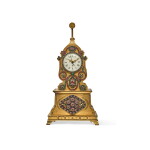
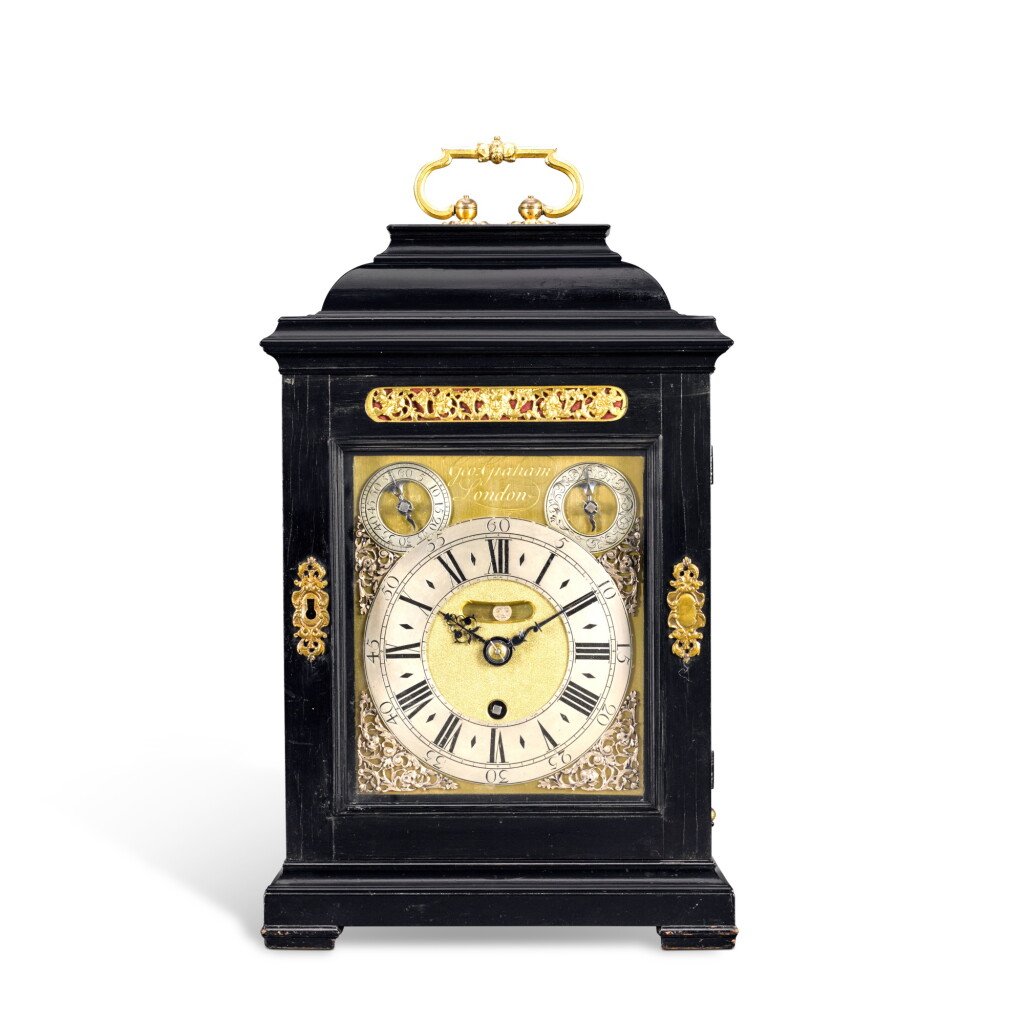
George Graham No. 615: an ebony silver-mounted quarter repeating table timepiece, London, circa 1725
Auction Closed
May 22, 05:01 PM GMT
Estimate
40,000 - 60,000 GBP
Lot Details
Description
5½-inch latched dial with double-screwed silver spandrels, finely matted centre with mock pendulum aperture, signed in the upper section of the dial Geo: Graham, London, the signature flanked by a subsidiary regulation dial and a foliate engraved dummy dial, the single fusee movement with six latched and knopped pillars, pivoted verge escapement with rise and fall regulation, pull quarter repeating on Tompion's system using blued steel interconnecting levers from either side of the case, the backplate finely engraved with strapwork and foliate scrolls inhabited by birds and squirrels, signed as the dial in an oval reserve and numbered twice, within the reserve and at the base of the backplate, 615, the case with inverted bell top and gilt-brass carrying handle above gilt door fret and brass escutcheons, the moulded base on block feet,
14¼in. 36cm. high
With Ronald A Lee, June 1969
Christies, London, 2nd July 2004, Lot 140
Anthony Woodburn
Antiquarian Horology, Vol.6 No.3, June 1969, p.118 (R A Lee)
George Graham (1674-1751), one of the most renowned clockmakers, was apprenticed to Henry Aske in 1688 and then entered the service of Thomas Tompion as a journeyman in 1695. He married Tompion's niece and became his partner in 1704, succeeding to the business after Tompion's death in 1713. He worked at the sign of 'The Dial and Three Crowns' at the corner of Water Lane and Fleet Street. Graham was elected a Fellow of the Royal Society in 1721 and Master of the Clockmakers' Company in 1722. He was a highly innovative maker and may be credited with the invention of the cylinder escapement, mercury pendulum and possibly the deadbeat escapement. On his death in 1751 he was buried, with Tompion, in the central aisle of Westminster Abbey. This present example of his work is rare in being a repeating timepiece rather than a fully striking two train clock and very few are recorded.
You May Also Like