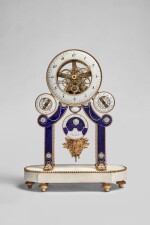
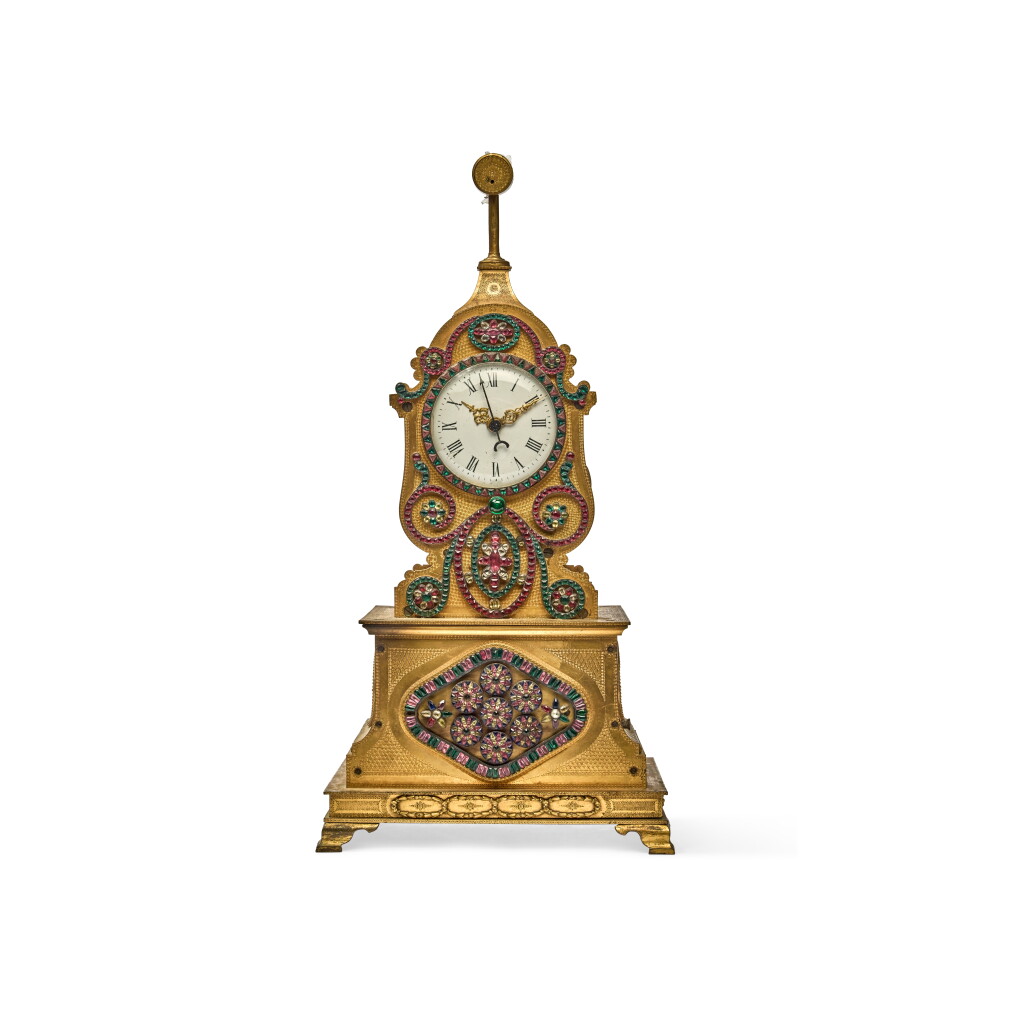
A George III Paste-Set Ormolu Quarter Striking Musical Automaton Clock for the Chinese Market, unsigned, circa 1790
Estimate
30,000 - 50,000 USD
We may charge or debit your saved payment method subject to the terms set out in our Conditions of Business for Buyers.
Read more.Lot Details
Description
3 1/4 inch enamel dial with center seconds, the two-train fusee clock movement with verge escapement, quarter striking on two bells, the musical/automaton fusee movement mounted in the base with a pinned cylinder playing tunes on a nest of eight bells with eight hammers, also powering the automaton features, the case with incomplete automaton surmount and finial, above paste-set flowers and scrolls, the plinth base with ten paste-set whorls, on bracket feet, the whole with punch and engraved decoration.
Height 18 1/2 in.
46.9 cm
European clocks were introduced to the Chinese imperial court during the late Ming Dynasty, notably when the Jesuit missionary Matteo Ricci presented two clocks to the Wanli Emperor in 1601, initiating a lasting fascination with Western clockwork. By the late seventeenth century, under the Kangxi Emperor, clockmaking had been established within the Palace Workshops, where Jesuit craftsmen produced clocks and watch mechanisms for imperial consumption. The European influence continued to dominate form, but with stronger Chinese characteristics including,” ...finely polished Zitan wood is prevalent, and the overall design of the clocks is more restrained: there are fewer auxiliary features and less lavish use of gilt bronze and colored glass stones than clocks from Guangzhou or Europe.”[1] Most importantly, palace clocks will often bear the mark Qianlong nianzhi, "Made in the Year of Qianlong."
Known in China as zimingzhong, or "self-sounding bells," these clocks quickly became fashionable under the Qianlong emperor (1736-1795), whose enthusiasm for European mechanical objects encouraged English workshops to produce increasingly elaborate examples combining horology, music and automata. A considerable number of clocks were displayed at the Qing emperor’s favorite summer retreat, Yuanmingyuan. The overarching theme of all things Western including architecture, furniture, wall hangings and curiosities made it the ideal repository for the emperor’s collection of clocks and watches.
The appeal to the Chinese court lay largely in the lavishly decorated gilt cases, brilliant enamel motifs and mechanized colored stones, which represented the height of European design and technology. As these clocks grew in popularity, the demand for their maintenance and repair fostered the development of a native industry in places like Guangzhou, Beijing and Suzhou. Clocks produced in Guangzhou remained largely European in form but incorporated a profusion of auspicious symbols. Examples native to Guangzhou exhibit delicate enamel floral motifs joined by vines or scrolls with individual color enamels with blue as their dominate color.
Clocks made for the Chinese market in London were often manufactured in pairs and call attention to extraordinary characteristics including spinning glass or paste stars and flowers, animated figures including humans and animals, some painted enamels, and all uniquely encased in in gilt bronze. A London-made clock emulating the same design as ours survives in the Palace Museum Collection, Beijing: Gilded Copper Flower Revolving Clock features a clock described as having, "two layers; the lower layer is a music box, decorated with red and green gemstones in a diamond shape on the front, and the red, green and white gemstone flowers on top can rotate. The upper layer has a three-hand clock face on the front and the outer edge is decorated with gemstones."[2]
[1] Catherine Pagani, “Eastern Magnificence & European Ingenuity”, Clocks of the Late Imperial China, (Ann Arbor: The University of Michigan Press, 2004), pg. 162
[2] The Palace Museum, Forbidden City Clocks, Beijing: The Forbidden City Publishing House, 2004, pg. 151
You May Also Like