
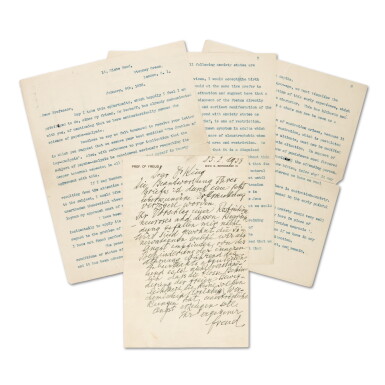
Sigmund Freud | Autograph letter signed, to J.E. King, on "restriction neurosis", 1938
Lot Closed
July 11, 01:03 PM GMT
Estimate
6,000 - 8,000 GBP
Lot Details
Description
Sigmund Freud
Autograph letter signed ("Freud"), to Doctor J.E. King, discussing the connection between the process of birth and adult neuroses ("...I do not agree with your suggestion of a restriction neurosis and the cause of it. We are accustomed to deducing innervations perceived as fear from restricted internal breathing experienced during the birth process. It does not make any sense to presume that the mere restriction of free movement, in the absence of any chemical (toxic) effects, should cause such unbearable fear..." [trans.]), in German, 1 page, 8vo, headed stationery of Berggasse 19, Vienna, 25 February 1938
[with:] retained carbon copy of King's letter to Freud, outlining his theory of "restriction neurosis" deriving from obstructions at the moment of birth, 3 pages, Stepney Green, London, 8 January 1938
FREUD REJECTS A NOVEL THEORY OF BIRTH TRAUMA. The father of psychoanalysis is here responding to a respectful letter by J.E. King which proposed a theory to account for neuroses such as claustrophobia, suggesting that they originated at the moment of birth if "the foetus felt that its efforts to emerge were meeting restriction". Freud's firm dismissal of this idea is not surprising: although he had described birth as our "first experience of anxiety", in the 1920s Freud had gone on to condemn the work of his erstwhile disciple Otto Rank on birth trauma. Freud argued that babies at the moment of birth lack the sensory development to retain memories that could be recalled as trauma in later life; neurosis has its origins, Freud insisted, on problems in psychosexual development during childhood.
Freud was not in general noted for his generosity when assessing psychoanalytic ideas that challenged his theory, but his terse tone in this letter is understandable given his circumstances at the time. He mentions in his letter that he was recovering from illness, and the cancer of the jaw that was to kill him the following year was by this time well advanced. Above these personal problems loomed the Nazi threat to Austria; the Anschluss took place little more than two weeks after this letter was written, and Freud was soon forced to flee his beloved Vienna for exile in London.