
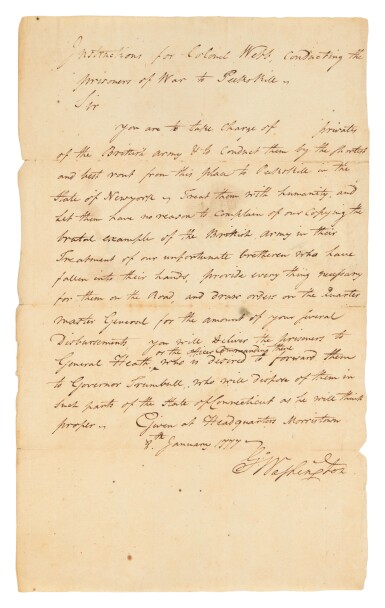
Washington, George | The commander in chief orders that Redcoat prisoners be treated "with humanity, and Let them have no reason to Complain of our Copying the brutal example of the Brittish Army"
Auction Closed
January 27, 03:32 PM GMT
Estimate
80,000 - 100,000 USD
Lot Details
Description
Washington, George
Manuscript document signed (“Go: Washington”), one page (333 x 203 mm) on a leaf of laid paper (counter-watermarked crowned GR), “Headquarters Morristown,” 8 January 1777, being orders to Lieutenant Colonel Samuel Blachley Webb headed “Instructions for Colonel Webb, Conducting the prisoners of War to Peekskill,” text in the hand of Stephen Moylan, verso addressed in Moylan’s hand “To Colonel Webb” and with filing dockets; some separations and pinholes at folds, two short horizontal tears, one just touching the crossbar of the t in Washington's signature, verso with a few stains and a couple of patches of mounting remnants. Half green morocco folding-case with engraved portrait of Washington.
Even in the heat of war, Washington demonstrates his sense of honor and compassion, ordering an aide-de camp to ensure that some 211 British and Hessian soldiers taken prisoner at Princeton and Trenton be treated humanely:
“You are to take charge of [space left for number ] privates of the Brittish Army & to Conduct them by the shortest and best rout from this place to Peekskill in the State of Newyork—Treat them with humanity, and Let them have no reason to Complain of our Copying the brutal example of the Brittish Army in their Treatment of our unfortunate bretheren who have fallen into their hands, provide every thing necessary for them on the Road, and draw orders on the Quarter Master General for the amount of your several Disbursements, you will Deliver the prisoners to General Heath or the officer Commanding there who is desired to forward them to Governor Trumbull, who will dispose of them in such parts of the State of Connecticut as he will think proper."
Webb conducted the prisoners through Peekskill on 12 January on their way to a permanent stockade in Connecticut. Washington issued an additional order to Webb on this date directing him to ask Major General William Heath to “order all Deserters and Straglers from this Army taken up and sent back.”
Washington’s stance was in marked contrast to the brutal treatment of American soldiers and sailors captured by the British. This was at least partly because George III had declared American forces traitors in 1775, which denied them prisoner-of-war status. But beyond that, American prisoners were kept in appalling conditions without sufficient food, clothing, or shelter, many incarcerated on fetid prison ships anchored around New York. It is estimated that 10,000 American prisoners died from neglect, disease, and malnutrition—far more than the number killed in action.
Samuel Webb (1753–1807) joined the Wethersfield Militia Company shortly after Lexington and Concord. He saw action during the Siege of Boston and at Bunker Hill and rose to be aide-de-camp to Major General Israel Putnam. Webb’s effectiveness in that position was noticed by Washington, who brought him on to his own staff. Webb was himself taken prisoner in December 1777, but as an officer, he was offered parole and fared much better than enlisted men, boarding in a private home on Long Island and even making several trips home to Wethersfield for private business. Webb was an original member of the Society of the Cincinnati and served as grand marshal at Washington's inauguration in 1789.
REFERENCE
The Papers of George Washington, Revolutionary War Series, ed. Grizzard Jr., 8:16
PROVENANCE
Absorbed into the papers of Major General Alexander McDougall, which were rediscovered to great fanfare in the possession of a descendant in 1968. (The Webb document is accompanied by a copy of the 23 February 1968 issue of Life, which featured a lengthy story on “The Long-lost Letters of General Washington,” that includes a photograph of this document on p. 38.) After again falling out of sight, the McDougall archive was purchased in 1993 by — Joseph Rubinfine — “A California Collector” (Christie’s New York, 19 June 2007, lot 310)