
Property from the Collection of Dr. Robert Small
Jefferson, Thomas | In a widely discursive letter, Jefferson announces that he is joining Washington’s cabinet and expresses great relief at the recovery of the President from a serious illness
Auction Closed
January 27, 03:32 PM GMT
Estimate
60,000 - 80,000 USD
Lot Details
Description
Jefferson, Thomas
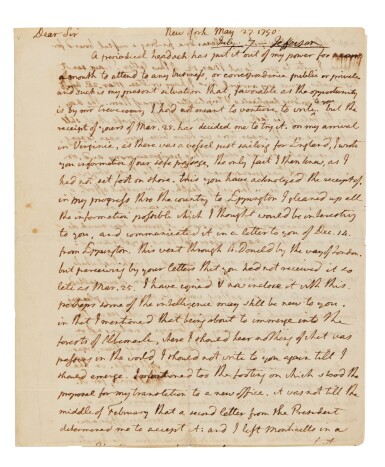
Autograph letter signed ("Th: Jefferson") as Secretary of State, 4 pages (238 x 200 mm) on a bifolium of laid paper (watermarked W), New York, 27 May 1790, to William Short, Chargé d'Affaires of the United States at Paris; with nine-line postscript of 28 May 1790; light browning, scattered spotting, some separations at folds (a few skillfully repaired).
This lengthy and remarkably informative letter, written shortly after Jefferson's return from France, had its genesis in a letter William Short sent to Jefferson, 25 March 1790, in which he complained that he was in the awkward position of not knowing when, or if, Jefferson would return to Paris as minister to France—or if he would accept an appointment as Secretary of State. (Short was Jefferson’s private secretary, but during the latter’s absences, Short served as Chargé d'Affaires.) Short’s frustration is palpable in his letter, “My last to you was of the 4th. inst. and I then intended not not writing again before I should have learned something from you respecting your return. The object of that letter was of the most disagreeable kind possible, since it was to desire you would sollicit for me what I thought a kind of justice, nay strict justice between a sovereign and a person in service. Lest that letter may have miscarried I will repeat here the substance of it. … My opinion respecting your return to Paris has changed very often according to different circumstances which have come to my knowlege. But one thing which has never changed is my extreme mortification that you should leave me so long to guess at this from indirect circumstances. I have been long ashamed to be asked about you by your friends here, because it always forced me to the humiliating confession that I had not yet heard from you except by third persons. I add often that you must have written to me frequently but that your letters have either miscarried or been delayed in the route. I sometimes endeavour to persuade myself of the truth of this, but a little reflexion shews me that the time which has elapsed is now too long to admit of such an interpretation. The construction which I at present put on your silence is that you had not absolutely decided whether you would accept the place offered you or not, and that you did not chuse to write in an uncertainty of mind. That would have been natural enough with a person indifferent to you, but I had fondly flattered myself that I should never be put on that footing” (Papers of Thomas Jefferson, ed. Boyd, 16:271–274).
This was clearly a letter that Jefferson could not ignore, and two days after he received it, Jefferson penned a widely discursive response, beginning with an elaborate series of defensive excuses, but not quite apology: “A periodical headach has put it out of my power for near a month to attend to any business, or correspondence public or private, and such is my present situation that, favorable as the opportunity is by Mr. Crevecoeur, I had not meant to venture to write to you. But the receipt of yours of Mar. 25. has decided me to try it. on my arrival in Virginia, as there was a vessel just sailing for England, I wrote you information of our safe passage, the only fact I then knew, as I had not set foot on shore. this you have acknoleged the receipt of. in my progress thro the country to Eppington I gleaned up all the information possible which I thought would be interesting to you, and communicated it in a letter to you of Dec. 14. from Eppington. this went through A. Donald by the way of London, but perceiving by your letters that you had not received it so late as Mar. 25. I have copied and now inclose it with this. perhaps some of the intelligence may still be new to you. in that I mentioned that being about to immerge into the forests of Albemarle, where I should hear nothing of what was passing in the world, I should not write to you again till I should emerge.”
Jefferson at last broaches the subject of his new position as Secretary of State, which he had entered two months earlier: “I mentioned too the footing on which stood the proposal for my translation to a new office. it was not till the middle of February that a second letter from the President determined me to accept it: and I left Monticello in a fortnight after for New York. at Alexandria finding a vessel bound for France I wrote to you to wit Mar. 12. of this letter I have sent triplicates. since my arrival here I have written Mar. 28. Apr.6.7. 27. 30. sending duplicates and triplicates of some of them.”
Returning to the topic of his migraine, Jefferson describes a more serious illness that befell President Washington—and the general relief felt at its resolution. “the day after the date of the last, I was taken with the illness which still confines me. In the mean time we have been very near losing the President. he was taken with a peripneumony and on the 5th. day he was pronounced by two of the three physicians present to be in the act of death. a succesful effort of nature however relieved him and us. you cannot conceive the public alarm on this occasion. it proves how much depends on his life.”
Jefferson then turns to matters related to Franco-American relations and also correctly predicts a new location for the nation’s capital, “no successor at Paris is yet named: nor is any other mission on the carpet. I wish that while you stay you could obtain the free introduction of our salted provisions into France. nothing would be so generally pleasing from the Chesepeak to New Hampshire. you will see in the newspapers a bill for increasing the tonnage of nations not in treaty with us to a given time and then prohibiting their transporting our commodities. this I think will pass. in the house of representatives there is a great majority for it. the hope I have held out of obtaining the introduction of our salted provisions into France, has been an efficacious incitement to this bill. a motion is now before the Senate for having the next meeting of Congress at Philadelphia: and it is rather probable it will be carried in both houses. in that case we shall remove to Philadelphia about the 1st. of September. I wish it may be decided in time for me to give you notice so that Petit and my baggage may come directly to Philadelphia.” Short, in fact, was Jefferson’s successor as Minister to France, serving until 1792, when he was transferred to the Netherlands and replaced in Paris by Gouverneur Morris.
Jefferson closes his letter with a flurry of news and a daunting list of instructions for Short: “with respect to the loss of your money by Nomeny I do not apprehend there can be any difficulty. only take care and establish on the best testimony the case will admit, how much of it was to be paid for public purposes, and how much was for your private use. this being done, I suppose the principles to be well established in law which will make the first a public, and the latter your private loss. it cannot be brought on till the settlement of your account, and then it will be decided on, not by Congress, but the regular judge in that department.
“You will see by the Virginia papers that Colo. Dudley Digges is dead: that Mr. Henry is elected contrary to what had been said of his retiring &c. &c. for these papers which I will regularly send you will convey to you all the small news I know. Madison of the College is coming here to be made a bishop. send me if you please the records of the Bastile which they had begun to publish.” (This work was La Bastille dévoilée, ou recueil de pièces authentiques pour servir à son histoire [Paris, 1789–1790]. Short obtained a set of nine parts of this work for Jefferson in August 1790; see Sowerby, Catalogue of the Library of Thomas Jefferson, no. 218.) “I send by Mr. Crevecoeur my alarm watch to be mended. there is a paper of explanation with it. I send also by him about ½ doz. ℔. of Balsamum Canadense for M. Deville, which be pleased to ask his acceptance of from me, and apologize from my sickness for my not writing. I wish, if it be practicable, that you could make all the paiments of rent for my house since my departure, enter into Mr. Grand’s accounts, so that I may have no occasion to place them in mine at all.—press the affairs of the Algerine redemption and write it’s progress continually. present me to all my friends as if they were here named, and be assured of the constant esteem & attachment of Dear Sir your sincere & affectionate friend.”
Dated 28 May, the postscript is of particular note not only for its content but as a demonstration of Jefferson's ambidexterity; the letter was written with Jefferson’s left hand, but the postscript with his right. “Last night I received your letters to me of Jan. 28. and Feb. 10. and to Mr. Jay of Jan. 23. and Feb. 10. they had arrived at Baltimore, gone to Mr. Jay at Portsmouth in New Hampshire, and returned here. the packet being to sail tomorrow I doubt the possibility of sending you the two copies of the Federalist bound. if it cannot be done now, it shall be by another opportunity. the motion for removal to Philadelphia has been evaded in the Senate and withdrawn. it is now moved in the other house: but probability is now rather against it’s success.—" Jefferson ends the postscript with an important update: "the President is well enough to resume business."
REFERENCE
The Papers of Thomas Jefferson, ed. Boyd, 16:443–445
PROVENANCE
Helen Fahnestock Hubbard (Parke-Bernet Galleries, 22 May 1956, lot 100) — The Elsie O. and Philip D. Sang Foundation (Sotheby Parke Bernet, 26 April 1978, lot 141)