
Property from the Jay T. Snider Collection of Benjamin Franklin
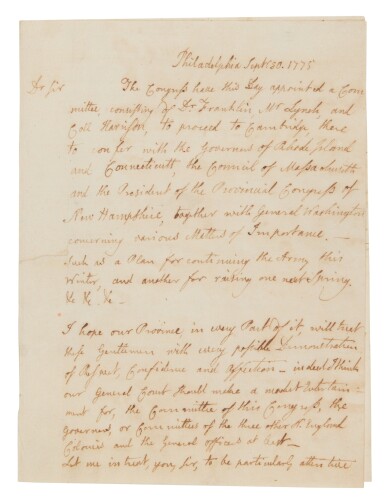
Adams, John | Establishing an American Army: John Adams introduces a congressional committee charged with meeting with General Washington “concerning various Matters of Importance”
Auction Closed
January 27, 03:32 PM GMT
Estimate
150,000 - 250,000 USD
Lot Details
Description
Adams, John
Autograph letter signed (“your Friend John Adams”), 2 pages (233 x 175 mm) on a bifolium of laid paper (watermarked crowned fleur-de-lis | L V C), Philadelphia, 30 September 1775, to James Warren, autograph address on verso of second leaf, “To the Hon. James Warren Esqr | Speaker of the House of Representatives | of the Massachusetts Bay | Watertown” and with autograph endorsement, “favoured by Dr. Franklyn”; seal tear and repair costing a few letters, lightly silked closing some short marginal tears and fold separations. Half red morocco folding-case gilt, chemise.
George Washington was elected to the Continental Congress as a delegate from Virginia on 5 August 1774, serving in the First Congress from September to October. On 25 March 1775, he was reelected to the Second Congress, which he served from 10 May to 15 June—the brevity of his tenure being the result of his having been unanimously appointed by his peers as commander in chief of the newly formed Continental Army. During the congressional debate about whether a standing army should replace the militias that had rallied to Lexington and Concord, Washington is supposed to have remarked, “To place any dependence on the militia is assuredly resting on a broken staff.”
Despite misgivings, Washington accepted the post, declining a salary (he did ask that his expenses be reimbursed) and pledging to operate under the civilian authority of Congress. Before departing for the besieged city of Boston, he told his fellow delegates, “Tho’ I am truly sensible of the high Honour done me in this Appointment, yet I feel great distress, from a consciousness that my abilities & Military experience may not be equal to the extensive & important Trust: However, as the Congress desire it I will enter upon the momentous duty, & exert every power I Possess In their service & for the Support of the glorious Cause” (Papers of George Washington, Revolutionary War Series, ed. Chase, 1:1–3).
Once in the field, however, Congress provided the General with little guidance, despite his repeated entreaties. After three frustrating months at his headquarters in Cambridge, Washington wrote a lengthy letter to President of Congress John Hancock, essentially demanding cooperation, if not direction, on a number of pressing issues, including pay, equipment, rations, retention of troops, and appointment and precedence of officers: “I have been in daily Expectation of being favoured with the Commands of the Honbl. Congress, on the Subjects of my two last Letters. The Season now advances so fast, that I cannot any longer defer laying before them, such farther Measures, as require their immediate Attention, & in which I wait their Direction. The Mode, in which the present Army has been collected, has occasioned some Difficulty, in procuring the Subscription of both Officers & Soldiers to the Continental Articles of War. … It gives me great Pain, to be obliged to sollicit the Attention of the Honorable Congress, to the State of this Army, in Terms which imply the slightest Apprehension of being neglected: But my Situation is inexpressibly distressing, to see the Winter, fast approaching upon a naked Army: The Time of their Service within a few Weeks of expiring, & no Provision, yet made for such important Events. Added to these, the Military Chest is totally exhausted. The Paymaster has not a single Dollar in Hand. The Commissary General assures me, he has strained his Credit for the Subsistance of the Army to the utmost. The Quarter Master General is precisely in the same Situation: And the greater Part of the Troops are in a State not far from Mutiny, upon the Deduction from their stated Allowance. I know not to whom I am to impute this Failure, but I am of Opinion, if the Evil is not immediately remedied & more punctuality observed in future, the Army must absolutely break up …” (Papers, Revolutionary War Series, 2:24–30).
Washington’s pointed letter was read in Congress on 29 September and sparked an immediate response. The following day Benjamin Franklin of Pennsylvania, Benjamin Harrison of Virginia, and Thomas Lynch of South Carolina were appointed a committee to meet with General Washington and representatives of the New England colonies to address the commander’s concerns and determine “the most effectual method of continuing, supporting, and regulating a continental army.”
On the same day, 30 September, John Adams, the most respected delegate from New England—and a strong supporter of Washington’s appointment despite some of his compatriots preferring a candidate, such as William Heath, from the northern states—wrote a series of letters of introduction for the committee: to Jonathan Trumbull Sr., Rhode Island Deputy Governor Nicholas Cooke, the Massachusetts Council, the New Hampshire Convention, and two related letters to James Warren, Speaker of the Massachusetts House of Representatives and President of the Massachusetts Provincial Council. (Over the next few days, Adams sent similar introductory letters as well to William Sever, John Winthrop, and Brigadier General William Heath.)
One of the letters to Warren is now in the collection of the Massachusetts Historical Society. That letter gives little insight into the purpose or significance of the committee (George Washington is not even referenced), but rather provides personal details about the committee members: Lynch is “an oppulent Planter”; Harrison, “the Friend and Correspondent of the General [with] some degree of Prejudice against our dear New Englandmen”; while of “Dr Franklyn needs nothing to be said. There is no abler or better American, that I know of.” (For the full text of this letter, see The Adams Papers, Papers of John Adams, ed. Taylor: 3:172–173.)
The present letter, by contrast, makes clear the gravity of the committee’s mission and impresses on Warren the importance of his cooperation. Moreover, the original of this letter was evidently unknown to the editors of both The Adams Papers and Letters of Delegates to Congress, both of which publish only a summary text taken from a 1941 auction catalogue. The full text has evidently never before appeared:
“The Congress have this Day appointed a Committee, consisting of Dr. Franklin, Mr Lynch, and Coll Harrison, to proceed to Cambridge, there to confer with the governors of Rhode Island and Connecticutt, the Council of Massachusetts and the President of the Provincial Congress of New Hampshire, together with General Washington concerning various Matters of Importance.— Such as a Plan for continuing the Army this Winter, and another for raising one next Spring. &c. &c. &c.
“I hope our Province, in every Part of it, will treat these Gentlemen with every possible Demonstration of Respect, Confidence and Affection—indeed I think our General Court should make a modest Entertainment for, the Committee of this Congress, the Governors, or Committies of the three other N. England Colonies and the General officers at least—"
Adams reveals that Harrison will need some extra consideration. In a 21 July letter to Washington, Harrison had made a sharp remark about the New England delegations in Congress while commiserating with the General: “your Fatigue and various Kinds of Trouble, I dare say are great, but they are not more than I expected, knowing the People you have to deal with by the Sample we have here.” Unfortunately, the letter had been intercepted and published in the 17 August issue of the Massachusetts Gazette by Loyalists hoping to foment regional antagonisms. Adams writes, “Let me instruct you, Sir, to be particularly attentive to these Gentlemen,—to Coll Harrison particularly—convince him, that the only narrow, selfish People belonging to our Province, the only ones actuated by Provincial Prejudices and Attachments, compass the Sample here—”
The letter closes with Adams pressing two financial concerns. First he notes that he “cannot conclude without beseeching you to communicate to the General Court the vast Importance of sending us, immediately your Accounts and Vouchers— Expenses are ac[cumu]lating so fast, that we shall be afraid to pay o[ur] Debts, anon—” And his final thought is about the urgency of Massachusetts settling her accounts with Franklin, who had served as provincial agent in London from October 1770 to March 1775: “Will it not be excellent Politicks to make Dr Franklin welcome by making him a grant of what is due to him from the Province? if you grant it in your provisional Paper, I suppose you can change it for him into continental.” On 23 October, the Massachusetts General Court resolved to pay Franklin £1,854 sterling for his services as agent.
Franklin, Harrison, and Lynch held two conferences, first with General Washington and representatives from Massachusetts, Connecticut, Rhode Island, and New Hampshire at Cambridge on 18–22 October, and then the following two days, 23–24 October, with Washington alone. For the proceedings of the conferences, which did resolve, at least in the short term, many of the obstacles facing the commander in chief, see, respectively, American Archives, 4th Series, 3:1156–61, and the “Committee of Conference Minutes of Proceedings, October 23–24, 1775,” in Letters of Delegates to Congress 2:233–238.
A vitally important letter from the foment of Revolution, responsible in part for salvaging the Continental Army; with distinguished provenance.
PROVENANCE
John Gribbel (Parke-Bernet, 22 January 1941, lot 2) — The Elsie O. and Philip D. Sang Foundation (Sotheby Parke-Bernet, 3 June 1980, lot 865); purchased by — Robert L. McNeil Jr., of Philadelphia — Jay T. Snider (acquired from the McNeil estate through the offices of Joe Rubinfine American Historical Autographs)
REFERENCE
cf. The Adams Papers, Papers of John Adams, ed. Taylor, 3:173, and Letters of Delegates to Congress, ed. Smith, 2:80–81 note, for cursory summaries of the letter based on the Gribbel auction catalogue.