
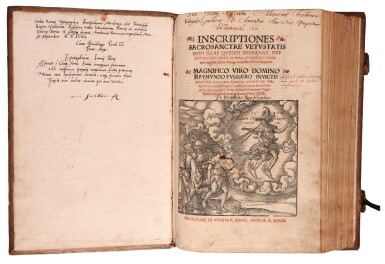
Apian, Inscriptiones sacrosanctae, Ingolstadt, 1534, contemporary pigskin, presentation copy
Auction Closed
July 9, 02:57 PM GMT
Estimate
3,000 - 4,000 GBP
Lot Details
Description
Apian, Peter and Bartholomaeus Amantius. Inscriptiones sacrosanctae vetustatis non illae quidem Romanae, sed totius fere orbis summo studio ac maxime impensis Terra Marique conquistae feliciter incipiunt. Ingolstadt: Peter Apian, 1534
Presentation copy from one of the authors, Amantius, addressed to the Tübingen professor Joannes Helvetius (Johann Schweitzer of Konstanz); Amantius, a poet laureate of the Holy Roman Empire, taught at Ingolstadt before moving to Tübingen in 1535. Helvetius has written in a fine humanist hand some additional poems: a long one on the flyleaf, addressed to Claude Dodieu, bishop of Rennes; on the verso a shorter epitaph of the Roman historian Ennius; on the rear flyleaf verses commemorating Raymund Fugger (who had died in 1535); and, finally, one addressed to Amantius himself.
On Qq4v some manuscript Latin verses (in a different hand) have been added to the head of the page, verses which usually appear alongside the image of the dolphin and anchor in Alciati's emblem book, headed "Princeps subditorum incolumnitatem procurans". Similar verses have been added to rr4, about Nemesis.
This finely printed book, published thirteen years after Mazzochi’s collection of classical inscriptions from the city of Rome (see lot 568), is concentrated on inscriptions from northern Italy and southern France and Germany, which are presented in topographical order: Spain, Cisalpine Gaul, Italy, Croatia, Dalmatia, Germany, Hungary, Greece, Asia, and Africa. It includes some obviously fictitious items lifted from the Hypnerotomachia Polifili (Venice 1499), as well as falsae from Ciriaco di Ancona. In fact, the book opens with one of Ciriaco’s apocrypha, an epigram he said he had found at Gades on the tomb of a Carthaginian called Heliodorus, a memento mori to anyone considering travel beyond the Pillars of Hercules. As in Mazzocchi’s book, there are some specially commissioned woodcuts, but mostly the inscriptions are shown with the printers’ types. It was financed paid for by the Augsburg banker Raymund Fugger (1489-1535), and includes inscriptions and statues from his collection.
The title-page woodcut of Mercury ensnaring four persons by the chains of his eloquence (The Captives of Eloquence) is by Hans Brosamer after the drawing by Dürer now in Vienna; seven woodcut initials featuring mathematical and astronomical instruments are also given to Brosamer; and the woodcut armorial insignia of the dedicatee is credited to Michael Ostendorfer.
Folio (316 x 206 mm). collation: Aa-Bb4 a-c4 A-Z aa-tt4: 280 leaves. Title printed in red and black with a woodcut vignette, large woodcut armorial of Raymund Fugger on Aa2, woodcut initials, borders and illustrations, woodcut printer's device on final verso (otherwise blank). (Occasional light foxing, title-page torn at head affecting inscription, a few small stains.)
binding: Contemporary blind-tooled pigskin over wooden boards (330 x 227 mm), two clasps, inventory number 36 written on top of foredge. (Binding slightly soiled, lacking one strap.)
provenance: Presentation inscription from Bartholomaeus Amantius to Joannes Helvetius (Johann Schweitzer, fl. 1485-1535) — Adam Veneudiger, inscription on title-page dated 1580. acquisition: Purchased in 2001 from Antiquariaat Papyrus, Voorburg. references: VD16 A 3086; Van Ortroy, Apian 109
You May Also Like
![(Hamilton, Alexander, James Madison, and John Jay) | Bushrod Washington's Federalist, praised by George Washington as a "work [that] will merit the notice of Posterity"](https://dam.sothebys.com/dam/image/lot/8ec02b17-38b4-4269-8039-d4830cd55431/primary/extra_small)


![[World War II – 21st Army Group] | An important archive of maps and files documenting the allied campaign in Europe, from the early stages of planning for D-Day and Operation Overlord, to the German surrender](https://dam.sothebys.com/dam/image/lot/f958941f-80a5-4c71-935b-c5441da85aa9/primary/extra_small)


