Property from a Private Collection
Cesare Gennari
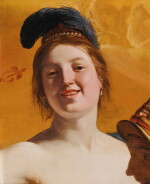
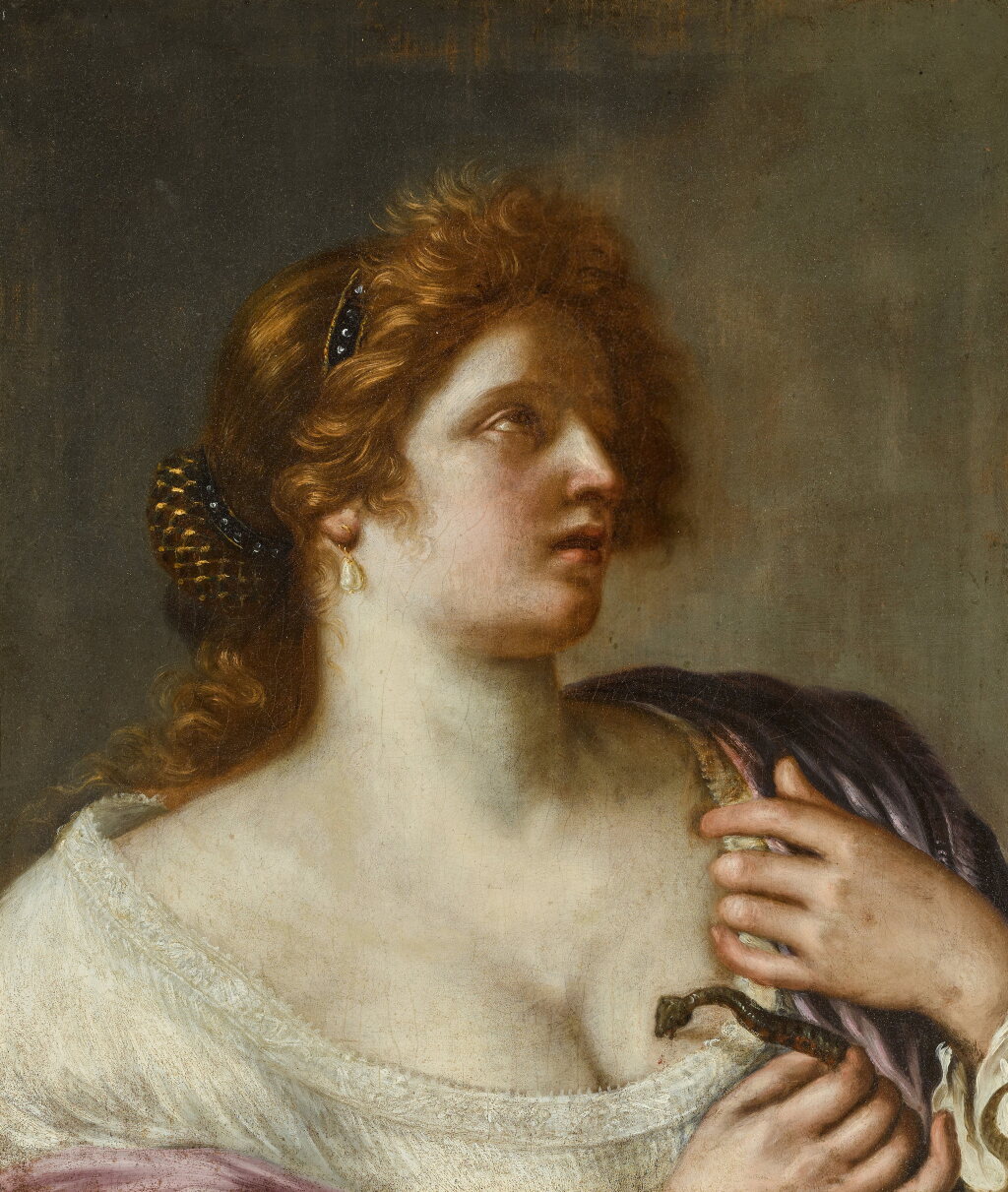
Cleopatra
Lot Closed
April 15, 11:42 AM GMT
Estimate
8,000 - 12,000 GBP
We may charge or debit your saved payment method subject to the terms set out in our Conditions of Business for Buyers.
Read more.Lot Details
Description
Property from a Private Collection
Cesare Gennari
Cento 1637–1688 Bologna
Cleopatra
oil on canvas
unframed: 65.8 x 55.5 cm.; 25⅞ x 21⅞ in.
framed: 83.7 x 73.6 cm.; 33 x 29 in.
Private collection, USA;
Acquired by the present owner in 2005.
E. Negro, M. Pirondini and N. Roio, La Scuola del Guercino, Modena 2004, pp. 209 and 220, reproduced in colour p. 230, fig. 376 (as 'di grande qualità').
Though born in Cento, Cesare Gennari relocated to Bologna in 1643 on his uncle Guercino's instigation, moving into the latter's home and entering his workshop with his brother, Benedetto Gennari, who was also a painter. Upon Guercino's death in 1666, Cesare took over the workshop, running it together with his brother until 1672, when Benedetto departed for Paris. Cesare, of all the Gennari family of artists, is the one whose style is most closely associated with that of his uncle. According to Prisco Bagni, he was the one who best understood Guercino's art.1 Indeed, Nicosetta Roio has underlined that Cleopatra's sizeable yet elegant form in the present painting can be compared closely with examples found in Guercino's late body of work.2
Although chronology in Cesare's œuvre is difficult to establish, it is reasonable to assume that this picture is a relatively early work, dating from the first half of the 1660s. The painting is comparable in style to Cesare's paintings of La Pittura in the Galleria Nazionale d'Arte Antica, Rome, which is signed and dated 1661, and his Mary Magdalene in the Pinacoteca Civica, Cento.3
The attribution to Cesare Gennari was first proposed by Sir Denis Mahon upon first-hand inspection of the painting in August 1989. It was later independently endorsed by Nicholas Turner on the basis of photographs.
1 P. Bagni, in Il Guercino, D. Mahon (ed.), exh. cat., Bologna 1991, p. 481.
2 N. Roio, in Negro, Pirondini & Roio 2004, p. 209.
3 Negro, Pirondini & Roio 2004, reproduced in colour pp. 227 and 229, figs. 373 and 375.