
Jan Miense Molenaer
Merry Company in a tavern
Lot Closed
June 10, 01:07 PM GMT
Estimate
12,000 - 18,000 EUR
We may charge or debit your saved payment method subject to the terms set out in our Conditions of Business for Buyers.
Read more.Lot Details
Description
Jan Miense Molenaer
Haarlem 1610-1668
Merry Company in a tavern
Oil on panel
Signed and dated on the right on the window Molenaer 1644
40,4 x 43,7 cm ; 15⅞ by 17¼ in.
Private Collection, France.
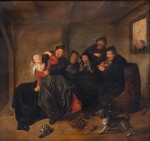
It was in the increasingly Puritan context of the United Provinces of the Netherlands in the seventeenth century that the production of paintings of debauched scenes in taverns developed. Here, the couple in the centre seem to be involved in a struggle: while the woman is toppling from the table, the man is pulling her towards him and undoing her bodice. Although she seems to be in an awkward position, the servant woman gives a hint of a smile, as though to mock the drunk’s clumsiness. Playing cards, a stoneware pitcher and a broken pipe have been dragged of the slipping tablecloth and lie on the floor, emblems of the excesses taking place in the tavern. At their feet, a dog – symbol of marital fidelity – snarls as if in disapproval of their licentious behaviour. The footwarmer has lost the brazier that should be heating it, adding to the lewd tone of the scene taking place around it.
The remaining figures watch the situation with a mocking air. One of the men seated at the table suggestively stuffs tobacco in his pipe, while casting a mischievous eye at the viewer. The old woman, the matchmaker, claps her hands. At the window, three young women are jeering.
The humorous tone is typical of Netherlandish genre scenes in the Golden Age, but is also characteristic of Molenaer’s work. He trained in the 1630s in Frans Hals’s workshop in Haarlem, alongside Adriaen Brouwer and Adriaen van Ostade. He shared with these colleagues a taste for tavern scenes, joyous celebrations and weddings. Although he was capable of a very fine finish in his portraits, he applied a more supple brushstroke to subjects considered vulgar. The materiality of this touch resonates with the artist’s painted descriptions of the vices and temptations of the carnal sphere.
You May Also Like