Henri Fantin-Latour
Musique et Poésie
Auction Closed
June 9, 01:57 PM GMT
Estimate
30,000 - 50,000 EUR
Lot Details
Description
Henri Fantin-Latour
Grenoble 1836 - 1904 Buré
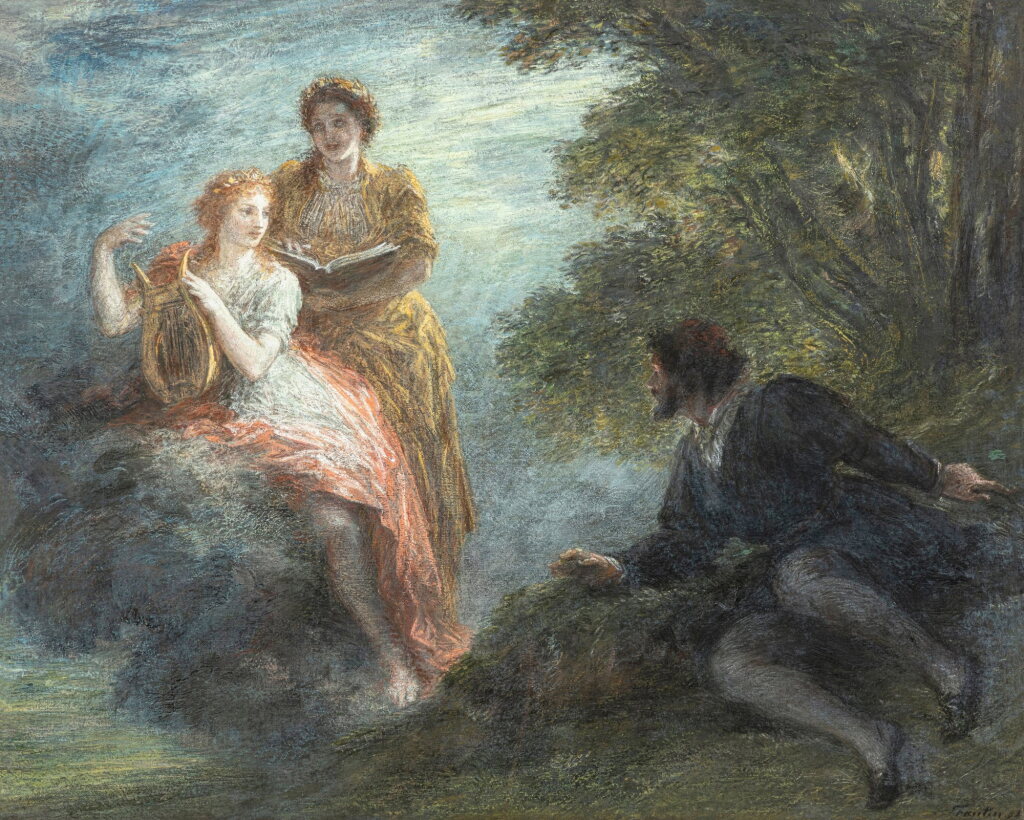
Musique et Poésie
Pastel on canvas
Signed and dated lower right Fantin .94
65,5 x 81,5 cm ; 25¾ by 32⅛ in.
We are grateful to Brame & Lorenceau for having confirmed the authenticity of the work after first-hand inspection. It will be reproduced in the forthcoming Catalogue Raisonné des peintures et pastels of the artist.
Madame Camus Haviland, in 1911;
With F. and J. Tempelaere, Paris;
Georges Desmarchelier, Roubaix;
By descent to the present owner.
Paris, Salon de 1894, no. 2162 (titled Musique et poésie; pastel).
G. Hédiard, Fantin-Latour, Catalogue de l’œuvre lithographique du Maître, Paris 1906, p. 51, under no. 46 (the pastel is mentioned as related to the lithograph "with important modifications");
V. Fantin-Latour, Catalogue de l’œuvre complet de Fantin-Latour, Paris 1911, p. 162, no. 1528.
A poet is seated in the shadow of a clump of trees. He leans towards two young women, personifications of the muses of Poetry and Music and symbols of inspiration. He gazes at one of them; she is illuminated by a bright light whose reflections fall back on the young man’s face. His pose is similar to that of the epic poet Wolfram van Eschenbach, portrayed by Fantin-Latour in 1877 in a lithograph titled Tannhäuser: The Evening Star. The medieval German poet is principally known today for his epic saga Parzifal, one of the sources of inspiration for Richard Wagner’s opera Parsifal.
The present ambitious and finished work is in pastel, the powdery hatching applied with small, swift strokes; the texture is so dense and finely worked that visually, Music and Poetry almost gives the impression of an oil painting.
The theme of the muse inspiring the artist occurs frequently in Fantin Latour’s work. It prompted him to create unreal visions, dreamlike and strange, with ghostly figures painted in tones of dark blue, grey and white. It was probably Fantin Latour’s passion for music, especially Schumann, Wagner and Berlioz, that led him down this path as early as 1862, with Tannhäuser: Venusberg.
These compositions were not initially admired by critics, who preferred his magnificent still lifes and portraits that touched on Realism. The emergence of Symbolism in the 1880s would change the public’s perception of these ‘projects of the imagination’, as Fantin Latour liked to call them. Sometimes described as ‘Wagnerian’, many were indeed inspired by Wagner’s work. Mysterious, unsettling and often sensual, they were in line with the aspirations of the period. Their popularity was such that they finally brought Fantin Latour fame and above all the financial security that enabled him, from 1890 onwards, to immerse himself in his universe. After copying the old masters and then taking his subjects from life, he could at last paint his dreams. As he himself said, ‘It took me a long time to move from reality to dream. The journey lasted nearly all my life.’
There is a lithograph of a similar composition (Hédiard, 1906, no. 46, op. cit.) and a preparatory drawing was in the fifth sale of the Beurdeley collection (Galerie Georges Petit, Paris, 2–4 June 1920). It differs in one important respect: the poet’s head droops, as though he is absorbed by his own dreams.
You May Also Like