
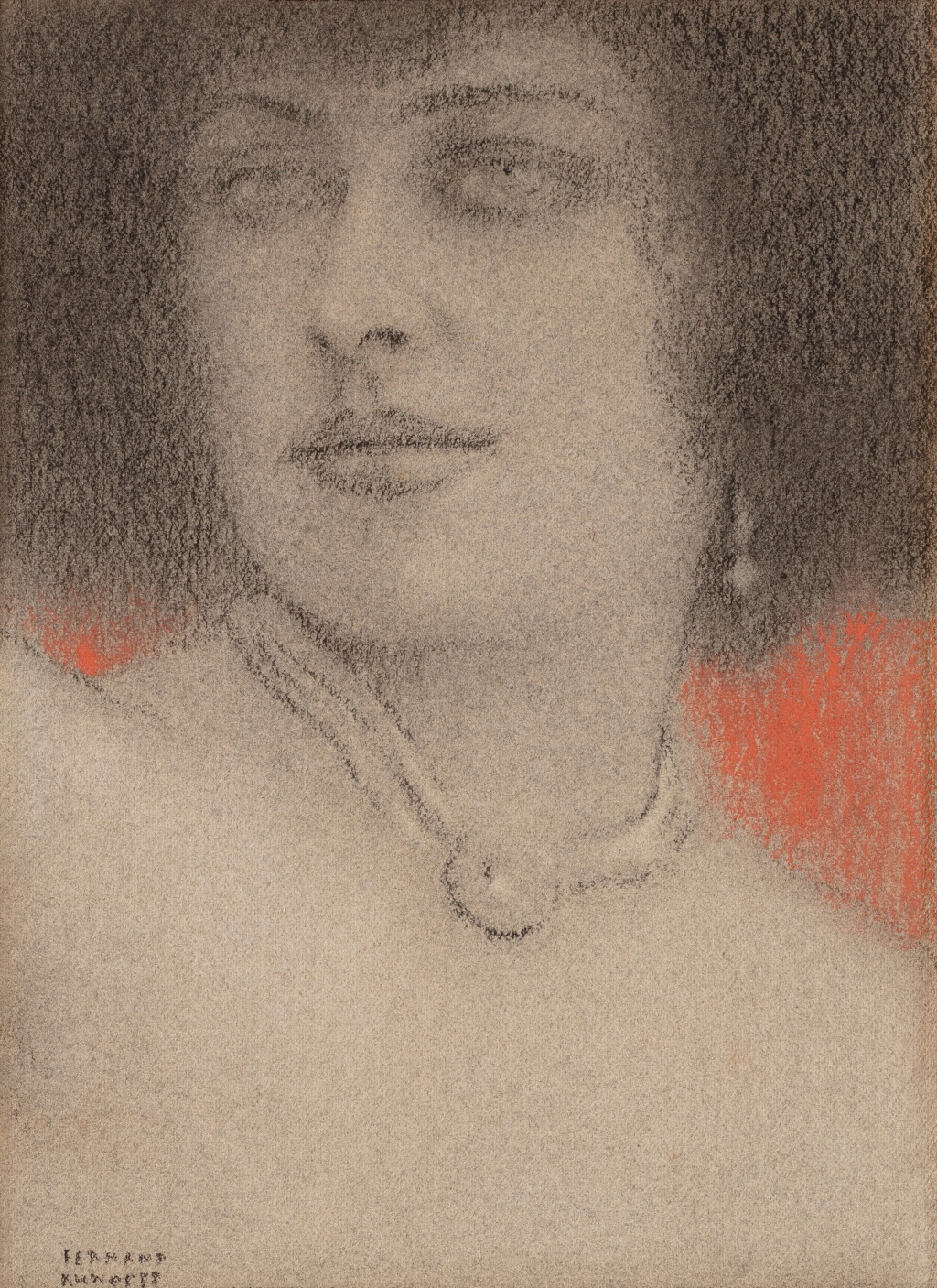
Fernand Khnopff
Study of a woman
Estimate
30,000 - 50,000 EUR
Lot Details
Description
Fernand Khnopff
Grembergen 1858 - 1921 Brussels
Study of a woman
Pencil, charcoal and pastel on paper
Signed lower left FERNAND / KHNOPFF
170 x 128 mm
Adelin Cerisier, Brussels;
Berthe Jacqmain-Cerisier, Brussels;
Mr. and Mrs. Marcel Debekker-Jacqmain, Brussels, in 1979;
Anonymous sale, Sotheby's, London, 26 March 1981, lot 132;
Where acquired by Willy A. d'Huysser, Brussels;
Anonymous sale, Christie's, London, 21 November 2012, lot 16.
R.L. Delevoy, C. de Croës and G. Ollinger-Zinque, Fernand Khnopff, Brussels 1979, p. 386, no. 549;
A. Bony, Alberto Pinto Signature, Paris 2016, pp. 43-44, repr.
A major figure of Belgian Symbolism, Fernand Khnopff distinguished himself through works that combine dream and mystery with meticulous realism. He was notably one of the founder of the avant-garde Brussels group Les XX alongside James Ensor, playing an essential role in the modernization of art in Belgium.
A painter, draughtsman, and sculptor, Khnopff drew extensively on Greek mythology and mysticism in his work, in which the female figure occupies a central place. At times angels, at others sphinxes, his models range from idealized figures to embodiments of the femme fatale. This feminine presence often takes the features of Marguerite Khnopff, his sister, who became a distant, cold, and almost sacred muse.
The sitter in the present study, however, does not appear to be Marguerite, but rather another model or a composite figure created by the artist. She recalls the figure in the study Des cheveux noirs (Black Hair), also dated 1914 (Christie’s, London, 5 February 2009, lot 133), with which she shares thick black hair and light-colored eyes.
Bare-breasted and with the top of her head cropped by the composition, the model appears to wear nothing but her jewelry. A necklace rests at the center of her chest, which occupies the lower half of the composition, while a single earring emerges from her curly hair. In a hieratic pose, with the suggestion of a raised right arm, the young woman fixes us with a cold, impenetrable gaze. Here, we are confronted less with the angel than with the sphinx.