
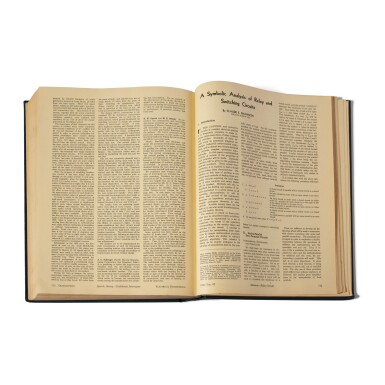
Claude Shannon
“A Symbolic Analysis of Relay and Switching Circuits," 1938
Auction Closed
July 15, 07:23 PM GMT
Estimate
10,000 - 20,000 USD
Lot Details
Description
CLAUDE E. SHANNON
“A Symbolic Analysis of Relay and Switching Circuits” In: Transactions of the American Institute of Electrical Engineers, Volume 57, pp 713 – 723. New York: 1938. 4to (285 x 216 mm; 11 ¼ x 8 ½ inches). Original green cloth stamped in gilt and blind. Faint foxing mainly to endpapers, cloth lightly rubbed, lower corners bumped.
FIRST APPEARANCE OF "PROBABLY THE MOST SIGNIFICANT THEORETICAL STEP TOWARD THE CONSTRUCTION OF ELECTRONIC DIGITAL COMPUTERS MADE PRIOR TO WORLD WAR II" (OOC). Herman Goldstine, one of the earliest computer scientists and who had helped to develop the ENIAC considered this work, , “one of the most important master’s theses ever written … a landmark in that it helped to change digital circuit design from an art to a science” (Goldsine pp119-120).
Shannon, who completed this paper while at MIT working with Vannevar Bush on the differential analyzer, was the first to apply Boolean algebra to electrical relay and switching circuits. He summarizes in section V, “Illustrative Examples”: "It is possible to perform complex mathematical operations by means of relay circuits. Numbers may be represented by the positions of relays or stepping switches, and interconnections between sets of relays can be made to represent various mathematical operations. In fact, any operation that can be completely described in a finite number of steps using the words 'if,' 'or,' 'and,' etc. ... can be done automatically with relays."
Shannon’s paper received instant recognition. George Stibitz, the Bell Labs researcher who had built a relay-based adder in November 1937, recounted his early encounter with the paper: “I was delighted with the simplicity and conciseness of Boolean algebra when it was used as a language describing relay circuits” (Stibitz p91). Shannon would go on to win the 1939 Alfred Noble Prize by the American Society of Civil Engineer for the work. The paper would influence not only the design of computers just being considered but also designs well into the next generation. Gertner, John. The Idea Factory. [New York]: Penguin, 2012; Goldstine. The Computer from Pascal to Von Neumann; From Gutenberg to the Internet 12.1; Hook and Norman. Origins of Cyberspace 363; Stibitz, George. The Zeroth Generation. 1993.

