
PROPERTY FROM THE FAMILY OF DR. CLAIR C. PATTERSON
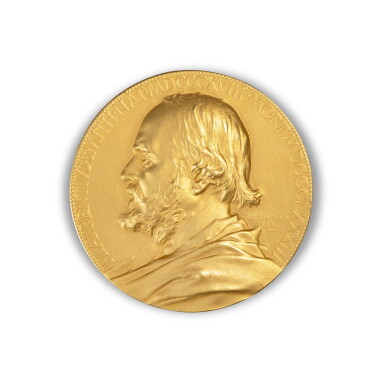
1973 J. Lawrence Smith Medal Awarded to Clair Patterson, for His Work Determining the True Age of the Earth
24 Karat Gold Medal, 12.153 Troy Ounces, Awarded to Clair Patterson by the National Academy of Sciences, Alongside One of Patterson's Canyon Diablo Meteorite Samples
Auction Closed
July 15, 07:23 PM GMT
Estimate
80,000 - 120,000 USD
Lot Details
Description
1973 NATIONAL ACADEMY OF SCIENCES J. LAWRENCE SMITH MEDAL, STRUCK IN 24 KARAT (.999 FINE) GOLD, WEIGHING 12.153 TROY OUNCES (13.333 STANDARD OUNCES, 378 GRAMS), AWARDED TO CALTECH GEOCHEMIST CLAIR C. "PAT" PATTERSON FOR DETERMINING THE TRUE AGE OF THE EARTH AND THE SOLAR SYSTEM USING LEAD DATING FROM METEORITES, WITH ONE OF PATTERSON'S CANYON DIABLO METEORITE SAMPLES
J. Lawrence Smith medal, struck in 24 karat gold, designed by J.C. Chaplain and manufactured by Medallic Art Company. Obverse with bust of J. Lawrence Smith, to top of medal, I · LAVRENTIUS · SMITH · NAT · MDCCCXVIII · MORT · MDCCCLXXXIII (J Lawrence Smith Born 1818 Died 1883) , behind head at right, J.C. CHAPLAIN / 1884. Reverse to outside, OB · CORPORA · METEORICA · FELICITER · INVESTIGATA (On account of successful research into meteoric bodies), to center ringed in laurel wreaths, CLAIR C. PATTERSON / ACADEMIA SCIENTIARUM AMERICANA ANNO MDCCCLXXXIV (American Academy of Sciences 1884). Weight: 378 grams (12.153 troy ounces, 13.333 avoirdupois ounces); diameter: 72 mm. Housed in the original black morocco case, top of case gilt lettered "Clair C. Patterson" at center, bottom of case gilt lettered "Medallic Art Co. / New York" to rear, interior lined with red velvet.
WITH: One of Clair Patterson's Canyon Diablo meteorite samples (48 x 48 x 19 mm, 126 grams). A replica J. Lawrence Smith medal, struck in bronze, housed in the original black morocco case. Four photographs from the personal collection of Clair Patterson, documenting his scientific career.
Directly from the family of Caltech geochemist Clair C. Patterson
THE 24 KARAT GOLD 1973 J. LAWRENCE SMITH MEDAL, AWARDED TO CALTECH GEOCHEMIST CLAIR C. PATTERSON, FOR DETERMINING THE TRUE AGE OF THE EARTH AND THE SOLAR SYSTEM
Former Caltech geochemist Clair "Pat" Patterson (1922-1995) has been called, "the most important scientist you've never heard of." And while this is undoubtedly true, it is also a massive understatement: Clair Patterson was one of the most important scientists of the 20th century, and one of the most impactful individuals of the past millennium.
Clair Patterson was awarded the 1973 J. Lawrence Smith Medal by the National Academy of Sciences – offered here and consigned to Sotheby's directly by his family – for his work determining the age of the Solar System and, by extension, the age of the Earth. If that were Patterson's only notable achievement, he would still have to be considered among the most noteworthy scientists of all time, reshaping our conception of the universe alongside the likes of Copernicus, Galileo, Darwin, Einstein, Crick & Watson, and Feynman. However, it was Patterson's decades-long campaign against the scourge of lead – a position he took as a direct consequence of his scientific investigations – that would cement his legacy, leading to laws banning the use of lead in gasoline, paint, food packaging, and more, and spurred him to develop "clean lab" procedures that were the forerunners to the clean room protocols now standard in scientific and medical laboratories across the world and without which modern science, technology, and medicine would not be possible.
Working for the Manhattan Project at Oak Ridge National Laboratory, Patterson learned mass spectrometry – in essence, measuring the composition and concentration of small quantities of a substance – to aid in the creation of fissile uranium for the war effort. This is a skill that would prove instrumental to his later efforts to determine the age of the Earth and would catalyze his concerns over global lead poisoning.
Patterson's research to determine the age of the Earth relied on the following facts: (1) all of the contents of the Solar System were created at the same time, and thus the Earth is the same age as the other planets and the asteroids in the asteroid belt; and (2) radioactive elements are known to drift upwards toward the mantle and crust of the Earth, the other planets, and the asteroids, whereas metals such as iron and nickel drift downwards toward their cores. The upshot is that (1) iron meteorites from the asteroid belt, and in particular their troilite nodules, contain negligible amounts of uranium but detectible amounts of lead isotopes resulting from uranium decay; and (2) the amount of "primordial lead" (that is, lead that has not resulted from uranium decay) in these troilite nodules has not changed since the formation of the Solar System. Thus, by knowing the half-life of uranium and comparing the levels of radiogenic lead to primordial lead, Patterson would be able to determine the age of both the Solar System and the Earth.
However, in order to get accurate measurements of lead in his meteorite samples, Patterson needed to make sure that there was no outside lead either in his samples or in the environment. Yet, as he was already aware by the early 1950s, this was not the case, and lead contamination was everywhere: his earlier tests on lead levels in granite (a type of rock with a known age) resulted in radiogenic lead levels many times higher than expected. Patterson came to realize that lead was covering the walls of the lab, the surfaces of his samples, his clothes, and even the inside of his mouth, and that in order for his measurements to prove successful, he needed to make sure everything was cleaned to a level never before achieved. Thus, he developed procedures – advanced air-flow mechanisms, acid-washing of lab materials, sterile suits, banning lead-soldered wires from the walls of his lab, etc. – that would allow for the highest level of cleanliness possible at the time.
He spent years refining his clean lab procedures and putting them into practice in order to determine the lead ratios of his Canyon Diablo meteorite samples, such as the piece from Patterson's lab that is included in this lot. Eventually, Patterson was able to use his samples of Canyon Diablo and several other iron meteorites to determine the age of the Earth to be 4.5 billion years old, a number he soon refined (using another set of stony meteorites) to 4.55 billion years old, a number that has stood the test of time as the true age of the Earth for nearly three quarters of a century.
Although Patterson's work determining the age of the Earth was groundbreaking, the importance of his battle against lead can also not be overstated; as journalist Lucas Reilly has written, “Patterson would save our oceans, our air, and our minds from the brink of what is arguably the largest mass poisoning in human history.” Lead is an insidious poison: although in high concentrations it can maim and kill relatively quickly, in lower concentrations it can cause severe but persistent cognitive deficiencies which are often permanent when poisoning happens at early age, but can be almost as detrimental in adolescence or adulthood. It can also cause severe hallucinations, tremors, musculoskeletal weakness, seizures, and many other horrific side effects up to and including death.
It is a perverse fact of history that many of the physical and social ills caused by lead have been known for thousands of years. Indeed, the Greeks and Romans were well aware of its dangers and yet continued to employ it, possibly contributing to their own demise. However, it took someone like Patterson, a person with a commitment to truth over all – over utility, profit, or politeness – to wage the battle necessary to rid us of this scourge at long last.
Patterson’s research quite literally took him to the ends of the Earth – to Greenland, Antarctica, Yosemite, and elsewhere – and won him many awards, including the Goldschmidt Medal of the Geochemical Society (1980), election to the National Academy of Sciences (1987), as well the premier international environmental award, the Tyler Prize for Environmental Achievement (1995). Patterson was honored with having an asteroid named after him, 2511 Patterson, as well as a peak in Antarctica. Although he did not win the Nobel Prize, his Caltech colleague Lee Silver believed this was because there is no Nobel Prize for geology; if there were, he likely would have won it for determining the age of the Earth.
This prize is a testament to the most important tenets of science and the most important features of a scientist, all of them embodied by Clair Patterson: dogged determination, an insatiable love of discovery, and the pursuit of truth above all else.
REFERENCES:
Denworth, Lydia. Toxic Truth: A Scientist, A Doctor, and the Battle Over Lead. Beacon Press, 2009.
Moseman, Andrew. This Caltech Scientist’s Legacy Is a Less Toxic World, Caltech Magazine, 2026.
Reilly, Lucas. The Most Important Scientist You’ve Never Heard Of, 2017.

