
Thomas Alva Edison
Documents Establishing and Ending the Edison Electric Railway Company
Auction Closed
July 15, 07:23 PM GMT
Estimate
20,000 - 30,000 USD
Lot Details
Description
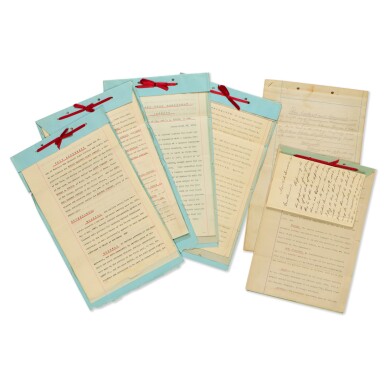
Group of Documents Including:
1. THOMAS EDISON. Document Signed, (“Thomas A. Edison”), January 12, 1881, 10pp, being an agreement for the Edison Electric Light Company to grant funds ($80,000) to Edison for continued experiments towards electric lighting. Also signed by Norvin Green as President of Edison Electric Light Company. Also establishes the Edison Electric Railway Company and its use of EELC patents, etc. File Docket reads: No. 3. / Thomas A. Edison / with / The Edison Electric Light Company / Agreement / Dated January 12, 1881.” Stamped “Edison Electric Light Company” and “Secretary’s Office.” Not included in The Papers of Thomas A. Edison.
2. THOMAS EDISON. Typed Document Signed (“Thomas A. Edison”), April 26, 1883, 4 pp, being an agreement between Edison and Stephen D. Field regarding the formation of a corporation the joins previous and future patents of the two parties for “Electrical Propulsion on Railways.” Also signed by Stephen D. Field, Simeon G. Reed, S. B. Eaton (2x), once as President of the Edison Electric Light Co. File docket reads: “66 / Agreement between Stephen D. Field, et al. / and / Thomas A. Edison, et al s. / in re: / N.Y. City Company / April 26th, 1883.” Field had worked on similar ideas for electric railways and this agreement “unites the two interests.” Supersedes similar agreement of April 20th. Earlier agreement in The Papers of Thomas A. Edison vol.7, pp 61-64.
WITH: Document “Extract from Agreement….”April 26, 1883, 2pp, regarding division of stock between Edison and Field. Not signed. File docket reads: “65. / Agreement / S.D. Field / and / T.A. Edison / In re. Stock Electric Railway Co. of the U.S. / April 26, 1883.”
Bound together, overall file docket reads: “Stephen D. Field et al / and / Thomas A. Edison et al / with / New York City Company / Agreement / Dated April 20th 1883.
3. THOMAS EDISON. Document Signed (“Thomas A. Edison”), April 26, 1883, 5 pp, being a memorandum of an agreement between Edison and Stephen D. Field regarding the formation of a corporation between Edison and Field for “Electrical Propulsion on Railways,” and lists guidelines for a railway company including patent assignment, choosing company directors and stock allocation. Also signed by Stephen D. Field, Simeon G. Reed, S. B. Eaton (2x), once as President of the Edison Electric Light Co., and Samuel Insull. File docket reads: “67 / Agreement between Stephen D. Field, et al. / and / Thomas A. Edison, et al s. / in re: / General Company / April 26th, 1883.” With later file docket that reads: “634 / Agreement between Stephen D. Field et al and Thomas A. Edison / in re / General Company / Dated April 26th 1883.” Very similar to previous document with some minor changes. Supersedes similar agreement of April 20th. Earlier agreement in The Papers of Thomas A. Edison vol.7, pp 61-64.
4. THOMAS EDISON. Document Signed (“Thomas A. Edison”), May 18,1883, 16 pp, being an agreement between Edison, Edison Electric Light Company and Electric Railway Company assigning patents for electric railway. Also signed by S.B. Eaton as the Edison Electric Light Co. President and C.W. Rogers as Vice President of Electric Railway Co. of the United States, with corresponding secretaries. Original file docket reads: “72 / Assignment / The Edison Electric Light Co. / Thomas A. Edison / to / Electric Railway Company of the United States / May 18th 1883.” And with a later file docket covering this that reads: “639 / The Edison Electric Light Co. / and / Thos. A. Edison / to Electric Railway Comp’y of the United States / Assignment / Dated May 18th 1883.” Stamped “Edison Electric Light Company” and “Transfer File.” References the April 26th agreement between Edison and Stephen D. Field. Includes Schedules A, B and C that list patents granted to Edison or to the Edison Electric Light Company. Not in The Papers of Thomas A. Edison.
5. THOMAS EDISON. Typed Document Signed (“Thomas A. Edison”), February 4, 1885, 7pp being an agreement between the Edison Electric Light Company and Thomas Alva Edison annulling the January 12, 1881 agreement to establish The Edison Electric Railway Company. Also signed by Eugene Crowell as Edison Electric Light Co. President. File Co. Docket reads: “No. 5 / Supplemental Agreement / between / The Edison Electric Light Company and T.A. Edison / Relating to Electric Railways / Dated Feb. 4th 1885.” Stamped “Edison Electric Light Company” and “Transfer File.” Annuls Edison Electric Railway Company, which had never formed and distributes its stock. The Electric Railway Company was instead formed.
WITH: Letter Signed, (“Thomas A. Edison”), New York, January 1885, 3pp, addressed to “Gentlemen,” regarding disposition of Electric Railway Company stock. Affixed to above document.
6. THOMAS EDISON. Typed Document Signed (“Thomas A. Edison”), February 24, 1885, 4pp, being an agreement between Edison, Edison Electric Light Company and the Electric Railway Company regarding elevated railways in New York City. Also signed by Edward H. Johnson as Electric Railway Company of the United States President and by Eugene Crowell as the Edison Electric Light Company President. Original file docket reads: “214 / Agreement / between / Edison Electric Light Co. / Thomas A. Edison / and Electric Railway Co. of US / Feb 24th, 1885.” Covered in later file docket that reads: “638 / Edison Electric Light Co. / Thos A. Edison / and / Electric Railway Co’y of U.S. / Agreement / Dated 24th Feby 1885.” Second leaf with separation at one fold.
EDISON DREAMS OF TRAINS.
Edison had been waiting for machinery for his New York power plant in Spring 1880 when echoes of his youth must have prompted him to begin work on an electric locomotive. He seemed to take what was essentially a diversion quite seriously and had almost a mile of track laid around Menlo Park and a 6-foot long, 4-foot wide electric locomotive built. This first full-sized electric locomotive made in America was powered from the generating station at the laboratory that usually ran the electric lights, the current sent through the two rails to the metal rims of the locomotive wheels. The 11-hp locomotive had two dynamos onboard that generated 75 amperes of current at 110 volts.
The locomotive’s trial run was on May 13, 1880, and crowds from neighboring towns and reporters were in attendance. Despite some technical issues – the friction wheels burst under the strain when it was switched into reverse – Edison and co. had the train moving well enough a few weeks hence to demonstrate it to the directors of the Edison Electric Light Company (EELC) and then file several patents related to his electrical railway system early that summer. Even a diversion would lead to patents for Edison!
The earliest document here, dated January 12, 1881, expanded the scope of the Edison Electric Lighting Company to accommodate a wider range of experimentation, it established the Edison Electric Railway Company as part of the EELC and assigned his railway patents in exchange for financial support:
“Whereas on the fifteenth day of November, one thousand eight hundred and seventy eight, the parties hereto entered into an agreement with respect to the carrying on of experiments in the use of electricity as a means of producing light, heat and power, to which said agreement this is supplemental, and said experiments have been carried on to the present time by Edison at the expense and for the interest and benefit of the Company… And whereas the experiments heretofore and now being carried on or contemplated have covered and will cover a wider field of experiment and investigation than was originally foreseen to the great benefit and advantage of both parties, and are likely to require still larger sums of money than have yet been paid….”
Unfortunately, the financial support was limited, Edison made little headway with the conservative railroad industry and EELC did little to promote Edison’s railway innovations. Henry Villard, an early supporter of Edison’s electric lighting and who served as president of the Northern Pacific Railroad, advanced Edison $40,000 toward an improved engine but he was later forced to discontinue support when he ran into financial distress when his company was thrown into receivership.
Rival inventor Stephen D. Field was able to take advantage of Edison’s poorly-drawn electric railway patents and filed interference suits against EELC. Field’s design essentially added one element to a design that was remarkably similar to that of Edison but was awarded a patent nonetheless. Edison had commented on this recurring phenomenon in an earlier interview: “It is a curious thing how vague the ideas of the general public are on the question of patents…. A man … draws an entire machine with his ‘improvement’ in it, and people think he has invented it all” (New York Herald, August 10, 1880). The Company directors decided to join Field as a settlement. The present April 26, 1883 document “unites the two interests” and combines their patents. The present May 18, 1883 document catalogues Edison’s electric railway patents.
The June 1883 demonstration of the Edison-Field locomotive at the Chicago Railway Exposition did much to spur popular interest in electric railways but Edison had little to do with the company after the 1883 merger. His employee Frank Julian Sprague later wrote “Edison was perhaps nearer the verge of great electric railway possibilities than any other American” (“The Electric Railway,” Century Magazine July 1905). Edison explained: “I could not go on with it. I had too many other things to attend to, especially in connection with electric lighting” (Electric World, August 4, 1884). The present group concludes with 1885 documents that annul the Edison Electric Railway Company in favor of the Electric Railway Company, the company name that appears on the final document. Josephson, Matthew. Edison: A Biography. New York: [2003]. Morris, Edmund. Edison. New York: [2019].