
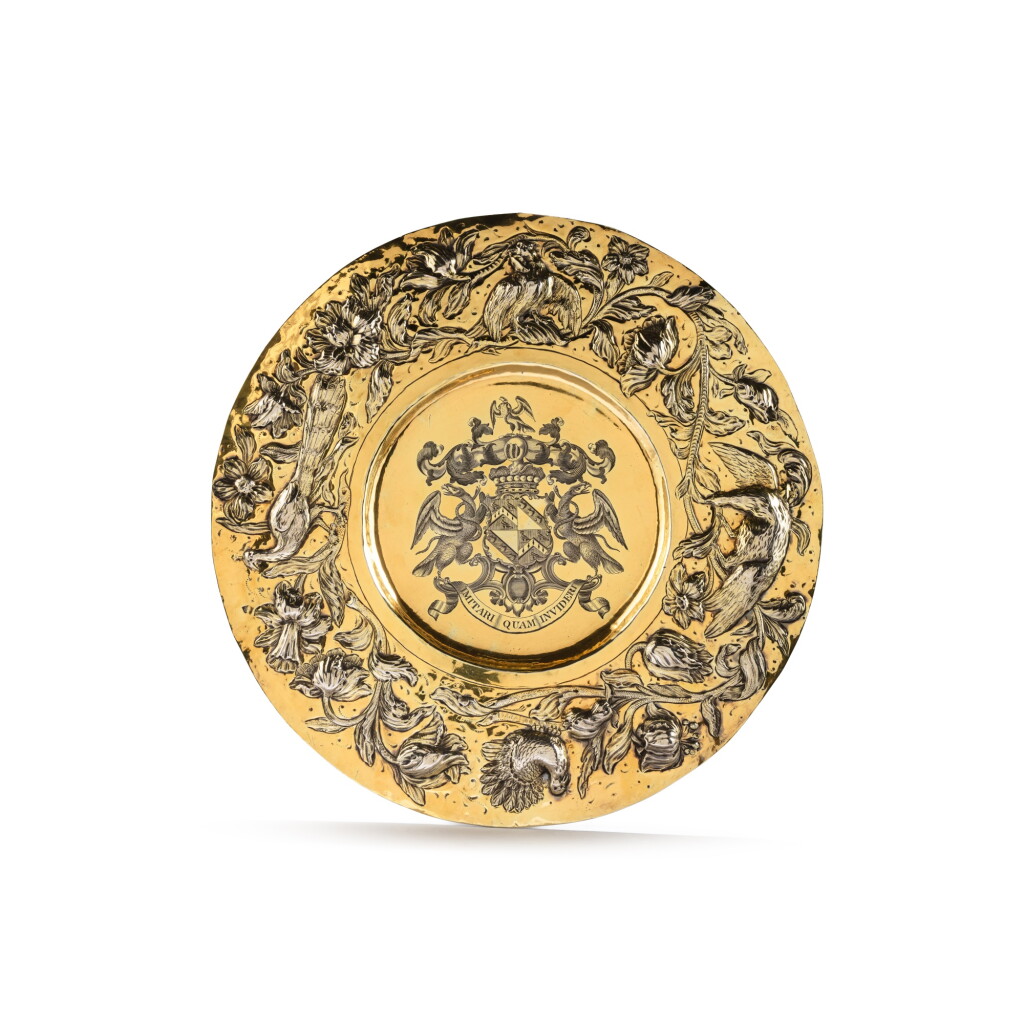
A Charles II parcel-gilt salver, circa 1680, by Henry Greenway, London, circa 1660-1680
Lot Closed
September 23, 01:59 PM GMT
Estimate
10,000 - 15,000 EUR
We may charge or debit your saved payment method subject to the terms set out in our Conditions of Business for Buyers.
Read more.Lot Details
Description
decorated with repoussé birds on flowered branches, engraved in the center with a coat-of-arms with a motto "IMITARI QVAM INVIDERI", the foot engraved with the weight 65"5", mark: maker's mark
Diam. 18 in (46 cm) ; Height. 3.1/2 in (9 cm)
Weight. 64.95 oz (2.20 kg)
Few serving dishes referred to as "fruit dishes" in inventories have survived to the present day. One of the oldest known examples is in the collections of the Duke of Northumberland and is attributed to Christian Van Vianen.
The repoussé decoration with large flowers is typical of English ornament around 1660, fashionable at the court of Charles II of England, who sought to restore splendour to his court. Having spent some time in the Netherlands during his youth, he admired the work of Dutch silversmiths, particularly the auricular style, which English silversmiths later adapted for the Court. A similar repoussé floral serving dish, also by Henry Greenway, London, 1660–1661, is held in the Gilbert Collection at the Victoria & Albert Museum (loan.Gilbert.609.2008). A two-handled cup with a stand featuring the same repoussé decoration, dated 1669, is illustrated in M. Clayton, The Collector's Dictionary of the Silver and Gold of Great Britain and North America, 1985, no. 168 (without information on its current location).
The maker’s mark is listed in Jackson's Silver and Gold Marks of England, Scotland and Ireland, London, 1994, p. 121, which references cups, tankards, and flasks bearing the same mark.
The coat-of-arms belongs to the Child family. Sir Josiah Child (1630–1699) established the family’s fortune as one of the directors of the East India Company, making successful financial investments and forging advantageous marriages. He notably purchased the Wanstead estate, east of London. His son Richard was created Earl Tylney (1680–1750). A politician, he had Wanstead House built in the new Palladian style of the time. His son John (1712–1784) was also a politician and resided at Wanstead.
You May Also Like


