
Property from a West Country manor house
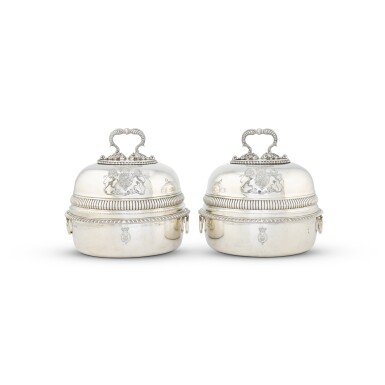
Royal: a pair of George III silver vegetable dishes, Richard Cooke, London, 1806
Lot Closed
June 9, 01:53 PM GMT
Estimate
5,000 - 7,000 GBP
We may charge or debit your saved payment method subject to the terms set out in our Conditions of Business for Buyers.
Read more.Lot Details
Description
Circular, with gadroon borders and drop-ring handles, engraved on the covers with the arms of the Duke of Cumberland, and on the bases with the royal badge, 'EAFs' (Ernsti Augusti FideikommisSum), 'EDC' and the scratch-weights 'No.1 78=2' and 'No.2 78=17',
24cm, 9½in. diameter
4902gr., 157½oz
Ernest Augustus, 1st Duke of Cumberland and Teviotdale, since 1837 King of Hanover (1771-1851), and then by descent to
Ernest Augustus, Crown Prince of Hanover, 3rd Duke of Cumberland and Teviotdale (1845-1923), sold to
Glückselig in 1924 and subsequently purchased in 1924 by
Lionel Alfred Crichton (Crichton Brothers), 22 Old Bond Street, London
Sotheby's, Paris, 15 December 2010, lot 24
A fideicommissum is a bequest whereby the recipient would in turn be expected to bequeath that same bequest to another person at a later stage. It was the intention of Ernest Augustus (1771-1851), Duke of Cumberland and Teviotdale since 1799, King of Hanover since 1837, that all art and collection items in his fideicommissum would be passed down in a direct line of succession for 'Erhaltung des Glanzes Unserer Krone' (Maintaining the shine of our Crown). Ernest Augustus founded his fideicommissum in 1843, and the silver in question (not only his own but also pieces belonging before to his sister Augusta Sophia (1768-1840) and of his wife Friederica (1778-1841), Princess of Mecklenburg-Strelitz, was engraved 'EAFs' in 1855.
Lionel Alfred Crichton (né Lionel Alfred Solomon, 1865-1938) will be long remembered as the leading London antique silver dealer of his generation. But perhaps his greatest triumph came in 1923 when he purchased a large collection of 18th and early 19th century English plate from Ernest Augustus, Crown Prince of Hanover, 3rd Duke of Cumberland and Teviotdale (1845-1923). The latter, a great grandson of George III, was the grandson of Ernest Augustus, Duke of Cumberland (1771-1851) who, by the Salic law of succession, became King of Hanover in 1837 and thereby inherited a vast collection of silver and jewels which would otherwise have passed to the new monarch of Great Britain, Queen Victoria.
It was reported in June 1923 that the Duke of Cumberland was negotiating with several groups of dealers, ‘each of them as quietly as possible, for even part of the collection would be regarded as a great prize.’1 With the English part of the Hanover/Cumberland silver secured, Crichton opened his first selling exhibition of it on 20 November 1923, which, coincidentally, was just a week after Cumberland’s death.2 A year later, in November 1924, Crichton repeated his success with a further selection of the Hanover/Cumberland plate.3 Among this group was the present lot described in the accompanying catalogue as '4 Casseroles and Covers'.
Notes.
1. The Times, London, Thursday, 21 June 1923, p. 13g
2. The Times, London, Tuesday, 20 November 1923, p. 11b
3. ‘The Cumberland Silver,’ The Times, London, Tuesday, 20 November 1923, p. 11b