
Property from a Regent's Park pied-à-terre
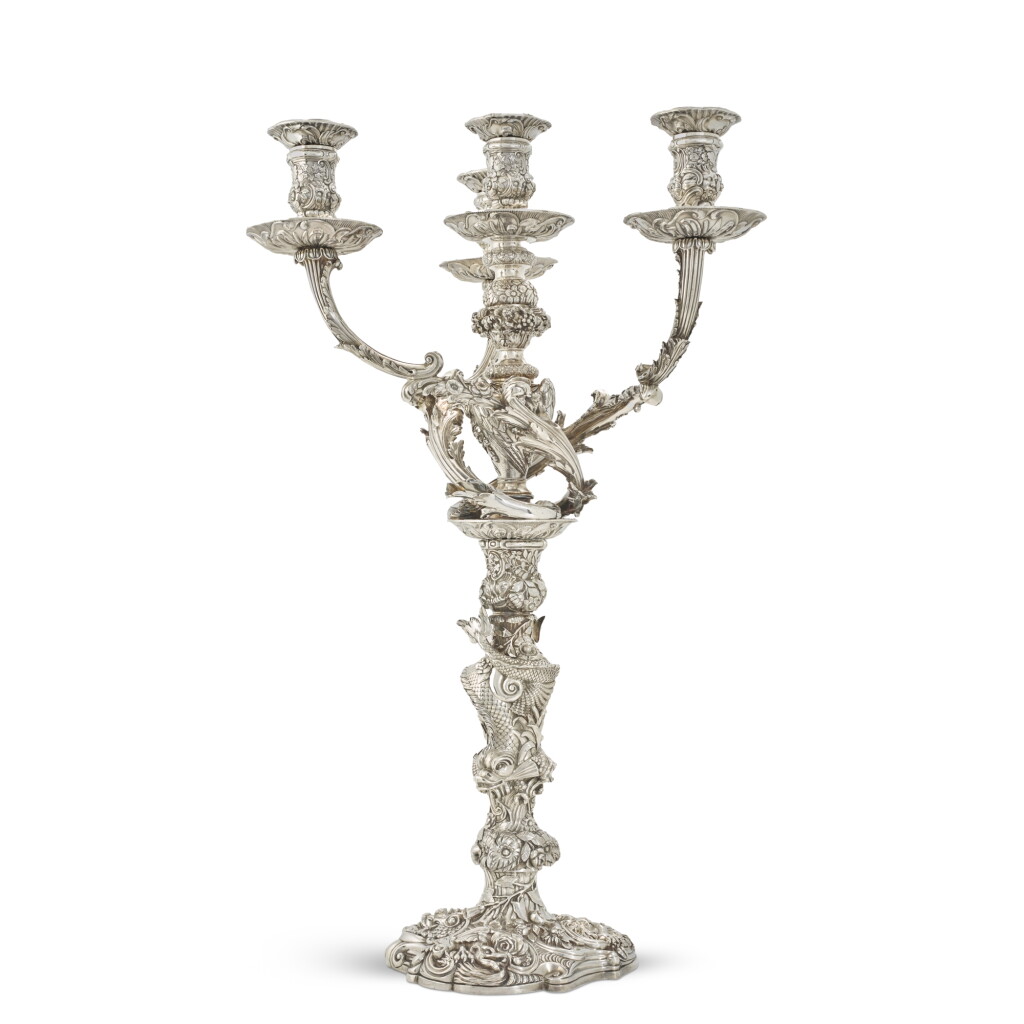
A George III silver four-light candelabrum, Paul Storr, London, 1816, for Rundell, Bridge & Rundell
Lot Closed
June 9, 01:54 PM GMT
Estimate
12,000 - 18,000 GBP
We may charge or debit your saved payment method subject to the terms set out in our Conditions of Business for Buyers.
Read more.Lot Details
Description
Shaped-circular base cast with busts of lion, dolphin, and dragon, the stem cast with owl heads below entwined dolphins and shells, the central knop cast with eagle wings, the nozzles with lion, bearded men, and owl masks, crested, two drip-pans marked for Paul Storr, 1818,
69cm, 27in. high
4587gr., 147½oz
Christie's, London, Magnificent Silver from the Collection of the late Hilmar Reksten, 22 May 1991, lot 17
The later crest is that of Bulkeley-Owen. On the branch collar which fits into the main stem is the a partially erased (but still identifiable) crest of the Dukes of Hamilton, presumably for the 10th Duke.
The sophisticated rococo design of this candelabrum was almost likely derived from an original of circa 1740-45. The earliest revival of the model seems to be a four-light pair marked for William Pitts of 1809, at a time when the taste for antiquarian plate was rapidly gaining ground (Christie’s, New York, 19 October 2005, lot 994). At this date Pitts was supplying the Royal Goldsmiths Rundell, Bridge and Rundell with pieces in historical styles, such as sideboard dishes and tankards in a 17th century manner (Chirstopher Hartop, Royal Goldsmiths: The Art of Rundell & Bridge, 1797-1843. Koopman Rare Art, 2005, p. 124). The stems of the 1809 candelabra have a doubling of the eagle-wing baluster producing a slightly awkward effect. In a suite of three by Pitts formerly at the Art Institute of Chicago, a pair of two-light candelabra of 1814 have a single eagle-wing baluster stem and may reproduce the rococo original, while the central three-light example of 1817 has the double baluster stem to reach its greater height of 25½in. (Christie’s, New York, 17 October 1996, lot 160).
The earliest example of this modelled with the mark of Paul Storr (working entirely for Rundell, Bridge & Rundell at this period) was a suite of three candelabra consisting of a pair of seven-light examples and a central eight-light example (see N.M. Penzer, Paul Storr: The Last of the Goldsmiths, 1954, pp. 164-65). Here Pitts’ double-baluster stem has been replaced by entwined dolphins above an owls’ head knop.