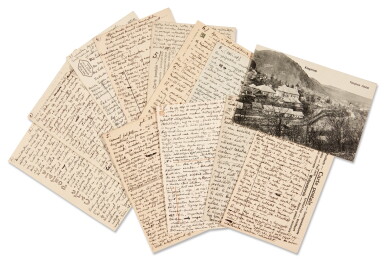
Béla Bartók. Two autograph letters to Klára Gombossy, 29 July and 10 August 1916, only partially published
Lot Closed
December 12, 03:12 PM GMT
Estimate
5,000 - 7,000 GBP
We may charge or debit your saved payment method subject to the terms set out in our Conditions of Business for Buyers.
Read more.Lot Details
Description
Béla Bartók
Two autograph letters to his muse Klára Gombossy, about the ballet The Wooden Prince and the Five Songs op.15, ONLY PARTIALLY PUBLISHED
the first of these lively and highly detailed letters, on postcards intended to further her art education, revealing that he is busy working on the full score [of The Wooden Prince], and that he has completed 41 out of an estimated 180 pages, informing her that he has played through the whole of the score on the piano to Aurelius Kern, who finally seemed to be enthusiastic, noting that when someone praises him he firstly does not believe him and secondly tries to find out what has made him praise him, relating Kern's view that the work could be conducted only by Kerner or Tango, and describing Kern's rapturous assessment of Tango's abilities ("...he began to depict Tango, saying what an extraordinary conductor he was, that when he was conducting the orchestra played as if it had twice the amount of strings, the oboe whispering as gently as a young lover to his beloved on a moonlit night [trans.]..."), outlining a possible difficulty with Tango, but noting that if Tango goes, so would any hope for a decent premiere of his ballet as all the home-grown conductors are not worth as much as Tango's little finger
the second concerning his songs op.15, mentioning the possibility of a concert in Vienna where they could be performed, in addition to works by Dohnányi and Kodály, observing that it will be strange to hear the songs, conceived entirely with Hungarian declamation in mind, in German translation, noting that it will be strange that her [Klára's] first public appearance in a concert programme will be made in a German city, writing out for her in the letter Emma Kodály's German translation of three of the songs ["Az én szerelmem [My love]" ("Die Liebe mein gleicht sicher dem Monde nicht..."); "Színes álomban [In vivid dreams]" ("Sah in bunten träumen dich schon") and Nyár [Summer] ("Szomjasan vágyva [Lying and longing]") ("Harre, vor Durst vergehend")], making humorous references to the text of the fourth song (Nyár), mentioning the slowness of his work on the score of The Wooden Prince, explaining that one would have to be as cunning as a chess player to make his difficult parts playable on the harp, envisaging 'with a bleeding heart' the sufferings of every conservative musician when faced with the hair-raising difficulties of the score, enclosing an article [not contained here] concerning the premiere of his first orchestral work, so that she might see 'what disasters are expected to attend the performance [of the ballet]'
...Gyalázatos hogy milyen lassan dolgozom; azok a fene hárfaszólamok! egy sakkozó ravaszága kell ahhoz hogy ilyen komlikált hárfaszólamokat játszhatóvá írjon az ember. Aztán meg, mennyi gyötrelem minden nehéz passage leirásánal; hátha túl nehéz, hátha könnyebbre lehetne változtatni. Perze minden töprengés mellett is megmatad mindig a passage nehezebbik formájaj. És én érzékeny lelhű ember, vérző szivvel irom le a leghajmeresztőbb (vagy "hajatlegmeresztőbb"?) nehézségeket partiturámba (csak ugy hemzseg tőlük), előre elgondolva, mekkor kinokat, da még mekkorákat fog minden egyes a szegény konservatív muzsikusoknak okozni; mennyire fognak engem érte átkozni, tán még ártlan ük-apáim emlékét sem hagyják békében.
Hogy lássa, mekkora kalamitások várhatók az előadás körül, mellékelek egy cikket, amely nem rég ócskaságaim közt kezembe került, s amely első zenekari művem előadásáról szól (egyszer meséltem erről). Ugyanaz az orkeszter fogja ezt a tácjátékot is játszani. Tekintve azt, hogy időközben többször volt velük összekoccanásom, elképzelhető, mi vár reám...
7 and 4 pages, 8vo, on postcards, each postcard of the letter of 29 July numbered in pencil '13', each postcard of the letter of 10 August numbered in pencil '15', with one unwritten postcard illustrating Klára Gombossy's home village of Hronec in Slovakia (Hungarian: Kisgaram), 29 July and 10 August 1916
TWO SEMINALLY IMPORTANT LETTERS BY BARTÓK TO HIS MUSE.
The first letter provides invaluable information concerning the composition of Bartók's ballet, The Wooden Prince, a work of great significance in the reception of Bartók's music. One particularly noteworthy passage concerns the merits of the Italian conductor Egisto Tango (1873-1951), to whom the composer eventually dedicated the work ("in deep gratitude"). The second offers unique insights into the op.15 songs (which include settings of four poems by Klára Gombossy), as well as contributing to our understanding of the composer's thinking in relation to them.
The choice of the postcard illustrations reflects the pedagogical side of the composer, always wanting to make his circle, as his first wife Martá Ziegler observed, more developed and learned. The four illustrations of the letter of 29 July (in order) are of the following: View of the rue des Eaux-de-Robec, Rouen; View of the Rio di S. Barnaba, Venice; Turner's The Fighting Temeraire; and Dürer's Virgin and Child with a Pear. The seven postcard illustrations of the letter of 10 August (in order) are of the following: Rembrandt's The Pilgrims to Emmaus and (formerly attributed to him) An Elderly Man in Prayer; Titian's Nymph and Shepherd and Girl in a Fir; The Young Cleric, formerly attributed to Velasquez; Milan Cathedral; and Rodin's sculpture Eternal Spring.
LITERATURE:
László Vikárius, 'Intimations through Words and Music. Unique Sources to Béla Bartók's Life and Thought in the Fonds Denijs Dille (B-Br)', Revue Belge de Musicologie, vol.lxvii (2013), p.179-217 [Appendix II nos.9 (letter of 29 July 1916) and 6 and 11 (letter of 10 August 1916)]
PROVENANCE:
Formerly in the collection of the composer's son, Peter Bartók (1924-2020)
You May Also Like