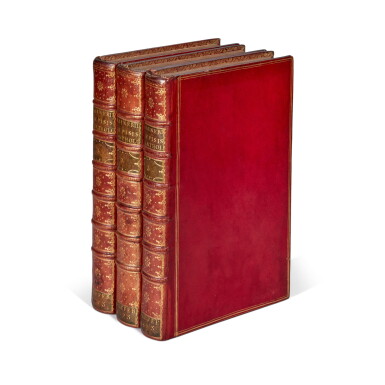
Rainerius de Pisis | Pantheologia, sive summa universae theologae. Nuremberg, 8 April 1473, signed by the rubricator
Auction Closed
November 28, 01:19 PM GMT
Estimate
20,000 - 30,000 GBP
Lot Details
Description
Rainerius de Pisis
Pantheologia, sive summa universae theologae (edited by Jacobus Florentinus). Nuremberg: Johann Sensenschmidt and Heinrich Kefer, 8 April 1473
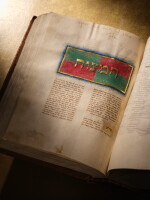
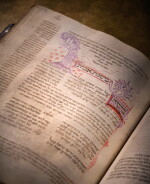
EDITIO PRINCEPS, 3 volumes, Royal folio (398 x 270mm.), 861 leaves (of 865; without initial blank in volume 1 and last three blanks in volume 3, textually complete), double column, 57 lines, gothic type, ATTRACTIVELY RUBRICATED THROUGHOUT, red initial strokes, headlines, paragraph marks, and chapter numbers in red, numerous three-line initials in red or blue, many with flourishes, each alphabetical section opening with a large puzzle initial in red and blue, end of the third volume WITH THE SIGNATURE OF THE RUBRICATOR (and/or owner) “FABIANUS”, heraldic drawing of a shield supported by an angel on the final blank of volume 1, eighteenth-century red morocco gilt attributed to Derôme on the fly-leaf, covers framed by thick and thin rules, raised bands, spine compartments with centrepiece medallion of lancet tools surrounded by circlets and dots, two green morocco labels, turn-ins with gilt floral roll, marbled endpapers, all edges gilt, binding slightly rubbed, volume 3 spine of with shallow chip at head
Rainerius de Pisis was a Dominican of the first half of the fourteenth century. His Pantheologia is an alphabetically arranged theological dictionary, and a magnificent summary of scholastic theology. Circulating in manuscript its importance and commercial viability was quickly realised; there were numerous editions in the fifteenth and sixteenth centuries, and it was even reedited in the mid-seventeenth century, and used in the Jansenist controversy.
Sensenschmidt had probably learned his trade at Mainz, and came to Nuremberg under the auspices of Heinrich Rummel, producing three books or more before the end of 1470, and probably therefore beginning work in 1469, a year before Koberger rented a house big enough to set up his large number of presses. Rummel, a doctor of Laws, was a member of an important Nuremberg family, and his name does not appear in any book, although there is a copy of Retza Comestorium (H 13884), considered to be the first book printed at Nuremberg, which he presented to the Nuremberg Charterhouse in 1472 (now at Erlangen).
This enormous work, "more than twice as large as any book which had hitherto left his press, is also the last book in which the two founts designed for Rummel by Sensenschmidt occur" (Scholderer, p. 237), and in all probability it sold slowly, not yielding therefore much of a return on what must have been an enormous capital outlay. The next book from the press is a much slighter affair, and the partner named is Andreas Frisner of Leipzig. Rummel would seem to have withdrawn from the partnership, and indeed we find him involved in a law-suit a little later.
The size of this book did not however militate against its publication: there are several other editions, two produced by Koberger, who dominated Nuremberg publishing, and the book travelled widely. A copy of the 1477 Koberger edition was in Eton College Library shortly after publication.
The Loménie de Brienne collection was extremely rich in incunabula, and the whole collection was offered en bloc (for a period of six months) in a catalogue published in 1791 in Sens. It did not sell, and de Bure began in March 1792 to sell the printed books in Paris, publishing at the same time a third volume of the catalogue. Michael Wodhull had already acquired this copy by mid-July 1792.
REFERENCES: Goff R-5; BMC II, 405; ISTC ir00005000; cf. Rhodes, “Notes on the Bibliography of Rainerius de Pisis” in The British Library Journal, vol. 22, no. 2 (Autumn 1996), p. 238; V. Scholderer, “Problems of Early Nuremberg Typography” in Fifty Essays (Amsterdam, 1966), pp. 237-39
PROVENANCE: Wernher Luf, early ink owner inscriptions, along with notation that the volumes were donated by him to the Franciscans of Rouffach (in Alsace); Cardinal Étienne-Charles de Loménie, comte de Brienne, his sale, Paris, 1791-92; Michael Wodhull, inscription “M. Wodhull July 16th 1792”, sale in these rooms, 19 January 1886, lot 2208; Christopher Henry Beaumont Pease, 2nd Baron Wardington (1924–2005), bookplate, his sale in these rooms 5 December 2006, lot 33
You May Also Like