Livres illustrés modernes (lots 172 à 253)
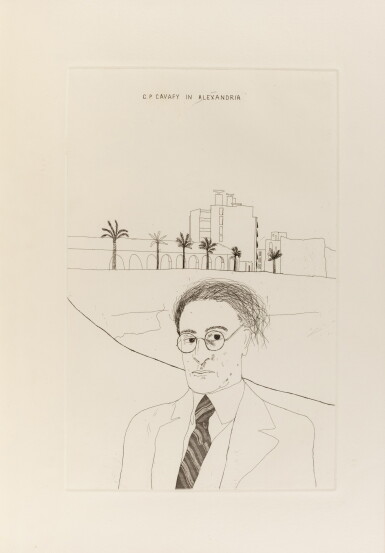
Hockney, David ─ Constantin Cavafy
Fourteen Poems. 1966 12 eaux-fortes de David Hockney. Exemplaire signé.
Lot Closed
June 22, 03:40 PM GMT
Estimate
3,000 - 4,000 EUR
Lot Details
Description
Livres illustrés modernes
HOCKNEY, DAVID ─ CONSTANTIN CAVAFY
Fourteen Poems.
Londres, Editions Alecto Limited, 1966.
In-folio (466 x 332 mm). Cartonnage toilé violet, étui toilé noir (Reliure de l'éditeur).
Poèmes de Constantin Cavafy, traduits du grec par Nikos Stangos et Stephen Spender.
12 eaux-fortes de David Hockney.
Un des 250 exemplaires numérotés sur papier Crisbrook, avec les 12 estampes (n° 231/500, de l'édition dite A, sans la planche supplémentaire non reliée).
Signé et justifié par David Hockney à la justification.
"This was Hockney's first major statement inspired by the poet. Although he originally intended to illustrate a far more ambitious range of poems, this proved impractical and he therefore decided only to include those on the subject of homosexual love. A new translation was produced by the poets Stephen Spender and Nikos Stangos, and published with the etchings in 1967. In early 1966 Hockney went to Beirut, which he saw as the contemporary equivalent of Cavafy's Alexandria, to research imagery for the prints. While taking inspiration from Cavafy's poetry, Hockney also drew upon his own experiences and environment. For instance, his ink drawing Boys in Bed, Beirut (1966) (in fact drawn in London using two of his friends as models) was adapted for one of the prints, According to Prescriptions of Ancient Magicians. Photographs were also used as reference material, especially for such prints as In an Old Book and The Beginning, and the portraits of Cavafy - images he describes as 'very posed' (Livingstone, p.86). Hockney was not entirely pleased with the results, however: 'Things like weight and volume are very hard to get from a photograph. You don't get the information you need to be able to do the line' (Livingstone, pp.87-8). Hockney conceived the images, like the English texts, as an updated translation of Cavafy's imagery. [...] Hockney did not work with the poems at his side, nor did he intend each image to be an illustration of a particular poem. Rather, he and Stangos assigned poems to the etchings only after the prints were done. Intended as visual equivalents to the mood and theme of all Cavafy's homoerotic poetry, Hockney's etchings depict variations on the theme of two men engaged in endless, anonymous pick-ups. Certain themes are found in the work of both Hockney and Cavafy: fleeting experiences, a nostalgia for the erotic, and a desire to be deeply involved in the lives of others while remaining a detached spectator." (Terry Riggs, catalogue online de la Tate Gallery, november 1997).
"Hockney creates scenes of touching intimacy in these simple etchings depicting gay love. They were made to illustrate a series of erotic poems by the Greek-Egyptian writer C. P. Cavafy. Hockney greatly admired Cavafy’s ability to write openly and unapologetically about gay relationships. Many of Hockney’s illustrations are based on intimate sketches of his friends. Others were drawn from photographs. The backgrounds are based on a trip Hockney took to Beirut, Lebanon in 1966. He felt that Beirut’s cosmopolitan atmosphere made it the contemporary equivalent of Cavafy’s native Alexandria, Egypt." (Gallery label, juillet 2021, cité dans le catalogue de la tate Gallery, supra).
You May Also Like