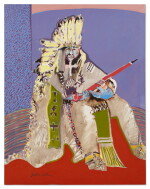
Still Life
Lot Closed
October 6, 06:02 PM GMT
Estimate
25,000 - 35,000 USD
Lot Details
Description
George J. Marinko
1908 - 1989
Still Life
signed MARINKO (lower left)
oil on Masonite
Masonite: 30 by 24 inches (76.2 by 61 cm)
framed: 38 by 32 inches (81.3 by 96.5 cm)
Painted in 1942.
Private collection, Newtown, Connecticut
Estate of the above
Acquired by the present owner from the above
Estate of the above
Acquired by the present owner from the above
George Marinko painted the present work in 1942, by which time he had fully evolved his surrealist style. Trained at the Waterbury Art School and Yale University, it is likely that Marinko gained exposure to this avant-garde mode of expression through his close proximity to Hartford, Connecticut. The home of the Wadsworth Atheneum, which presented the first show of Surrealism in America, Newer Super-Realism, Hartford emerged as an early hub for the movement in the United States and also fostered the careers and artistic development of such American surrealist painters as James Guy and Walter Quirt.
The years 1935-1942 mark the most fruitful period of Marinko’s career during which he traveled widely and exhibited his works at such celebrated public institutions as the Whitney Museum of American Art, The Pennsylvania Academy of the Fine Arts and the Museum of Modern Art. In the present work, Marinko presents a surrealist interpretation of a traditional still-life. Items such as mechanical cogs, a paintbrush, a lit candle with a blue flame and a pair of pliers are interspersed in an urn alongside flora adorned with bottle caps, safety pins and nuts. Beyond this arrangement is a verdant landscape, one the artist could have seen firsthand in his Connecticut home. Marinko renders each element of the composition with an exacting attention to detail, ultimately creating an image that irreverently straddles the line between rationality and absurdity and clearly aligns him with the aesthetic and intent of such renowned Surrealists as Salvador Dalí and Giorgio De Chirico.
In 1946, Marinko described his artistic intent in a letter to to the Director of the Wadswoth, Charles Cunningham, writing: “If I am described by my own efforts, the symbolism is subconscious, determined by incongruities. The meaning is left to the observer and is determined by their own experience and perceptibility” (as quoted in Elizabeth Mankin Kornhauser, American Paintings Before 1945 in the Wadsworth Atheneum, vol. 2, New Haven, Connecticut, 1996, pp. 547–48).
The years 1935-1942 mark the most fruitful period of Marinko’s career during which he traveled widely and exhibited his works at such celebrated public institutions as the Whitney Museum of American Art, The Pennsylvania Academy of the Fine Arts and the Museum of Modern Art. In the present work, Marinko presents a surrealist interpretation of a traditional still-life. Items such as mechanical cogs, a paintbrush, a lit candle with a blue flame and a pair of pliers are interspersed in an urn alongside flora adorned with bottle caps, safety pins and nuts. Beyond this arrangement is a verdant landscape, one the artist could have seen firsthand in his Connecticut home. Marinko renders each element of the composition with an exacting attention to detail, ultimately creating an image that irreverently straddles the line between rationality and absurdity and clearly aligns him with the aesthetic and intent of such renowned Surrealists as Salvador Dalí and Giorgio De Chirico.
In 1946, Marinko described his artistic intent in a letter to to the Director of the Wadswoth, Charles Cunningham, writing: “If I am described by my own efforts, the symbolism is subconscious, determined by incongruities. The meaning is left to the observer and is determined by their own experience and perceptibility” (as quoted in Elizabeth Mankin Kornhauser, American Paintings Before 1945 in the Wadsworth Atheneum, vol. 2, New Haven, Connecticut, 1996, pp. 547–48).
You May Also Like