Simon Fokke
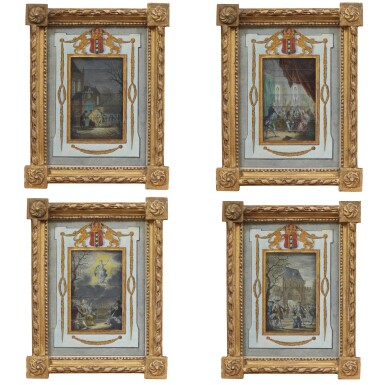
Cadre à système, dit "changementskastje", vers 1781 Frame with a mechanism, called "changementskastje", circa 1781
Lot Closed
July 12, 12:33 PM GMT
Estimate
4,000 - 6,000 EUR
Lot Details
Description
Simon Fokke
Frame with a mechanism, called "changementskastje", circa 1781
Louis XVI frame in gilded wood (25.5 x 19.5 cm) including a mechanism in the structure allowing for 5 colored engravings by Simon Fokke to appear, including:
four depicting scenes from Joost van den Vondel's Gijsbrecht van Aemstel, with captions:
- "Ontbindt den knecht, so magh hij onverhindert spreken" ;
- "de tijt verloopt, 't is spa, daer komen mijn soldaten" ;
- "O Klaere, aenschouwtge dit? vrouw Machtelt zie uw kint" ;
- "O Gysbrecht zet getroost uw schouders onder 't kruis" ;
and one scene from The wedding of Kloris and Roosje with the caption: "Je zoudt de vreugd hier wel verknollen, Wel laet jy al de borden rollen".
By moving the slides at the back of the cabinet, the various scenes can be observed.
The play entitled Gijsbrecht van Aemstel, chronicling the siege of Amsterdam, has been a huge success since its premiere in the Netherlands in 1641, and has been performed every year since then. Since the beginning of the 18th century, performances of the Gijsbrecht have been, at least for the traditional New Year's Day performances, followed by that of the farce The Marriage of Kloris and Roosje. This system frame (called "changeskastje" in Dutch) also combines these two pieces, under the painted arms of the city of Amsterdam.
Simon Fokke (1712-1784), son of the surgeon and actor Arend Fokke, became a pupil of Jan Caspar Philips (circa 1700-1773) when he was 13, and although he had originally wanted to become an actor, on completing his apprenticeship with Philips in 1732 he chose a career as an artist. He soon developed a highly individual style as a printmaker and draughtsman. His interest in the theatre (he also designed stage scenery) may have contributed to the dramatic nature of many of his drawings and etchings. They are spontaneous, elegant and evocative and sometimes show the influence of Cornelis Troost. Fokke, however, was inspired mainly by scenes of everyday life.
_________________________________________________________
Simon Fokke
Cadre à système, dit "changementskastje", vers 1781
Encadrement Louis XVI de bois doré (25,5 x 19,5 cm) dont le mécanisme, dans le châssis, permet de faire apparaître 5 gravures coloriées (11,3 x 7,2 cm) de Simon Fokke.
Quatre scènes de Gijsbrecht van Aemstel de Joost van den Vondel (vers 1772), légendées :
- "Ontbindt den knecht, so magh hij onverhindert spreken" ;
- "de tijt verloopt, 't is spa, daer komen mijn soldaten" ;
- "O Klaere, aenschouwtge dit? vrouw Machtelt zie uw kint" ;
- "O Gysbrecht zet getroost uw schouders onder 't kruis" ;
et une scène de De bruiloft van Kloris en Roosje [Le mariage de Kloris et Roosje] de Dirk Buysero (1781), légendée : "Je zoudt de vreugd hier wel verknollen, Wel laet jy al de borden rollen".
Ces cinq différentes scènes apparaissent en faisant bouger le mécanisme à l'arrière.
La pièce Gijsbrecht van Aemstel, relatant le siège d'Amsterdam, connut un immense succès aux Pays-Bas depuis sa création en 1641, et est depuis lors représentée chaque année. Depuis le début du XVIIIe siècle, les représentations du Gijsbrecht ont été, du moins pour les représentations traditionnelles du jour de l'an, suivies de celle de la farce Le mariage de Kloris et Roosje. Ce cadre à système (dit "changementskastje" en néérlandais) associe aussi ces deux pièces, sous les armes peintes de la ville d'Amsterdam.
Simon Fokke (1712-1784), fils du chirurgien et acteur Arend Fokke, devient l'élève de Jan Caspar Philips (vers 1700-1773) à l'âge de 13 ans. Bien que voulant d'abord devenir acteur, il choisit la carrière d'artiste à la fin de son apprentissage avec Philips en 1732. Il a rapidement développé un style très personnel en tant que graveur et dessinateur. Son intérêt pour le théâtre (il a également conçu des décors de théâtre) peut avoir contribué à la nature dramatique de nombre de ses dessins et gravures : spontanés, élégants et évocateurs, ils montrent parfois l'influence de Cornelis Troost. Fokke, cependant, s'est surtout inspiré de scènes de la vie quotidienne.
Betty Aardewerk & Zonen, The Hague, by whom sold in April 1996;
Professor Dr Drs Anton C.R. Dreesmann, Laren, inv. no B154 ;
Collection Mrs Marianne L. Dreesmann-van der Spek, Laren, inv. no B011 ;
Thence by inheritance to the present owners.
__________________________________________________________________________
Betty Aardewerk & Zonen, La Haye, vendu en avril 1996;
Professeur Dr Drs Anton C.R. Dreesmann, Laren, inv. n° B154;
Collection Mrs Marianne L. Dreesmann-van der Spek, Laren, inv. n° B011;
Par descendance jusqu’aux propriétaires actuels.
- F. Muller, De Nederlandsche Geschiedenis in Platen, Beredeneerende Beschrijving van Nederlandsche Historieplaten, Zinneprenten en Historische Kaarten, Frederik Muller & Cie, Amsterdam, 1863-1870, IV, n° 184a, p. 19;
- Atlas van Stolk, Katalogus, Amsterdam, F. Muller & Co, 1895, I, n° 123, p. 122;
- Ch. E.M. Wolff, "De restauratie van een changementskastjecat", cat. no. 15037, p. 662-671, Antiek, April 1978, 12, n° 9, p. 662-671 (een changementskastje in boekvoerm 1774);
- L. Buijnesters-Smets, "Simon Fokke (1712-1784) als Boekillustrator", Leids Kunsthistorisch Jaarboek 1985, Achttiende-Eeuwse Kunst in de Nederlanden, Delft, Delftsche Uitgevers Maatschappij BV, 1987, p. 127-146.
You May Also Like