The Psychology of Jade: Between Heaven and the Self
As the Biao De Xuan Collection of Chinese archaic jades comes to Sotheby’s Hong Kong, we explore jade’s evolving role as an ancient ritual stone to a lens for understanding the layered human mind.

I n early China, jade was never merely perceived as a precious material dug up from the earth. Jade was believed to be a substance alive with meaning – imbued with qi, resonant with sound, and charged with the divine capacity to mediate between Heaven and Earth. “If one material represents, even embodies the values and expectations of China, it is jade.” (Rawson, Jessica, Life and Afterlife in Ancient China). The appeal of jade resided not only in its lustrous sheen and silky touch, but in its ability to embody an entire system of thought: one in which matter, morality, and metaphysics were inseparable.
In his essay, Jade in Early Chinese Thought, Professor Zhou Boqun of The University of Hong Kong explores the material’s profound significance in ancient China, where it functioned not merely as an object of beauty but as a nexus of cosmological, spiritual, and ethical meaning. He posits that at its core, jade was understood through four interrelated dimensions: its numinosity, virtue, sound, and pattern (read the full essay here). It was a sacred medium through which shamans communicated with spirits, and later, a moral exemplar through which philosophers articulated human virtues.
Ritual objects such as bi discs and cong embodied cosmological principles and were used in communication with the divine. This sacred quality was linked to jade’s concentration of qi, the vital essence. “This subtle qi, though invisible and intangible, underlies both the vitality of living beings and the operations of the mind; even spirits and ghosts themselves are constituted by it.” (Zhou, Boqun, Jade in Early Chinese Thought).


Over time, especially from the Western Zhou period (c. 1046-221 BCE) onward, jade gradually became central to ethical philosophy. Confucian thinkers interpreted its physical characteristics – warmth, translucency, resonance, and strength – as analogues for moral virtues such as benevolence, righteousness, wisdom, courage, and purity. Jade thus emerged as a model for the cultivated gentleman.
Anciently, superior men found the likeness of all excellent qualities in jade.
Soft smooth and glossy, like benevolence
Fine, compact, and strong, like intelligence
Angular, but not sharp and cutting, like righteousness
His pendants hanging low to the ground, like humility
When struck, its sound clear, elevating and expansive, like music
Its flaws not concealing its beauty, nor its beauty concealing its flaws, like loyalty
With an internal radiance issuing from all sides, like good faith
The aura of a pure rainbow, like the heavens
The spirit of hills and streams, like the earth
Standing out as symbols of rank, like virtue
Esteemed by all under heaven, like truth and duty.
— Confucius, Book of Rites
To wear or contemplate jade was to engage in a process of self-refinement. Jade thus became both object and mirror, reflecting an idealised vision of the self, shaped through discipline and learning. It is precisely this dual capacity – as both vessel of meaning and mirror of the human condition – that allows jade to resonate so strongly in modern thought.
If ancient thinkers saw in jade a model for virtue, modern philosophy increasingly encounters jade as a surface upon which introspection is invited. What was once a conduit between cosmic realms has become, in the modern imagination, a conduit into the self.
Sigmund Freud (1856-1939) famously likened psychoanalysis to archaeology, a process of uncovering buried layers of experience. An avid collector of antiquities, Freud saw a profound intellectual and symbolic connection between archaeology and psychoanalysis. He often likened the work of the psychoanalyst to that of an archaeologist excavating the physical remnants of past civilisations.
“The psychoanalyst, like the archaeologist, must uncover layer after layer of the patient's psyche, before coming to the deepest, most valuable treasures.”
In this context of Freud’s archaeology of the mind, Chinese archaic jades take on a new kind of agency – they are no longer mediators between Heaven and Earth, but between the conscious and subconscious mind.
Echoing the thought, Italian philosopher Giorgio Agamben (b. 1942) wrote that “the only thing we possess and can know with any certainty is the past,” suggesting that it is through engagement with what has been that we come to understand what is. Jade, in this sense, operates as a material bridge across time. Its meanings are not fixed but cumulative, layered through centuries of interpretation. The act of looking at jade – handling it, contemplating its form, tracing its patterns – is itself a kind of excavation, not of the object alone, but of the self encountering it.
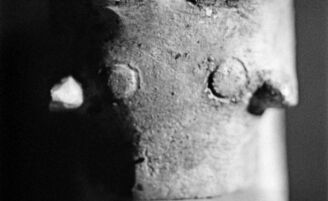
Consider the taotie mask, with its symmetrical yet elusive features. In its original context, it may have signified protection, power, or ancestral presence. Today, it invites a more inward reading. The mask becomes a site of projection, evoking primal fears, hidden desires, or the fragmented nature of identity. Similarly, the cong – with its interplay of circular interior and square exterior – once articulated the relationship between Heaven and Earth. Now, it may be read as a meditation on duality within the self: the tension between inner and outer worlds, between what is known and what remains concealed.


What unites these ancient and modern perspectives is a shared belief in the revelatory power of material form. For the Confucian scholar, jade revealed the structure of virtue; for the psychoanalyst, it reveals the contours of the psyche. In both cases, the jade makes visible what might otherwise remain abstract or inaccessible. The difference lies not in function, but in frame of mind: from outward alignment with cosmic and social order to inward exploration of personal consciousness.
In this way, from moral virtue to inner consciousness, jade remains a unique medium through which the human condition is explored and connection sought – once to the cosmos, now to themselves.