The Allure of JAR: A Collector’s Guide to the World’s Most Elusive Jeweler
By
Margo Gonzalez| Nov 11, 2025
From his discreet atelier on Place Vendôme, Joel Arthur Rosenthal – better known as JAR – has spent nearly five decades redefining high jewelry with audacious color, painterly pavé and unmatched secrecy, inspiring devotion from the world’s leading jewelry collectors.
From his discreet atelier on Place Vendôme, Joel Arthur Rosenthal – better known as JAR – has spent nearly five decades redefining high jewelry with audacious color, painterly pavé and unmatched secrecy, inspiring devotion from the world’s leading jewelry collectors.
J
AR Jewelry has operated its atelier at the same Paris storefront, located at 7 Place Vendôme, since its inception in 1977. In the near-50 years that Joel Arthur Rosenthal has been making jewelry, the designer’s namesake brand has become synonymous with iconoclastic pieces that are notoriously challenging to attain. Rosenthal only makes a limited number of pieces yearly, roughly a few dozen or so. Each of his pieces are dazzlingly singular – a feat of technical mastery merged with his sensibility for unusual materials and left-field color combinations.
But JAR’s bold brooches, audacious earclips, and other precious objects are rarefied precisely because they seemingly break every rule of jewelry. His earrings don’t always match, sometimes purposefully so. He uses aluminum juxtaposed against coveted natural pearls. Then there’s the air of secrecy and exclusivity that marks his way of conducting business. “One simply can't walk into his atelier, say, look at something in a cabinet, and put down your credit card,” says Catharine Becket, the Global Head of High Jewelry at Sotheby’s. Unlike other jewelry brands, “you essentially have to be invited,” she says, by Rosenthal himself to purchase JAR pieces. Although he sometimes will work with gems from certain clients, it all comes down to his individual feeling about the piece in question.
“People come to me for my taste,” he said in an interview. “That’s what they pay for. My name is on the piece. I won’t do it if I don’t like it.”
Given their scarcity, JAR pieces tend to perform exceptionally well in the secondary market. Luckily Sotheby’s has acquired an astonishing trove of stunning JAR pieces as part of several upcoming auctions, some of which were first shown at the jeweler’s first major retrospective at London’s Somerset House. Here’s what burgeoning JAR collectors should know about the iconic brand that Diane von Furstenberg once called “the Fabergé of our time.”
Originally from New York City, Rosenthal came to jewelry after a stint working in the film industry and with needlepoint; he had a small shop wherein he sold hard-to-find hues. As Forbesonce noted, Rosenthal’s life took a heel-turn when a client requested that he design a mount capable of holding a specific gemstone. When he was 35 years old, he moved to France so he could start “playing with stones,” as he told The New York Times in 1985.
But even as a newcomer to jewelry, Rosenthal firmly believed in the work speaking for itself and didn’t outwardly market his designs. His little shop didn’t have a visible sign, nor regular hours. He first sold a ring to a friend, and his business grew from there as word caught on.
“Some of his jewels are so fantastical, I liken them to visions from a fever dream.”
- Catharine Becket, Global Head of High Jewelry, Sotheby’s
Even Rosenthal’s initial designs displayed a quality that he would later become known for: a penchant for surrealism. “There are certain people whose minds I would like to inhabit, if just for a day,” Becket says of Rosenthal. “Some of his jewels are so fantastical, I liken them to visions from a fever dream.”
That dreaminess surfaces on pieces such as a pair of breathtaking sapphire, tsavorite garnet and diamond earclips on offer at Sotheby’s Geneva. These striking earclips showcase Rosenthal’s talent for translating motifs drawn for nature into otherworldly, wearable art.
Remarkably, Rosenthal has said that his ideas are instinctive rather than meticulously conceived. “Imagination for me is instantaneous flashes. There’s nothing I have to think about,” the told the Times. “And I’m not joking. The entire process is somewhere between 10 and 60 seconds. I see the thing. I write it down, in a sketch or words.”
Rosenthal achieves these feats of surrealism in his designs because of his distinctive technical prowess in jewelry craftsmanship. Perhaps most famously, Rosenthal has mastered the art of the pavé setting technique, a tricky process that requires setting minuscule stones so that they appear to almost hug one another. This results in the jewels appearing to compose not many stones but instead one "continuous surface,” as the Metropolitan Museum of Art wrote in a catalogue accompanying its 2013 retrospective of about 400 pieces – the first-ever of its kind for a living jeweler.
The aforementioned earclips display the marvels of JAR’s pavé technique, with dozens of circular-cut sapphires enclosing a larger sapphire on one piece, while the other sees pavé-set tsavorite garnets framing an old mine-cut diamond. The pavé setting is almost a disorienting illusion, taking on the appearance of a contiguous wave of stones rather than many tiny gems, meticulously set beside one another, to form a whole.
Additionally, Rosenthal sometimes uses antique setting styles that give a certain softness to a jewel. Calling back to techniques that watchmaker and jeweler Louis-François Cartier himself used in his designs, Rosenthal employs single-cut diamonds – as opposed to full-cut stones – which fell out of use by most jewelers by the mid-20th century.
Three JAR clip-brooches in blue sapphire, yellow sapphire and garnet, with pearls.
Although JAR does not consistently return to one familiar motif for his designs – as with Cartier and its Panthère – there is a noteworthy through-line in the jeweler’s thematic proclivities: a sense of playfulness. His stylish flora pieces veer towards the bright and whimsical, inspired by flowers including camellias (one even adorns the doorknob at his nondescript Paris storefront), gardenias and wild roses.
A landmark jewelry auction at Sotheby’s New York will feature three exceptionally rare JAR flower clip-brooches inspired by real wild roses. The first, crafted circa 1991, features a button-shaped natural gray pearl at its center. Its blooming petals are pavé-set with a burst of sapphires and amethysts. Another wild rose in the auction, made around the same year, sees pavé-set twinkling with a whimsical array of pink and purple sapphires, dusted with garnets as an additional flourish. The third wild rose ensconces a natural pearl with citrines and yellow sapphires.
As a collective, the three floral brooches suggest how Rosenthal winkingly fuses elements of the natural world with a cerebral touch.
“To wear a jewel by JAR requires confidence. Once that jewel is on your lapel or clipped to your ear, the confidence grows.”
- Catharine Becket, Global Head of High Jewelry, Sotheby’s
Other flora and fauna appear throughout JAR’s work: butterflies are common, as are wilier creatures like serpents. The mighty elephant has also become a focal point in brooches in the past. So have egrets.
JAR has also toyed with geometric motifs, notably the quatrefoil, to brilliant effect. Another auction at Sotheby’s Geneva features a Greek cross studded with button-shaped pearls, circular-cut purple sapphires and single-cut diamonds.
Regardless of theme, what sets JAR pieces apart from his peers’ work is its size. His brooches, rings and necklaces are bodacious, daringly significant in scale. “To wear a jewel by JAR requires confidence,” Becket says. “Once that jewel is on your lapel or clipped to your ear, the confidence grows.”
JAR’s Mastery Over Materials
Rosenthal’s continuously surprising oeuvre wouldn’t be possible without his host of inventive materials. He cannily uses unusual elements to bring his pieces to life including non-precious materials such as aluminum, titanium and resin. This also makes some of his trademark oversized looks more wearable.
“They might give the appearance of being very substantial in weight, but they’re actually quite light,” Becket says.
A rare trio of JAR clip-brooches is coming to auction at Sotheby’s New York.
Another JAR staple is far more challenging to source: natural pearls, as opposed to the more common cultured pearls. The cost of natural pearls makes them out-of-reach for most contemporary designers, furthering the exclusivity of his jewels.
JAR employs other materials that aren’t in themselves revelatory. Many designers have indeed used sapphires, garnets, diamonds and other precious and semiprecious stones in spectacular fashion. But Rosenthal’s eye for composition transforms these gems, such as inset diamonds into the illusion of wood or into something otherworldly. Some of his more surreal pieces might feel like they hail from a distant future, but Rosenthal simultaneously manages to frequently draws upon his deep understanding of the decorative arts and antique jewelry. For example, he crafted a pair of chandelier-style earrings out of iridescent beetle wings, referencing the Victorian predilection for incorporating organic materials such as butterfly wings, kingfisher feathers and, yes, particularly vibrant insect wings.
JAR’s earclips are some of the atelier’s more whimsical offerings – and they happen to be a great place to start collecting, says Becket. “While JAR is best known for his one-of-a-kind jewels, he has on several occasions created series of limited edition earclips in non-precious materials: resin gardenias, titanium pansies and aluminum violets,” she explains. “The secondary market for these pieces is indeed robust, but they offer a more approachable point of entry for those of us who wish to own a jewel by JAR.” The materials themselves are nonprecious materials, and they are created in his characteristic oversized style. Like his unique pieces, the earclips are generally oversized and often applied with electrifying colors.
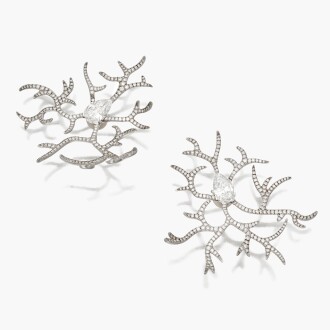
A standout pair of JAR’s earclips are on offer at Sotheby’s New York. The piece features two pear-shaped diamonds surrounded by round diamonds, splintering outwards like branches blanketed with a frosty fleck of snow. Another offering on Sotheby’s marketplace is a considerably amusing affair: a pair of earclips fashioned with gold glass baubles and spiral titanium wires.
JAR’s Kaleidoscopic Colors
JAR excels where dramatic and unexpected color combinations are concerned. Instead of relying on the three basic gems to demonstrate a range of colors – rubies, sapphires, emeralds – Rosenthal takes care to showcase a whole spectrum of colors in his pieces. Rosenthal leverages pavé settings to create slight gradations of color, which reflects “a painterly approach to his jewelry,” says Becket. By contrast, a stunning pendant-brooch coming to auction in December, employs the same setting technique like a color field painter of the mid-20th century. The jewel is set in-the-round with planes of sapphires, green garnets, pink tourmalines, rubies and amethysts and may be worn on other side, depending on your desired color palette.
How to Become a JAR Collector
Those who have been lucky enough to receive an invitation to JAR’s atelier tend to be longtime collectors. It’s uncommon for JAR collectors to let go of their pieces, which is why they reliably create a “firestorm of bidding at auction,” Becket says, and often surpass estimates.
To aspiring collectors who haven’t yet received an invitation to JAR themselves, Becket says: “If you’re lucky enough to have a friend willing to make an introduction, take full advantage. Until then, let auction be your passport to the wonderful world of JAR.”
Photo of superb gem-set, sapphire and diamond ‘Moghul’ pendant and brooch by JAR (Sold by Sotheby’s Geneva in 2022 for 630,000 CHF) by Robert Hradil / Getty Images for Sotheby’s