Collector’s Item: Bing and Kathryn Crosby’s Christmas Miracle
Collector’s Item: Bing and Kathryn Crosby’s Christmas Miracle
By
James Haldane| Dec 9, 2025
From Hollywood glamour to exquisite Fabergé, “Swinging on a Star: The Collection of Bing & Kathryn Crosby” captures a lifetime of passion, taste and festive charm. Their son, Harry Crosby, reflects on some of its most cherished treasures before they go under the hammer at Sotheby’s New York on December 18.
Photography by Henry Leutwyler
From Hollywood glamour to exquisite Fabergé, “Swinging on a Star: The Collection of Bing & Kathryn Crosby” captures a lifetime of passion, taste and festive charm. Their son, Harry Crosby, reflects on some of its most cherished treasures before they go under the hammer at Sotheby’s New York on December 18.
Photography by Henry Leutwyler
Portrait of Bing Crosby by Sam Manning, featuring his signature hat and pipe—accessories central to his persona both on and off screen.
M
y father didn’t come from a fancy background, and neither did my mother. But he had already built a career in music and film by the time they met in 1953. He had the trappings of a home and the experience of raising four boys after being widowed from his first wife, Dixie Lee. My mother was raised in West Columbia, Texas, and from a young age loved acting. She got into the University of Texas at 17, and after a year in the drama department moved to California to become a contract player.
The studios worked like a trade school—you were paid a few dollars a week while learning every aspect of filmmaking: screen tests, choreography, assisting directors, watching producers at work. That’s where they met, but it wasn’t automatic. He was 30 years older, she was 20, and it took four years to court, building a deep, trusting partnership.
It wasn’t until I got older and began understanding the business side that I really appreciated what Dad achieved. Music and film technology were shifting in the 1920s as his career took off: radio was emerging, films were moving from silent pictures to talkies and the record business was evolving. In the ’30s, he worked closely with Jack Kapp at Decca Records, and together they had a long and successful run. Dad developed a new way of singing into the microphone—intimate, unlike standing before a full orchestra and belting. That’s why they called him The Crooner.
Portrait of Kathryn Crosby in her late 20s, painted by Sam Manning, which hung in the couple’s bedroom.
Outside the studio, his passions took a different form. He loved horses, from thoroughbreds to hunters, and the culture surrounding them, including English sporting art. He befriended Charles Howard, owner of Seabiscuit, and owned a horse called Meadow Court, who won the Irish Derby in 1965. He moved easily between racetracks and galleries, surrounded by people, horses and paintings, from Herring to Munnings.
Dad wanted his talent to thread through all parts of society, regardless of background or creed, so he was careful about politics, preferring to entertain without dictating opinions. That neutrality and his unassuming nature once made his Palm Springs home a haven for John F. Kennedy, who needed a place to escape in 1962. Frank Sinatra had thought Kennedy would use his house, but I think the appeal was Dad’s relaxed attitude: “The keys are under the plant. Just have fun, and turn the lights out when you leave.”
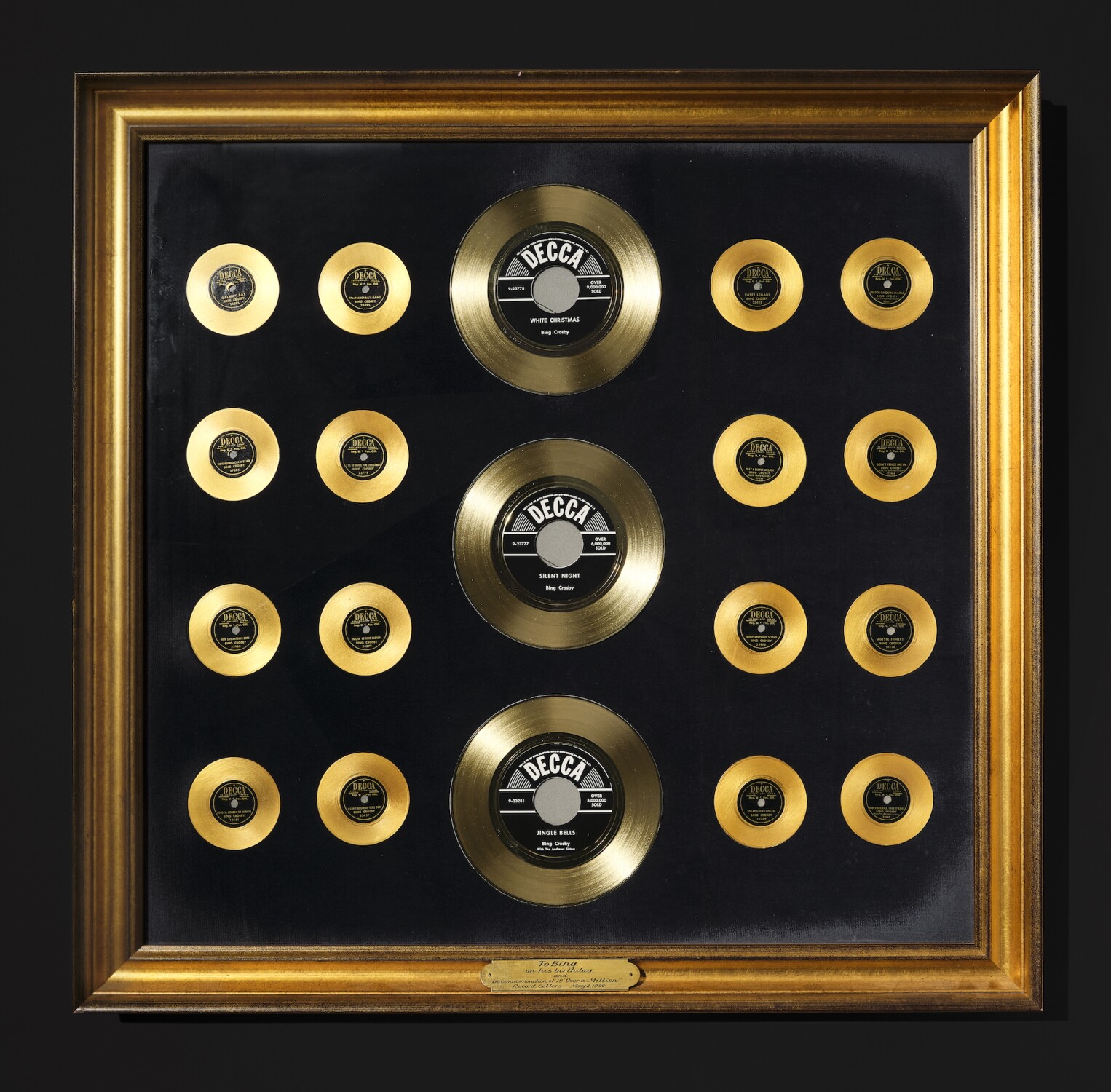
Gold records presented by Decca, inscribed “To Bing on his birthday and in commemoration of 19 ‘Over a Million’ record sellers—May 2, 1957,” including “White Christmas” (over 9 million sold in 1957), “Silent Night” (over 6 million) and “Jingle Bells” (over 5 million).
My mother, though younger, was a quick study. Early in their marriage, she told my father, “I’m not that interested in jewelry, but I like this thing called Fabergé.” She discovered A La Vieille Russie, a Russian imperial art and antique gallery founded in Kiev that later relocated to New York, and studied under its matriarch, Ray Schaffer. She absorbed every detail and became fiercely discerning, especially about the animals—from the big lion to the little mouse. She learned as much as any dealer and spent hours on the phone negotiating trades. She wasn’t buying just to deal though—she wanted to acquire and keep things.
That was my parents’ way. They didn’t just collect—they lived with what they loved: always curious, always careful, always enjoying the process.
Alfred Munnings’ “The Hunt,” 1914, purchased by Bing and treasured by Kathryn after his death in 1977 until her passing in 2024.
Left: Bound volume of musical arrangements from “White Christmas,” 1954, created by Paramount Pictures and inscribed to Bing by the film studio’s music director, Joseph J. Lilley. Right: Boots made to accompany Kathryn’s Christmas costume.
.
Custom 1960s coat-dress with matching capelet, likely created for Kathryn to wear on one of Bing’s Christmas television specials, in which the family often appeared.
“Dad wanted his talent to thread through all parts of society, regardless of background or creed.”
—Harry Crosby
Left: A selection of Bing’s signature hats, by makers including Cavanagh and Dobbs & Co., adopted after early hair loss and later integral to his personal style. Center: Left: Fabergé gold-mounted nephrite pipe holder, made in Saint Petersburg circa 1900 and purchased from A La Vieille Russie. Right: Group of ornate walking sticks and an umbrella owned by Bing.
Tiffany & Co. cigarette box gifted to the Crosbys by President John F. Kennedy, engraved with a personal message in his handwriting.