Léonard Tsuguharu Foujita: An Extraordinary Life in Art

Léonard Tsuguharu Foujita: An Extraordinary Life in Art

Spanning six decades, 15 works from the Lewis Collection reveal an artist who continually reinvented himself at the intersection of Japanese tradition and Western modernism.
Chapters
Spanning six decades, 15 works from the Lewis Collection reveal an artist who continually reinvented himself at the intersection of Japanese tradition and Western modernism.

L éonard Tsuguharu Foujita remains one of the most enigmatic figures of 20th-century modernism—an icon of the École de Paris who seamlessly fused Japanese artistic traditions with Western art history and avant-garde technique.

Spanning the breadth of his career, these 15 exceptional works from the Lewis Collection capture the remarkable arc of Foujita’s six-decade career. From the avant-garde crucible of Montparnasse to the quiet countryside sanctuaries of his late French years, Foujita continually bridged East and West—uniting the linear delicacy of sumi ink with the grandeur of European classical traditions. Together, they testify to an extraordinary legacy defined by technical genius, cultural reinvention, and an enduring devotion to beauty.
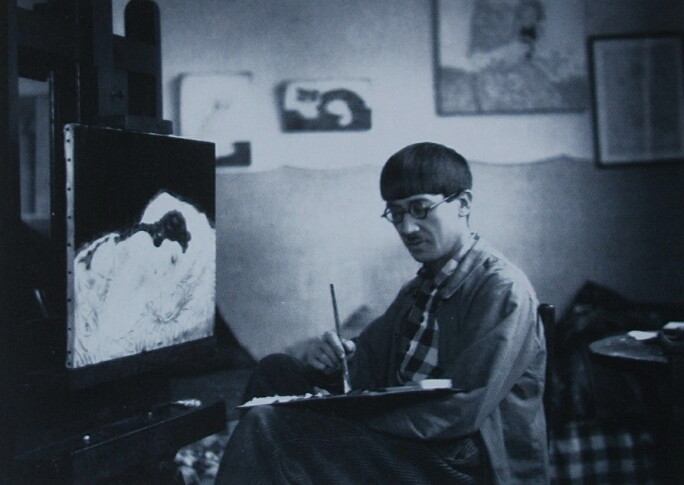
Léonard Tsuguharu Foujita in his studio, 1917.
Léonard Tsuguharu Foujita in his studio, 1917. Photo by Jean Agélou (1878–1921).

1910s

L éonard Tsuguharu Foujita landed in Paris in 1913, on the eve of the First World War.

Born in 1886 in Tokyo, as an adolescent Foujita had already resolved firstly to become a painter, and secondly to study in France, the avant-garde centre of the art world. Foujita’s father was an army medical director who persuaded his precocious son to pursue his fine art studies in Japan. Foujita dutifully graduated in 1910 from what is now the Tokyo National University of Fine Arts and Music, where he studied courses on nihonga (Japanese-style painting) as well as under Seiki Kuroda, an exponent of yōga (Western-style painting).

But impatient for more, Foujita finally moved to Paris in 1913 at the age of 27. His father offered him a three-year annuity, on the understanding that Foujita would return to Japan by the age of 30, a plan soon derailed by the outbreak of war. He settled in Montparnasse, quickly becoming part of the brilliant and eclectic École de Paris that included peers Amedeo Modigliani and Pablo Picasso.

From the beginning of his stay in Paris, Foujita took advantage of his proximity to the Louvre (which remained open during the war until two shells exploded in its gardens in 1918) to study the works of Old Masters such as Raphael, Rembrandt, and Leonardo da Vinci. From 1917, Foujita produced a series of highly stylised portraits, often in profile, that drew on Renaissance portraiture as much as Japanese ukiyo-e prints.
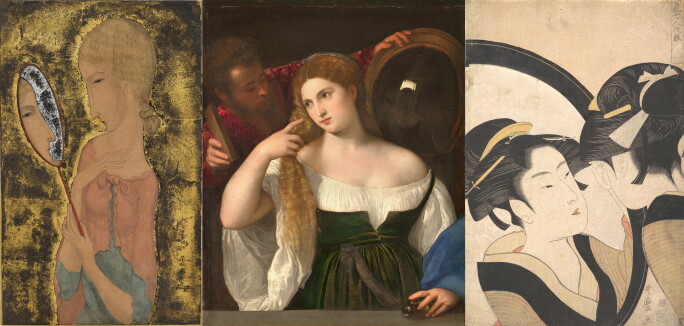
Gazing intently into her slender oval hand mirror, La femme au miroir (1918) transports Titian’s golden-haired beauties into the realm of Kitagawa Utamaro's woodblock print muses.
[Left to right] Léonard Tsuguharu Foujita, Femme debout, 1914; Titian, La Femme au miroir, 1515. Collection of the Louvre Museum; Kitagawa Utamaro, Naniwa Okita Admiring Herself in a Mirror, circa 1790–95. Collection of the Met.

Foujita’s signature linear style, an ultra-fine, quasi-calligraphic ink line which favoured delicate two-dimensional elegance over heavy modelling, distinguished him from peers such as Modigliani whose parallel fascination was with elongated, Mannerist visages and limbs characterised by bold and heavy-handed brushwork.

  • Femme debout, 1914
  • La femme au miroir, 1918
  • Les trois danseuses, 1918
  • Femme debout, 1914
    Painted as the glittering Parisian demi-monde was subsumed under the cloud of the First World War, Femme debout is a startling study in grief. A pivotal early work, it captures the aesthetic collision between Foujita’s Japanese roots and the European avant-garde, and prefigures his spiritual turn in later life. The figure’s gold-edged blue and crimson robes evoke traditional depictions of the Virgin Mary, while Foujita’s delicate Japanese linework gives her East Asian features and sculpted hair inspired by African and Egyptian art. Her pose and palette also recall 14th-century Japanese Buddhist deities such as Fudō Myōō. Over her shoulder, the weeping willow and boat carry dual symbolism: in the Western tradition, they suggest the soul’s passage from earthly sorrow to salvation; in East Asian iconography, the willow’s association with Kannon and the vessel evoke healing, resilience and crossing the seas of suffering.
  • La femme au miroir, 1918
    Gazing intently into her slender oval hand mirror, La femme au miroir transports Titian’s golden-haired beauties into the realm of Kitagawa Utamaro's woodblock print muses. These intimate vignettes not only captured modern fashions and grooming rituals, but also the intriguing psychological interplay between the observer and the observed. The gilded background, a feature of Foujita’s early avant-garde period in the late 1910s to early 1920s (and later revisited in his religious works of the 1950s and 1960s), marries the opulence of Japanese folding screens with the sacred presence of Byzantine icons.
  • Les trois danseuses, 1918
    Painted in the same year, Les trois danseuses portrays three ballerinas twirling on a gilded stage, the living embodiment of the Three Graces from Greek mythology—Aglaia (Beauty), Euphrosyne (Mirth), and Thalia (Abundance). Ballet was a fertile ground for avant-garde cross-pollination—Picasso designed costumes and theatre sets for the Ballets Russes, whilst other artistic luminaries such as Henri Matisse and Sonia Delaunay dazzled Paris with their edgy designs for Sergei Diaghilev’s productions.

1920s

I n 1923, Foujita wrote excitedly to a friend that he had fallen head over heels for "a lovely, lovely beauty of almost twenty, and she also loves me.” The object of his affections, Lucie Badoud, possessed lustrous copper-toned hair and skin so enchantingly white that he re-christened her “Youki,” the Japanese word for “snow.” That same year, Foujita’s paintings attracted critical acclaim at the celebrated Salon d’Automne. A decade after moving to Paris, Foujita had officially arrived.

Youki inspired Foujita to new heights. “In order to give form to my fine lines, I needed a smoother and more lustrous canvas,” noted Foujita. He developed his trademark grand fond blanc—a secret blend of flaxseed oil, crushed chalk (or white lead) and magnesium silicate—that simulated radiant ivory flesh in his sensational nude portraits of Youki and other female muses.

By the mid-1920s “Fou-Fou,” as he was nicknamed by his French friends, was so well-known in Paris that department store windows were dressed with mannequins bearing his trademark bangs, gold hooped earrings and round tortoiseshell glasses.

  • Mon portrait, 1924
  • Les enfants, 1924
  • Nu assoupi sur la table, 1927
  • Mon portrait, 1924
    Mon portrait was Foujita’s first major fully realised self-portrait of his iconic Paris period. The painting would become the prototype for dozens more self-portrayals during his artistic career. Depicting himself at his desk, surrounded by a symbolic assortment of traditional East Asian calligraphy tools alongside the accoutrements of a modern European gentleman, Foujita asserts an iconic hybrid identity that bridges his Japanese heritage with the bohemian sophistication of the Parisian avant-garde.
  • Les enfants, 1924
    Foujita’s unmistakable blend of playful Eastern-Western whimsy was also evident in Les enfants . Karako-zu, a traditional Japanese art motif of Chinese children at play, proliferated across painting scrolls, porcelain and even samurai tsuba (sword handguards) in Foujita’s homeland. Heads shaved but for two miniature topknots, two chubby baby boys wrestle mid-air as two leaping dogs watch on. Drawing on Renaissance putti (angelic cherubs), and painted on silk, a traditional Asian medium that elevates the fine linework of Japanese ink painting, Foujita places this charming Asian motif at the intersection of Western academicism and East Asian childhood folklore.
  • Nu assoupi sur la table, 1927
    Nu assoupi sur la table testifies to the success of Foujita’s technical invention—hair-thin contour lines applied with a traditional Japanese menso brush delineate luminous flesh from drapery thrumming with latent tension. Observing the Japanese concept of ma (negative space), Foujita transformed Western figurative painting into a sublime and minimalist celebration of sensuousness.

1930s-40s

A s Foujita rode the waves of public popularity, his private life was marred by a number of personal and financial entanglements. After marrying his muse Youki in 1929, he was subjected to demands from the French tax authorities for unpaid taxes dating from 1925. He left for Japan with Youki, where he had a series of major exhibitions lined up in Tokyo, Osaka and Fukuoka. Foujita was, however, met with an ambivalent reception from Japanese critics, and he returned to Paris in 1930. Under financial strain, Foujita moved into shared accommodation with the French poet Robert Desnos, but was devastated when his beloved Youki subsequently embarked upon a relationship with Desnos.

Compounded by severe financial and romantic distress, Foujita left Paris and embarked upon an extensive journey through Latin America in late 1931 and 1932 with his new partner, Madeleine Lequeux, a dancer at the Casino de Paris nicknamed “the panther.” Foujita’s final stop was Mexico in late 1932, where he and Madeleine stayed seven months.

After his travels in Latin America, Foujita returned to Japan in 1933, where (barring a brief return to Paris in 1939) he stayed until after the Second World War ended. In 1949 he departed for New York. It was a period of intense creativity: over the course of ten months he held exhibitions announcing his postwar comeback and taught at the Brooklyn Museum Art School, before relocating back to France in early 1950, never to live in Japan again.

  • Chatte et chaton, 1932
  • Madeleine endormie, 1933
  • Le mexique, 1933
  • Le rêve (Hommage à La Fontaine), 1949
  • Chatte et chaton, 1932
    A quiet portrait of a mother cat and her kitten, Chatte et chaton , revisits Foujita’s iconic full-scale reclining nude compositions from his late 1920s and 1930 heyday, but elevates felines from languid background companions to primary subjects in this wistful image of cosy domesticity. Foujita famously viewed cats and women as parallel enigmas—simultaneously loving, independent, and utterly unpredictable. Often citing cats as his favourite companions, they became a key motif in Foujita’s practice following the success of his 1930 publication, A Book of Cats.
  • Madeleine endormie, 1933
    Madeleine’s fiery red hair and clear blue eyes, sensual and dynamic compared to Youki’s alabaster classical beauty, was captured in extraordinary works such as Madeleine endormie , which spoke of the relaxed intimacy earned during the couple’s years on the road.
  • Le mexique, 1933
    In Le mexique , an extraordinarily scarce work on paper and the largest of his Latin American series, Foujita recreates the atmosphere of a crowded Mexican market in immersive detail—assorted pottery and earthenware lie scattered on a blanket across the ground, a mother reminiscent of the Madonna with her royal blue headscarf breastfeeds a baby in her lap, whilst various figures around her doze or recline mutely in the oppressive midday heat. These vibrant daily life and local character studies, fusing Foujita’s characteristic Japanese fine lines and watercolour techniques, pay tribute to Mexican muralism—specifically the monumental figurative works of Diego Rivera, which pushed him toward bolder spatial layouts and a focus on indigenous communities.
  • Le rêve (Hommage à La Fontaine), 1949
    Le rêve (Hommage à La Fontaine) is one of only four known works from Foujita’s series paying tribute to the French writer Jean de La Fontaine and his philosophical Fables. It is inspired by Le Songe d'un habitant du Mogol (“The Dream of an Mogol Resident”), the tale of a man who dreams of a surreal reversal of fates. Le rêve presents a slumbering fox, watched over by his mate and cubs swaddled in cloths echoing the French Tricolore, and a miniature rendering of Jean-Francois Millet’s Gust of Wind that points to the sleeper’s inner turmoil—a veiled allusion to the mounting sense of alienation he felt following his wartime years in Japan. Presented at Foujita’s solo show at Mathias Komor Gallery in November 1949, it cemented Foujita’s international comeback, restoring the artist’s confidence and proving his commercial success ahead of his eventual return to Paris in January 1950.

1950s-60s

D elighted to be back, Foujita declared his intention never to leave Paris again. His works paid homage to his beloved city: he began painting a series of “Paris landscapes,” and by 1952 his style had taken on a nostalgic, dreamlike realism in the European classical tradition.

Alongside him was Kimiyo Horiuchi, whom he had met in Tokyo in the mid-1930s, and who had become his constant companion throughout the turbulent war years. Providing the artist with a sense of stability and quiet devotion after decades of restless travel and heartbreak, she remained the primary anchor of his mature life. Foujita and Kimiyo married in 1954, gained French nationality in 1955 and subsequently renounced their Japanese nationality.

Abandoning the provocative nudes of his 1920s Montparnasse heyday, Foujita’s mind turned towards comforting, intimate depictions of maternités and young children, aided by his collection of porcelain dolls which he posed in the arms of his little subjects. Children became his primary subject, bridging the linear precision of nihonga painting, European folk realism and Northern Renaissance portraiture.

The late 1950s and 1960s marked a profound personal and spiritual transformation for Foujita. The couple converted to Catholicism and were baptised in Reims Cathedral in 1959, with Foujita taking the Christian name Léonard. Now in his seventies, having retreated from the bustling Parisian nightlife of his youth to the quiet French countryside of Villiers-le-Bâcle in 1961, Foujita’s late work shifted towards contemplative, sacred subjects.

Just a few years later, Foujita was diagnosed with cancer. He passed away on 29 January 1968 in Zürich, Switzerland, leaving behind an extraordinary legacy.

  • La belle espagnole, 1952
  • Deux filles, 1954
  • Barques à marée basse, 1957
  • Petit Garçon, 1958
  • Fleurs, 1963
  • La belle espagnole, 1952
    Masterworks such as La belle espagnole paid homage to a particularly Parisian icon—da Vinci’s Mona Lisa. Seated in a very familiar three-quarter pose with hands resting calmly in her lap, Foujita’s mysterious Spanish woman wears a diaphanous black lace mantilla, rendered using his trademark ultra-fine Japanese menso brush. Her ambiguous gaze and porcelain skin, with subtle green undertones, gives her a timeless statuesque quality that points to Foujita’s own healing rappel à l’ordre after the chaos of the intervening war years.
  • Deux filles, 1954
    Seated in an oversized chair and cradling the arm of her doll, Foujita’s child heroine in Deux filles is the epitome of innocence and purity. Her miniature Renaissance-style gown serves to highlight the contrast between her circumstances and her tender age. Favouring a muted palette of earthy browns, pistachio green and rustic orange, Foujita conjures up a world of fairytale fantasy.
  • Barques à marée basse, 1957
    Painted two years after Foujita obtained his French nationality, Barques à marée basse depicts La Hume in Arcachon Bay, a region in southwestern France known for oyster farming, tidal mudflats, and wooden fishing boats. These boats, stranded in shallow waters during low tide, set against a quiet horizon and open sky, spoke of the quiet, transcendental satisfaction of life in their adopted homeland.
  • Petit Garçon, 1958
    In another work from his mature post-war period, Petit Garçon , a street urchin is rendered in close-up with large, expressive eyes that gaze dreamily off-canvas, whilst two little girls stand like dolls on either side of him in the distance along a cobblestone street. Foujita’s superb calligraphic technique captures the feather-light, wispy handling of hair and broader, fluid strokes that render the folds of the gamin’s cape. In both works, exaggerated non-linear perspective creates a surreal, doll-like atmosphere, evoking a melancholic nostalgia for a European childhood far removed from the trauma of war.
  • Fleurs, 1963
    Painted in his final years, Fleurs reflects a deeply reflective state of mind deeply attuned to mono no aware, the bittersweet awareness of life’s transience. Once held in the collection of his widow, Kimiyo, Fleurs presents a delicate array of ephemeral spring blooms, including hyacinths and lilies of the valley, spread across a horizontal plane. Rather than directing the eye to a single focal point, it invites a panoramic sweep in the manner of reading traditional handscrolls. Embracing the Japanese concept of ma (negative space), it is executed with Foujita’s delicate sumi ink contours and translucent washes of colour, blending East Asian spatial sensitivity and classical kachō-ga (flower-and-bird paintings) with the naturalistic precision of European botanical illustration.
Modern Art | Asia Sotheby's Maison, Hong Kong

About the Author

More from Sotheby's

Sell with Sotheby's

Sell with Sotheby's


Wondering what your item could be worth?

Share a few details and photos to receive a complimentary online estimate.

Request an Estimate
Hand holding iphone with Sotheby's estimate tool showing

Stay informed with Sotheby’s top stories, videos, events & news.

Receive the best from Sotheby’s delivered to your inbox.

By subscribing you are agreeing to Sotheby’s Privacy Policy. You can unsubscribe from Sotheby’s emails at any time by clicking the “Manage your Subscriptions” link in any of your emails.

Stay informed with Sotheby’s top stories, videos, events & news.

Receive the best from Sotheby’s delivered to your inbox.

By subscribing you are agreeing to Sotheby’s Privacy Policy. You can unsubscribe from Sotheby’s emails at any time by clicking the “Manage your Subscriptions” link in any of your emails.

arrow Created with Sketch. Back To Top