22 Unmissable Highlights of Hong Kong’s Modern & Contemporary Evening Auction
A compelling selection of modern and contemporary masterpieces anchor a dynamic upcoming Evening Auction in Hong Kong.


A head of the Modern & Contemporary Evening Auction on 28 September, we celebrate the boldness of 20 international visionaries whose paintings and sculptures unveil the unseen beauty of our world.

Lalan, Remember Henri Michaux, 1984
A swirling symphony honouring friendship, Remember Henri Michaux is Guizhou-born Lalan’s tribute to the European experimental poet, writer and painter. When Lalan and her then husband Zao Wou-ki entered the Parisian art scene in 1948, it was Michaux who championed them, and introduced Lalan to Edgard Varèse, under whom she studied electronic music composition. The only one of her two tributes to Michaux to be executed on canvas, this sublime layered abstraction is a moving monument of affectionate remembrance. The painting has been extensively exhibited, including at Paintings of Lalan (Peintures de Lalan) at Paris's Espace Pierre Cardin. It also featured in the film Le Souffle de Lalan (2015) made by Raphaël Dupouy.
Zao Wou-Ki, 07.05.59 - 01.02.71, 1959-71
A twisting vortex leads the eye up through turbulence and serenity, light and darkness, towards a gloom-hued morass of the unknown. The monumental dimensions of this work—at 162 cm high—make this a painting to be encountered rather than merely seen. From 1959 onwards, Zao Wou-Ki used titles which refused the anchor of narrative, choosing instead to focus his viewer’s attention on energy and feeling. Crucially, the long passage of more than a decade in completing 07.05.59 - 01.02.71 (1959-71) suggests a vision that resisted closure. Its effect, ultimately, is that of an encounter with a cosmic abstraction as large and unknowable as time itself. Fresh to auction after more than three decades in the same private collection, 07.05.59 - 01.02.71 offers a rare opportunity to encounter and acquire this treasured masterpiece.
Zao Wou-Ki, 31.07.68, 1968
In 31.07.68 a soot-hued horizon looms heavily over a pool of mesmerising, fluid azure, setting the scene for a height-of-summer marine introspection. The Chinese-French artist found himself caught in the midst of a year of student uprisings in Paris and a decade of his wife Chan May-Kan’s declining health. Here, pain wrestles with rising tides of optimism in an oil painting about movement, control and balance. The painting calls to mind Zao Wou-ki’s commentary in his 1988 autobiography: “Les souvenirs ne sont pas faits pour être racontés, mais pour être transformés en couleurs” (“Memories are not meant to be told, but to be transformed into colours”).
Yayoi Kusama, Infinity-Nets (LHLUJ), 2017
Infinity-Nets (LHLUJ) recalls Kusama’s earliest white Infinity Nets painted in late 1950s New York. A painting of alluring beauty, the vivid electric blue ground injects fresh vibrancy into the hypnotic mesh. The Infinity Nets are prized for their vast and rhythmic serenity, and the white scheme is particularly in demand, with two out of the top five auction records of Kusama attributed to her white Infinity Net paintings. The work was included in Yayoi Kusama: Life is the Heart of a Rainbow at Museum MACAN (2018), her first major survey in Southeast Asia. Ultimately, as the Guardian newspaper observed in its August obituary, Yayoi Kusama will be remembered as the “artist who became a global superstar.”
Rhee Seundja, Untitled, 1960
In Untitled, densely-packed individual strokes gradually yield to amorphous multi-dimensional forms. It is a snapshot of Korean artist Rhee Seundja’s pivotal plunge into abstraction, a creative harbinger of her imminent Woman and Earth series. Rhee stands as a pioneer of abstraction and of the cross-cultural Asian-French dialogue which produced significant artistic innovators in the post-war period. Her artworks are in the collections of the Musée d'Art Moderne de la Ville de Paris and Centre National des Arts Plastiques in France, and she was the subject of a critically lauded dual presentation alongside the Lebanese artist Etel Adnan at White Cube Seoul earlier this year.
Liang Yuanwei, Dawn, 2012
Beijing-based Liang Yuanwei is a master of timing, repetition and the meticulous. In Dawn (2012), a misty morning wander in a forest is immortalised in a six-part dynamic interplay of light and haze. This rare large-scale series appears for the first time at auction, and its extended scale becomes the ideal forum for an independent and interconnected dialogue of colour fields, an ever-evolving visual rhythm of echoes and deviations.
Fernand Léger, Quatre papillons et un insecte, 1953
With its organic subjects delineated in clean black lines and imbued with the heft of industrial machinery, this oil on canvas carries dramatic graphic clarity and punch. The imagery recalls the Léger of the late 1930s, when he first began to re-imagine butterflies in his still lifes. Executed in 1953, this is a mature endeavour of decision and confidence, executed during an apogee period of synthesis and balance just two years before Léger’s death in 1955. In 1957 Quatre papillons et un insecte was featured in the landmark Léger retrospective at the Kunsthaus Zürich, cementing its place in art history.

Pierre-Auguste Renoir, Paysage avec figures, 1890-93
Impressionist master Renoir draws the viewer into dreamy sylvan slopes, where elegant society lies languid and supine upon radiant, sun-dappled grass. Renoir’s balmy colours, soft brushstrokes and gentle contours speak of his admiration for 16th-century masters such as Rubens and Titian. Meanwhile the delicious vibrancy of the ladies’ dresses and rich greenery echoes a new decade of rising optimism and popularity in Renoir’s life, marked by mounting prosperity, success and marriage to his long-time companion Aline Charigot.
Vu Cao Dam, Conversation d'élégantes au jardin, 1939
The mellow sophistication and ease of this scene of leisure is a beautiful counterpoint to the sheer technical accomplishment entailed in this large-scale ink on silk work. Indeed, this tableau of a gracefully attired female circle represents the elegant pinnacle of Vu Cao Dam’s acclaimed silk period, which was the Hanoi-born, Paris-based artist’s primary medium until 1951. It is his largest known multi-figure silk composition, juxtaposing Sino-Vietnamese architecture with the compositional and tonal élan he developed in Europe. The arrangement of the five seated female figures is reminiscent of family photos the artist brought from Vietnam, a silent sign of nostalgia and affection for relatives and friends about to slip further out of reach at the advent of World War II.
Claude Monet, Marine, 1882
Likely painted at Pourville-sur-Mer on France’s Normandy coastline, this impressionist painting of seething ocean, relentless waves and loose brushwork of wet, falling rocks conjure up the sound of crashing waves and the tumultuous spray of the sea. Painted in 1882, this joyous plein air rendering of shifting light and weather paved the way for Monet’s ensuing signature investigations of haystacks, Rouen Cathedral, and water lilies. With its raised perspective, angled towards a corner of the Channel’s coastline, Monet’s painting blends the passionate immediacy and spontaneity of Impressionism with an almost photographic sense of equilibrium and authenticity.

Yoshitomo Nara, Present, 1994
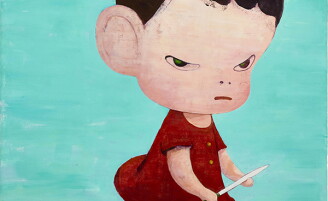
Present is the first Nara painting on canvas to depict his iconic child in full figure, and one of the two largest knife-bearing canvases of the 1990s. Painted in the artist’s new and larger studio in Cologne, following his move from Düsseldorf, a vermilion-clad child strides forth with a menacingly disarming confidence, a diminutive underdog in the tradition of David versus Goliath. An oversized head and purposeful expression of sulky defiance dominates the top right corner amidst a sea of blazing aquamarine. Present is a crucial milestone in Nara’s artistic output, foreshadowing Knife Behind Back (2000), which sold for HK$195 million at Sotheby’s Hong Kong in 2019.
Zeng Fanzhi, Mask Series 2001 no. 6, 2001
Hand in pocket, the solitary masked man striding towards the viewer radiates insouciant assurance. But is it real or an act? In the world of social media, Zeng Fanzhi’s exploration of alienation and enforced play-acting is more relevant than ever. Mask Series 2001 No. 6 bookends a truly era-defining series which began in 1994, when Zeng’s move to Beijing prompted his ground-breaking investigation of social deracination and dislocation. This is his last known painting of a solitary figure against a backdrop of the sea, with the large-format canvas neatly bisected by a horizon line into two halves of sunflower yellow and cerulean blue, adding to the sense of psychological dislocation, a schism between reality and projection.
Tom Wesselmann, Still Life with Odalisque, 1999
Executed in 1999, this painting re-evaluates and re-configures Wesselmann’s 1960s imagery, uniting Wesselmann’s two defining pictorial subjects, the still life and the nude. Included in Tom Wesselmann After Matisse at Almine Rech, Paris (2022), it manifests Wesselmann’s decades-long engagement with Henri Matisse’s use of colour and contour. Presented amidst crowded spatial field of vibrant everyday objects (and one stark black goldfish), the nude form is nearly crowded out, a nod to the casual commodification of the female figure in the consumerist, advertising-powered boom of the Pop Art era in which the artist first flourished.
Yu Nishimura, at night, 2022
This oneiric nocturnal beach scene points to the artist’s treasured photographic influences. In a portrait of haunting spontaneity, five friends are captured in various unstaged poses, a bicycle parked close by, their garments glowing in fields of unadulterated colour from zesty orange to vivid blackcurrant. Simultaneously ink-dark and spotlit, tree trunks slice across a deep blue sky. This fleeting moment of camaraderie underlines Nishimura’s verve for immortalising the transience of figurative memory, executed in his distinct, animé-inflected aesthetic.
Sanyu, Nude, Hugging Knees, Viewed from the Front I, 1950s
Once in the collection of Sanyu’s close friend and patron, the Italian architect Frederico Cappellin, the warm, ochre-coloured female form is poised in a paradoxical state of precarious relaxation. The artwork’s combination of controlled irreverence and accomplished dry-brush (feibai) technique demonstrates Sanyu’s mastery of both traditional Chinese calligraphy and the human form. One of only two compositions in the Chinese-French master’s known oeuvre for which a larger-scale oil counterpart exists (the other is in the permanent collection of the National Museum of History, Taiwan), this is a pivotal work in Sanyu’s practice.
Henri Matisse, Femme nue, circa 1915
Femme nue (1915) calls to mind Eugène Delacroix‘s Odalisque, and indeed the terracotta tints and whiff of sunnier climes may have been inspired by memories of Matisse’s visit to Morocco in 1912 to 1913. Femme nue resounds with a sense of physical possibility and optimism, replete with upbeat, sensuous warmth. The model is unknown, but the painting clearly foreshadows Matisse’s portraits of his best-known model, Laurette, who would lead Matisse further down the path of naturalism and psychological intimacy between 1916 to 1917. This painting was acquired by the American critic and collector Walter Pach, who helped to secure Matisse’s inclusion in the ground-breaking 1913 Armory Show in New York, and championed Matisse’s career in America throughout the war, helping to cement his status as a pioneering Modernist globally.
Zenzaburo Kojima, Woman in Chemise, 1925-28
Female subjects account for only a small portion of Kojima’s oeuvre, yet are among his most celebrated images. Examples are held in major public collections including the National Museum of Modern Art, Tokyo, Kojima had visited the major art institutions of France and Spain during his 1925 European tour, and the reclining figure and vivid palette recall the immediacy of Francisco Goya’s La Maja Vestida and the audacious colour choices of Matisse and Dérain. The flattened composition echoes the influence of traditional Japanese ukiyo-e prints, underlining Kojima’s search for a uniquely Japanese mode of oil painting.

Qiu Xiaofei, Green and Ropes, 2013
Following Hauser & Wirth’s announcement of global representation, Qiu’s debut solo exhibition at Hauser and Wirth in New York this year was a sold-out success. Suspended between abstraction and figuration, this painting was featured in the Heilongjiang-born artist’s first solo show at Pace in New York in 2014, and large-scale works like this one are now exceptionally scarce in the primary market. Green and Ropes is richly symbolic. As Qiu Xiaofei once explained, the flowing mountainous contours in verdant green symbolise humanity’s instinctive life force, while the taut ropes embody anchoring and restraint, a dialogue between chaos and order, growth and limitation.
Wu Guangzhong, Wooden-pillar houses of Sichuan, 1974
Diaojiaolou and diaolouzi are traditional wooden stilt houses built by ethnic minorities such as the Miao and Zhuang in the mountainous regions of China, and Wu Guangzhong transports the viewer into their very midst. Banned from painting during a turbulent period in his homeland’s history, the restriction was partly lifted in 1972, ushering in a fruitful period of creativity focused predominantly on landscapes, flowers and forests. Deeply inspired by the French master Paul Cézanne, the low viewpoint recreates the artist’s exploratory progress among the small paths between Sichuan’s village homes, captured in chocolate wood tones that enhance the interplay of light between the lush emerald tones of the trees and grass and the auspicious flashes of reds that scintillate the eye.
Hao Liang, Fisherman Recluse on the Autumn River, 2019
This panoramic silk painting, Hao Liang’s largest ever to appear at auction, attests to his definitive shift from figuration towards abstraction. Mountains and trees become geometric shapes, sentinels within a shadowy fusion of literati imagery, Picasso's Cubist forms, and Kandinsky's abstract symbols. This is one of three large-scale works created between 2017 and 2019: its sister work Streams and Mountains without End is now in the collection of the Getty Museum in Los Angeles, while Night and Day is in the collection of Asia Society, Hong Kong. In 2019, this painting was exhibited at the Aurora Museum in Shanghai in Hao Liang: Circular Pond. A construction of breathtaking balance and harmony, its subject has been a popular one in Chinese literati painting since the Yuan Dynasty, stemming from Qu Yuan's poem The Fisherman.

Alexander Calder, Untitled, 1953
Formed of 10 delicately linked, flattened sheet metal plates painted white, Untitled is one of Alexander Calder’s graceful, signature kinetic sculptures. Poised in the air in full flight, each new gust or draught creates entirely new permutations of physical space, emptiness and shadow. Calder once modestly remarked, “My fan mail is enormous—everybody is under six.” Calder’s liberation of sculpture from the shackles of the pedestal into joyous freedom and motion shows the wisdom of being a child at heart. The current record for an equivalent Calder mobile in white was set in 2018, when 21 Feuilles Blanches, also executed in 1953, sold for US$18 million.
François-Xavier Lalanne, Mouton de Pierre, 1986
Since his first flock of 24 Moutons de Laine was conceived in Paris in 1965, Lalanne’s sheep have become his most iconic and iterative works, coveted and collected by designers including Yves Saint-Laurent, Tom Ford, Karl Lagerfeld and Hubert de Givenchy. Lalanne’s first flock was inspired by Odysseus’ narrow escape from the Cyclops’ cave, clinging to the underbellies of giant sheep, as told in Homer’s Odyssey. Lalanne’s version renders such an escape more challenging, executed in unforgiving patinated bronze and epoxy stone. Whilst the sheep bring a touch of the rural to the bustle of urban life, Lalanne’s move to the big city was a fortunate one. When the Gascony-born artist moved to Montparnasse on Paris’ Left Bank at 18, his neighbour was the sculptor Constantin Brancusi, who introduced him to his circle of Surrealist friends, including Man Ray and Max Ernst.