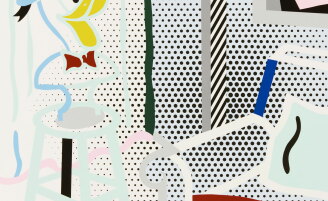
I n the early 1960s, Roy Lichtenstein made his dots by hand. To bring the Ben-Day pattern of cheap comic-book printing onto canvas, he would rub paint through a perforated stencil with a toothbrush, a painstaking labor meant to make a picture look as though no one had labored over it at all. But, in screenprinting, he discovered a process that inherently produced the mechanical precision and uniformity he had previously worked so hard to emulate.. While Lichtenstein continued making paintings throughout his life, the screenprint, as curator Stephen Coppel writes, gave Lichtenstein “the ideal medium for realizing the impersonal commercial effect he was seeking.”
That shift is the key to collecting Lichtenstein’s prints. The print historian Susan Tallman has observed that Lichtenstein and Andy Warhol “were less concerned with how print might echo paint than how paint and canvas could imitate print.” For an artist whose true subject was our perception of art, the print was never a souvenir of the painting. In a sense, it was the original.
In October 2026, Sotheby’s offers one of the final groups of prints from the Collection of Dorothy and Roy Lichtenstein in Reflections on Pop, a live auction on October 7 alongside an online sale closing October 9. What follows is a guide to the four decades of printmaking behind them: what makes a Lichtenstein print valuable, where a new collector might begin and what to check before bidding.
Lichtenstein pursued printmaking at the same time as painting. (The catalogue raisonné of his prints begins in 1948.) “Printmaking was integral to his overall artistic practice,” says Chanler Rutherfurd, AVP, Specialist and Co-Head of Sale in Sotheby’s Prints Department. Lichtenstein did not issue editions of his best-known paintings; “He was not merely reproducing paintings in an edition, but used the qualities of the printed medium to inform and enhance his work.” He deliberately chose each technique, Rutherfurd says, “for the distinct visual and aesthetic effects it could achieve.”
This experimentation with technique is best examined through his collaborations with some of the most technically ambitious print workshops in America. Lichtenstein was already an established printmaker before he met Kenneth Tyler in the late 1960s, however his close working relationship with the master printer would alter the artist’s approach to printmaking. His first project with Gemini G.E.L., the Los Angeles workshop co-founded by Kenneth Tyler, came in 1969: two series after Claude Monet, the Haystacks and the Cathedrals. Monet had painted the same haystacks and the same cathedral façade again and again to catch the passage of light. Lichtenstein made the repetition mechanical. His dots were no longer rubbed through a stencil but generated photographically, a negative of his full-scale drawing laid over a Ben-Day screen on light-sensitive plates, rendering Impressionism’s most atmospheric subjects as flat, industrial patterns.
Over the next quarter century, he returned to Gemini and to Tyler Graphics, the workshop Tyler later founded in New York, and worked as well with Graphicstudio in Tampa and Saff Tech Arts in Maryland. Each partnership pushed the medium somewhere new. The curator Ruth Fine, writing in the 1994 catalogue raisonné of the prints, saw the workshop as the place where Lichtenstein let himself loosen up: “Printmaking provides for Lichtenstein an arena in which he is far more apt to play around, try something new, experiment with materials.” In the prints, she continued, “the nature of reproduction, of multiple originals, of layered process as well as layered meaning are added to the mix.”
The workshop also let Lichtenstein work big. Early prints can be modest (the sheet of Modern Art Poster, from 1967, measures about 9 by 12 inches), but those he made with Gemini and Tyler often approach the scale of his canvases. Reflections on Minerva (1990), printed on a sheet more than four feet wide, is larger than Reflections: Wimpy I (1988), a painting from the same series that sold from the estate at Sotheby’s in September 2025 for $2.9 million. The print is estimated at $60,000–80,000. For collectors, that difference offers the most direct way to own a Lichtenstein.
“More so than several of the other Pop artists he was associated with, Lichtenstein pushed the boundaries of printmaking,” Rutherfurd says, “utilizing a breadth of different techniques, often combining them in one print, which provides more overall texture and depth to the work and invites a closer look.”
The Landscapes series, printed at Gemini in 1985, is a good place to watch this play out. In The River, offered in the online sale, lithography, woodcut and screenprint share a single sheet, each contributing its own kind of mark: the even field of the screen, the grain of the woodblock, the tonal range of the stone. Four years later,Grandpa, from the Brushstroke Figures series, added waxtype to the mix, four processes stacked into one image.
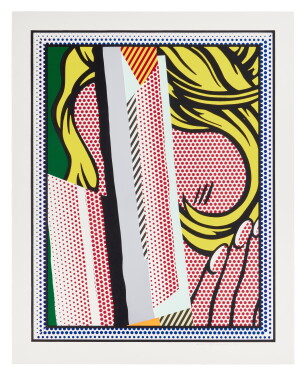
The most demanding of these experiments is the Reflections series, published by Tyler Graphics in 1990. Lichtenstein returned to the comic-book heroines and fighter pilots of his 1960s paintings and obscured them behind bands of glare, as if the viewer were looking at a framed picture under glass. To build that illusion, the prints combine lithography, screenprint, relief and metalized PVC collage with embossing; inReflections on Minerva, also in the online sale, the reflective collage catches real light where the image depicts an imaginary one. “The prints are so large and complex,” the curatorJane Kinsman has written, “that the various processes were pushed to the very limit, while demanding that the printer achieve perfect registration, without overlap, and keep the paper, with all its collage and embossing, intact.”
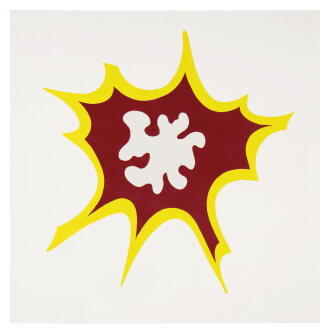
The estate has also surfaced the working material behind these feats. “Something I’ve found particularly interesting in selling works from the estate is seeing the studies for his prints,” Rutherfurd says. The study forReflections on The Scream, Lichtenstein’s send-up of Edvard Munch, is offered in the live sale;an impression of the finished print sold from the estate at Sotheby’s in September 2025. Seen side by side, the two show how much of the finished print was decided before it ever reached the press, and how much could only be solved within the process itself.
“We have seen a desire for prints spanning his career,” Rutherfurd says. At one end are the classic Pop images of the 1960s. The screenprints Reverie and Sweet Dreams, Baby!, both from 1965 and both published in the 11 Pop Artists portfolios volumes II and II and , have been sought after for years. They are, in Rutherfurd’s words, “so quintessentially Lichtenstein with the comic book imagery and graphic vocabulary.” The period’s offset lithographs, such as Crying Girl (1963), have also performed consistently well at auction. But condition across these early sheets varies considerably, Rutherfurd cautions, “particularly with the strength of color.”
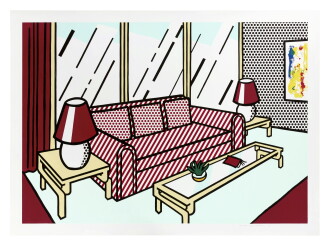
At the other end is the late work. The Nudes series of 1994, the last prints Lichtenstein made with Tyler, brings back his comic-book heroine while folding in motifs from the Mirrors, Interiors and Water Lilies. As Rutherfurd points out, the series also marked the first time Lichtenstein portrayed the female nude, a subject he subsequently took up in painting.
Among the late series, Rutherfurd singles out one: “The Water Lilies series in particular has become extremely desirable in recent years.” Made with Saff Tech Arts in 1992, the works are screenprinted in enamel onto stainless steel that was masked and swirled before printing, so that the metal itself flickers as the viewer moves: Monet’s changing light, rendered in an industrial material. According to the Lichtenstein catalogue raisonné, Water Lilies with Cloud, offered in the live sale, required 12 colors printed in eight runs from eight screens, in an edition of 23. The results, Rutherfurd says, end up “blurring the boundaries between print, painting and sculpture.” The live sale also includes a study for Water Lilies – Blue Lily Pads, whose editioned counterpart sold from the estate in September 2025.
“There is a Lichtenstein print for everyone given the breadth of his printed output and variety of imagery he used,” Rutherfurd says: figuration and abstraction, send-ups of his own earlier work and homages to other artists. That range means a first purchase can follow taste, not just budget.
But for an especially savvy first acquisition, Rutherfurd points to Water Lily (1993), a screenprint in the live sale estimated at $15,000–25,000. The image measures about 12 by 17 inches, a manageable size, and it distills the essentials: the Ben-Day dots, the nod to Monet and a direct line to the Water Lilies series that collectors now prize. She also suggests Sunshine Through the Clouds (estimated at $60,000–80,000 in the live sale), from the 1985 Landscapes, for its mix of lithography, woodcut and screenprint, an introduction in one sheet to the artist’s layered method.
Beyond the entry point, the important measure shifts to scarcity. Among the online sale’s rarities, Rutherfurd singles out Haystack #6, one of only 13 impressions of its second state, which “rarely appears on the market.” Ten Dollar Bill, a lithograph Lichtenstein made in 1956 and published himself in an edition of 25, is one of his earliest prints and, Rutherfurd says, “the first ‘proto-pop’ image in his graphic oeuvre,” made years before the comic panels that would define him. And the complete Cathedral Series, Rutherfurd notes, “rarely comes to market as a complete set of six.”
Asked what a first-time buyer should check, Rutherfurd is emphatic: “Condition, condition, condition!” Lichtenstein’s richly saturated colors are integral to the work, and they are also its vulnerability. Several of his inks tend to fade or darken over time, particularly in the earlier prints, so look hard at the reds and yellows, the colors that give a Lichtenstein its punch and that tend to show age first.
The problem is compounded by the prints’ original accessibility. Brushstroke, a quintessential Pop image from 1965, was issued in an edition of 280, and because it was affordable at the time, Rutherfurd explains, impressions “were frequently framed and displayed without preservation in mind.” The sheet in the online sale (estimated at $15,000–25,000) is in particularly good condition, which is exactly what distinguishes a premium impression from an ordinary one. The same is true of Modern Art Poster (1967), offered with its bright colors intact and estimated at $6,000–8,000. The sale also includes, as a separate lot, the collaged color separation Lichtenstein made for it, a rare chance to see the print taken apart into its component layers.
Authenticity is another factor, especially at the more attainable end. The offset lithographs and Leo Castelli Gallery exhibition mailers of the 1960s “should probably be avoided for first-time buyers unless you are acquiring from a reputable source,” Rutherfurd says. “There are plentiful fakes out there given the larger edition size and lack of numbering.”
Collectors now have a free resource online: the catalogue raisonné of Lichtenstein’s prints. Before buying, Rutherfurd advises, check any potential purchase against its entry, and especially confirm the signature, the numbering, the edition size and the image dimensions. A print that departs from the record on any of these deserves a second look—or a pass.
“Sotheby’s sales of works from the estate since November 2024 have transformed the market for Lichtenstein’s prints,” Rutherfurd says. Demand for the artist’s graphic work had been strong for a decade, but “the depth of bidding we have seen for the prints from the estate has been extraordinary and has led to stronger prices for the artist’s prints across the board.” So far, she says, 100 percent of the prints the estate has offered have sold, many at record prices.
The effect has not stayed confined to the estate. Rutherfurd describes a “rising tide lifts all boats” dynamic, in which Lichtenstein prints from private collections offered in Sotheby’s sales have also outperformed expectations. For owners, that suggests the current market is a favorable one in which to sell; for buyers, it means the benchmark for a well-preserved impression has been reset.
Estate works, though, carry a premium of their own. “You cannot get better provenance than directly from the artist,” Rutherfurd says, and the condition, in her assessment, is the best she has seen. These works never left the artist’s collection, and many of the prints are being framed and exhibited for the first time. They are, Rutherfurd says, “in the same condition they were the day they were printed and therefore look exactly as Lichtenstein intended.” Whoever buys one will also be its first owner after the artist himself.
Four days after the live sale, on October 11, the Whitney Museum of American Art opens Roy Lichtenstein: Like New, a retrospective of some 130 works, prints among them.
There is an irony in all this that Lichtenstein would likely have enjoyed. He built a career on images designed to be thrown away: the comic panel, the newspaper ad, the printed page destined to yellow. The sheets he kept for himself have outlasted their disposable sources by decades, and they arrive at auction looking as though they have just come off the press. For an art about the cheap and the ephemeral, it is a strange and fitting fate to end up, at last, like new.