Jackie Kennedy Onassis, Maurice Tempelsman, and the Greatest Love Story You’ve Never Heard
Jackie Kennedy Onassis, Maurice Tempelsman, and the Greatest Love Story You’ve Never Heard
By
Lili Göksenin| Jun 22, 2026
From an incredibly rare gold box to stunning antiquities and works of art, Maurice Tempelsman’s collection—which also includes gifts from Jacqueline Kennedy Onassis—bears all the hallmarks of a life thoughtfully, intimately, lived.
From an incredibly rare gold box to stunning antiquities and works of art, Maurice Tempelsman’s collection—which also includes gifts from Jacqueline Kennedy Onassis—bears all the hallmarks of a life thoughtfully, intimately, lived.
T
he late Maurice Tempelsman was a man of many extraordinary talents: he was a prescient businessman and a collector of beautiful art and objects which, on 24 June, will come to auction at Sotheby’s New York. Tempelsman was also the last great love of Jacqueline Kennedy Onassis.
Having fled Belgium as a child, traveling across Europe with his family to escape the Holocaust, Tempelsman would go on to become a formidable New York City-based mining executive and financier and, over time, adviser to U.S. presidents. His proximity to Washington, DC, brought Tempelsman into contact with Jacqueline Kennedy Onassis, whose husband at the time, John F. Kennedy Jr., was serving as the Democratic senator from Massachusetts. Though they kept in touch, it wasn’t until after her second husband Aristotle Onassis died in 1975 that the two grew closer.
Maurice Tempelsman (left) poses with John F Kennedy Jr.
It may have seemed an unusual pairing: America’s most iconic First Lady and a self-made war refugee. But to those close to them it was clear they were kindred spirits. Though they never married, Tempelsman would eventually move into Jackie’s Fifth Avenue apartment and remain her companion through the worst of the cancer that would eventually take her life. Upon her passing, Jackie was surrounded by family, including her children Caroline Kennedy Schlossberg and John F. Kennedy Jr., and Maurice Tempelsman.
It is a great love story that is very seldom told. The quiet kind of love story, and one that evolved over decades, deepening over time. Unlike her well-known, public marriages, this relationship was deeply private. It involved two people who, by their mid-40s, had experienced more excitement, adventure, and tragedy than most people do in a lifetime.
At her funeral, Tempelsman read the poem “Ithaka,” by C.P. Cavafy, a testament to their love of antiquity and poetry, and the curiosity and wonder each brought to life. The title of this exhibition, A Marvelous Journey, is taken from Cavafy’s poem.
The pair filled their lives with family and friends, beauty and laughter, sharing a love of philanthropy, art, and literature. Tempelsman was a great collector who found joy in gold snuff boxes, antiquities, maritime art, and rare books and kept paintings of Jackie—and by Jackie—alongside works by Paul Klee, Montague Dawson, and Marc Chagall and American artists Robert Frederick Blum, William Trost Richards, and Henry Roderick Newman.
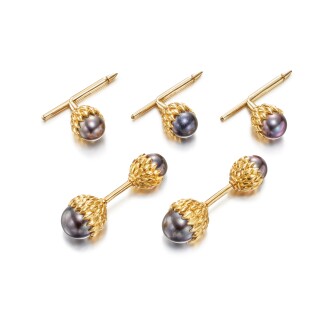
Gifts from Jackie, also in the sale, include a classic Cartier Tank Louis bearing the inscription (in her handwriting) “for Maurice, Love J.,” as well as a gold and black-pearl dress set of studs and cufflinks, designed by Schlumberger for Tiffany & Co. that he often wore to formal events. Another gift, “My Greek Alabaster Head of Goddess,” was bequeathed to him in her will and underscores both a profound love and their shared passion for classical objects.
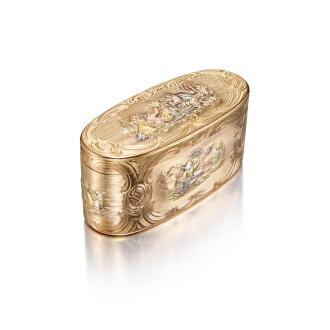
Elsewhere in the collection we find a rare gold and hardstone “Steinkabinett” box (or stone cabinet) by Christian Gottlieb Stiehl. It’s an exceptional example of a Steinkabinett, remaining in pristine condition after 250 years. It also contains a secret: a small, concealed button along the bottom edge that, when pressed, reveals a hidden compartment. Inside the compartment is the original booklet from 1770, handwritten in both French and German, listing more than a hundred semi-precious hardstones used in the creation of this magnificent box as well as their origin.
A Secret Hidden for 250 Years: Inside the Mystery of a Rare Gold Cabinet | Sotheby’s
The Story Behind Maurice Tempelsman's Rare Gold Cabinet
Further highlights include an Egyptian gold-snake armlet from the Roman Period (circa 1st century BC-1st century AD), and a definitive collection of Rudyard Kipling works, signed by the writer.
Seen in the context of a remarkable life, his intimate and thoughtfully chosen collection reminds us that a love of beauty often goes hand in hand with a life well lived. It is also a poignant testimony to a profound and enduring love.