Collected Wisdom: How Kiran Nadar Brought India to the Venice Biennale
Collected Wisdom: How Kiran Nadar Brought India to the Venice Biennale
By
James Haldane| May 8, 2026
The philanthropist and founder of India’s first private museum dedicated to modern and contemporary art is building a new home for a collection of more than 16,000 works and has been a driving force behind the country’s return to the Venice Biennale.
The philanthropist and founder of India’s first private museum dedicated to modern and contemporary art is building a new home for a collection of more than 16,000 works and has been a driving force behind the country’s return to the Venice Biennale.
Describe your collection in three words? Intimate, educational, enduring.
How did your collection begin? I bought my first works in the late ’80s for our home that we were building in Delhi. Two paintings by M.F. Husain, and one each by Rameshwar Broota, Tyeb Mehta and Krishen Khanna. While I have expanded the collection, those works remain in important spots.
How do you live with your collection? As the collection grew, I began using a space on the campus of HCL Technologies, the company founded by my husband, Shiv Nadar. In 2010, I launched the Kiran Nadar Museum of Art with an inaugural exhibition titled “Open Doors.” Over time, I realized that our visitors were limited by the location, so we moved to our current space in Saket in South Delhi. It’s larger but it’s within a mall, which drew some criticism. If I can share the works, location doesn’t matter—but the right setting can draw people in.
“Tyeb Mehta: Bearing Weight (with the lightness of being),” a major centennial retrospective at KNMA through June 30, 2026. Courtesy of KNMA.
What role does art play in your marriage? My husband didn’t have a strong interest in art, but he’s always been supportive. Today, he enjoys touring our shows with our artistic director and chief curator, Roobina Karode. He reads every wall card.
What was your very first collection, maybe as a child or a teenager? I collected stamps briefly when I was around eight. My father encouraged me. Later, I grew fond of Bollywood music, so I used to collect the songbooks that came with films and learn the lyrics.
How has your taste evolved over time? When I started collecting modern and contemporary South Asian art, contemporary was a new category. The market boomed, then fell sharply after 2008. Those areas have remained central to the collection. Over time, I began acquiring Indian miniature paintings and antiquities, which broadened the offering into something more encyclopedic. I also collect diasporic Indian artists such as Raqib Shaw and Anish Kapoor, alongside select Western artists and those from other regions. William Kentridge was the first non-Indian, non-diasporic artist that I started collecting. I think he has a personal connection to India, visible in his video works.
Collector Kiran Nadar at home in Delhi with Arpita Singh’s “Whatever is Here....,” 2006. The Kiran Nadar Museum of Art staged a retrospective of Singh’s six-decade career in 2019. Courtesy of KNMA.
Why is philanthropy important? Our philanthropy began in education, prompted by my mother-in-law telling my husband, “You have achieved a lot. It’s time to pay back.” We focused on education, with the Shiv Nadar Foundation creating an engineering college in Chennai and then founding the VidyaGyan schools. They’re boarding schools, comparable to the country’s top institutions, for meritorious children from families in rural areas of Uttar Pradesh with an annual income of less than 100,000 rupees (about $1,000).
Sayed Haider Raza, “Saurashtra,” 1983. Courtesy of KNMA.
Best impulse buy? A work by S. H. Raza called “Saurashtra,” bought at an auction at Christie’s in London. I was invited to view it and was immediately mesmerized, but I looked at the estimate and thought, “This is getting out of hand.” The head of the department told me: “Come to the auction. You could bid to the low estimate. You don’t have to go haywire.” I went along and got very carried away.
Which piece doesn’t “fit” in your collection but still works? A large hemp work by Mrinalini Mukherjee. It was the only work my husband has ever objected to having in our home. I put it into storage, and eventually it became the only work I’ve ever sold at auction. The buyer had storage issues, however, so I later offered to buy it back. After a year of persuasion, it returned to the collection and went off to the Met in 2019 for their Mukherjee exhibition.
A work by Lubna Chowdhary installed in the 2022 exhibition “Pop South Asia: Artistic Explorations in the Popular,” at KNMA Saket. Courtesy of KNMA.
Do you have a bidding strategy? I prefer to bid on the phone, and I never leave advance bids because then you regret it if the lot sells for one increment higher. Overall, I’m quite undisciplined in my buying.
How did you design your new museum? We worked with Malcolm Reading, an architectural competitions consultant who brought us a longlist of about 60 architects, which we narrowed to five. We had an excellent final selection committee, including Glenn Lowry, and it was a unanimous decision to choose Adjaye Associates. Unfortunately, our original site fell through, but about two years later, we found another one near the airport. This sent us back to the drawing board—the earlier building was vertical. We’re now building more than 1 million square feet across three floors. We’ll have about 27 galleries in the museum, two auditoriums and a cultural center.
Which museum would you like to be locked in overnight? The Louvre. The scope of the art is phenomenal, plus the jewelry. I first visited on my first trip abroad, aged 19. I spent about a week in Paris, and two or three days in the Louvre.
MF Husain, “Battle of Ganga and Jamuna: Mahabharata 12,” 1971-72. Courtesy of KNMA.
What’s the piece that got away? A painting by M. F. Husain titled “Battle of Ganga and Jamuna.” It came up for auction in 2008, and I bid up to my absolute maximum figure, but ultimately had to give up. About 15 years later, the buyer was forced to sell his collection, and I bought it then—at almost no increase in price. So it got away and came back.
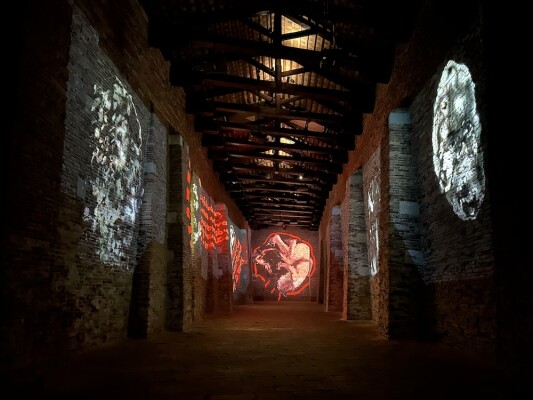
When did you first visit the Venice Biennale? I came in 2011 when India had a space curated by Ranjit Hoskote. I’ve visited all the Biennales since, but India didn’t have a pavilion again until 2019, when KNMA collaborated with the government and the Confederation of Indian Industry to produce an exhibition. I tried to persuade the government to return. Considering our heritage, it doesn’t make any sense that we are not represented. In 2024, we mounted our own M.F. Husain immersive exhibition at the Magazzini del Sale and secured the space for the next two editions.
Who are you exhibiting this year? Nalini Malani, an artist I collect. She came to me as the last Biennale was closing and offered to develop a special work. It was very touching to receive this proposal from one of the senior-most women artists from India. It didn’t take more than 10 minutes to say yes.
What exhibition are you looking forward to visiting? India has taken a pavilion this year, and they’re showing five artists: Alwar Balasubramaniam (Bala), Sumakshi Singh, Ranjani Shettar, Asim Waqif and Skarma Sonam Tashi. Dayanita Singh is showing at the Archivio di Stato and Amar Kanwar, one of the best video artists we have in India, at Palazzo Grassi.
Sotheby’s Magazine
About the Author
James Haldane
James Haldane is the Executive Editor of Sotheby's Magazine.