A Look Into The World of Van Cleef & Arpels High Jewelry
Explore the luxurious world of Van Cleef & Arpels high jewelry, where timeless craftsmanship meets exquisite design in every piece.

Van Cleef & Arpels has repeatedly approached high jewelry as a problem of both imagination and engineering. Gemstones can appear to float without visible prongs in the Mystery Set, a necklace can transform into a bracelet through the mechanics of the Zip and flexible goldwork allows a Ludo bracelet to move almost like fabric. Behind these designs is a willingness to make technical complexity feel effortless.
Founded in Paris in 1906, Van Cleef & Arpels developed a design vocabulary that has continued to evolve across generations. Nature has provided one rich source of inspiration, while transformability and inventive gemstone setting have shaped some of the Maison’s most ambitious jewels. Understanding Van Cleef & Arpels high jewelry therefore means looking beyond individual gemstones to the craftsmanship and ideas that turn them into distinctive designs.
| Feature | What to Know |
|---|---|
| Maison Heritage | Founded in Paris in 1906, Van Cleef & Arpels developed a high jewelry tradition shaped by technical innovation and imaginative design. |
| Mystery Set | Patented in 1933, the technique secures specially cut gemstones in concealed metal rails, minimizing visible settings across the surface. |
| Transformable Jewelry | Transformability appears throughout the Maison’s history, from the Zip necklace-bracelet to high jewelry necklaces with detachable elements. |
| Ludo | Introduced in 1934 and named for Louis Arpels, the Ludo is known for its flexible construction and distinctive buckle design. |
| Secondary Market | Technique, period, condition and the quality of the overall design can all influence how Van Cleef & Arpels high jewelry is evaluated. |
| Current Example | Ruby and Diamond ‘Mystery-Set’ Earclips are offered in Sotheby’s High Jewelry sale in Hong Kong on September 17, 2026. |
Van Cleef & Arpels was founded in Paris in 1906 by Alfred Van Cleef and his father-in-law Salomon Arpels, opening its first boutique at 22 Place Vendôme. The Maison developed during a period of rapid change in jewelry design, moving from the refined forms of the Belle Époque into the stronger geometry of Art Deco. Rather than adhering to a single aesthetic, its designers experimented with how jewelry could move on the body and how gemstones could be set in increasingly inventive ways.
That experimentation produced some of Van Cleef & Arpels’ defining technical achievements. The Ludo appeared in the 1930s, as did the patented Mystery Set, while the Zip later transformed an everyday fastening mechanism into high jewelry. Nature also became a recurring source of ideas, interpreted through flowers and other organic forms. Together, these developments established a vocabulary that the Maison has continued to revisit rather than simply reproduce.
Patented by Van Cleef & Arpels in 1933, the Mystery Set, or Serti Mystérieux, conceals much of the metal normally visible between gemstones. Specially cut stones are fitted into a framework of hidden rails, creating an uninterrupted surface of color. The technique requires considerable precision because each gemstone must be individually shaped to fit its position within the design. Rubies and sapphires are especially associated with Mystery Set jewels, although the technique has also been adapted across other creations.
A Van Cleef & Arpels Mystery-Set Ruby and Diamond Brooch sold for $723K USD in December 2025. Designed as a flower, its calibré-cut ruby petals surround round diamonds, while the detachable stem and leaves are set with diamonds in contrasting cuts. More recently, a pair of Ruby and Diamond ‘Mystery-Set’ Earclips is offered in Sotheby’s High Jewelry sale in Hong Kong on September 17, 2026. The earclips combine en serti mystérieux calibré-cut rubies with calibré-cut diamonds and are signed and numbered by Van Cleef & Arpels. Together, the two examples show how the Mystery Set can move from elaborate naturalistic compositions to more compact high jewelry designs while preserving the seamless gemstone surfaces at the heart of the technique.
The Van Cleef & Arpels Zip began with an unexpected reference: the zipper. The idea emerged in the late 1930s following a suggestion associated with the Duchess of Windsor, but translating the mechanism into precious metal presented a considerable technical challenge. The finished Zip necklace appeared in the 1950s, transforming an object associated with clothing into a sophisticated piece of high jewelry.
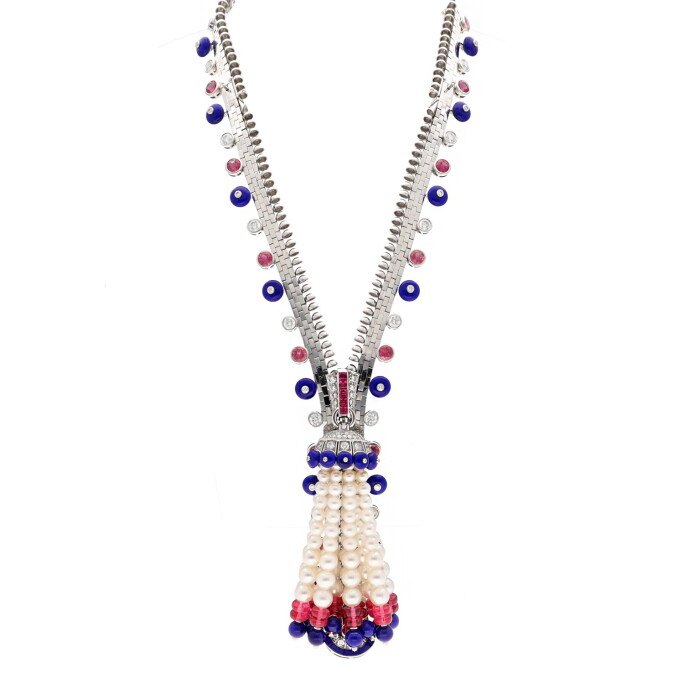
Its construction is central to the design. The articulated necklace functions much like its utilitarian counterpart, with a working slider that allows certain versions to be closed and worn as a bracelet. Van Cleef & Arpels has continued to reinterpret the concept through different materials and gemstone combinations. A White Gold, Tourmaline, Lapis Lazuli, Cultured Pearl and Diamond Zip Couture Necklace offered through Sotheby’s provides a contemporary example of how far the original idea can be pushed, using contrasting materials and color while retaining the mechanical structure that defines the Zip.
Introduced in 1934 and named after Louis Arpels, the Ludo bracelet reflects Van Cleef & Arpels’ experiments with flexible jewelry during the Art Deco period. Its closely articulated links create a supple, fabric-like surface that wraps around the wrist, typically fastening with a prominent buckle. Different versions have incorporated diamonds and colored gemstones, while the underlying construction remains central to the design.
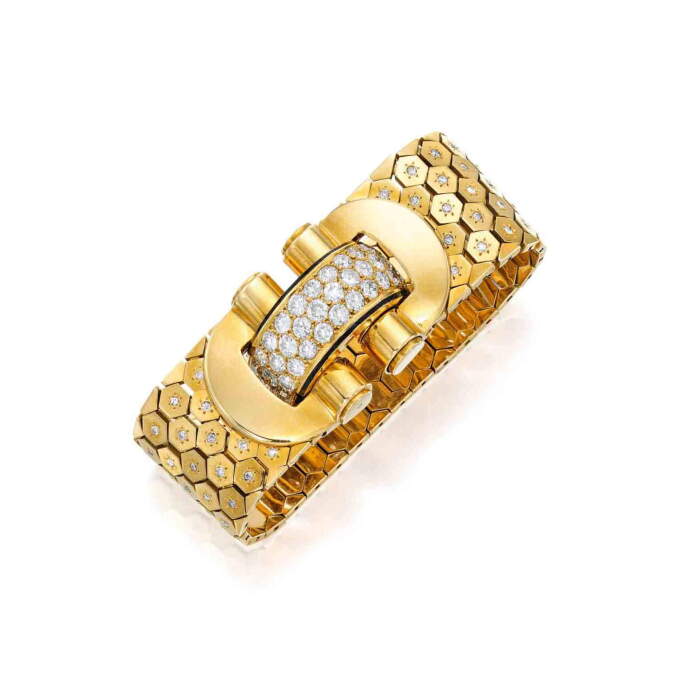
Vintage examples reveal how varied the Ludo could become. A Van Cleef & Arpels Gold, Diamond and Enamel ‘Ludo Hexagone’ Bracelet sold for $95,000 USD in April 2021. Its hexagonal gold links are accented with black enamel and diamonds, demonstrating how changes in surface treatment and materials could give the familiar Ludo structure a distinctly different character.
Transformability extends well beyond the Zip in Van Cleef & Arpels high jewelry. Necklaces may incorporate detachable elements that become brooches, while other jewels can be reconfigured to change their scale or function. These mechanisms allow a single creation to take on different forms, but they also demand careful engineering: clasps and removable components must work reliably without disrupting the composition of the jewel.
A Van Cleef & Arpels Diamond Necklace/Brooch Combination sold for 1.1M CHF in May 2025. Designed as a stylized wreath of marquise-shaped and brilliant-cut diamonds, the necklace incorporates a detachable tassel set with pear-shaped diamonds that can be worn separately as a brooch. The transformation is integrated into the design rather than treated as an accessory, illustrating how versatility can become part of the architecture of a high jewelry piece.
Not every important Van Cleef & Arpels jewel belongs to a named collection. Diamond high jewelry has provided another arena for the Maison’s approach to movement and construction, particularly in necklaces and earrings where individual stones are arranged to create fluid compositions. In these pieces, the relationship between the diamonds can be just as important as the size of any single stone.
A pair of Van Cleef & Arpels Diamond Pendent Ear Clips sold for 737K CHF at Sotheby’s Geneva in May 2025. Tiered clusters of marquise-shaped diamonds suspend detachable pear-shaped diamonds weighing 8.31 and 8.12 carats. Rather than relying on a decorative motif, the design uses the graduated arrangement of the diamonds and articulated drops to create movement. The detachable pendants also introduce an element of versatility, connecting the earrings to the Maison’s broader history of jewelry designed to be worn in more than one configuration.
The strongest Van Cleef & Arpels high jewelry often reveals as much through its construction as through its gemstones. A Mystery Set jewel can be assessed for the precision and continuity of its gemstone surface, while a transformable piece depends on mechanisms that function smoothly without compromising the design. With vintage creations such as Ludo bracelets, condition becomes especially relevant because alterations or repairs may affect the original structure.
Signed pieces associated with significant periods or techniques can attract particular attention on the secondary market, but a recognizable design name does not determine importance on its own. Quality of execution and condition remain central, as does the strength of the individual composition. Looking closely at how a jewel was made often reveals more about its significance than simply identifying the collection to which it belongs.
Look closely at the continuity of the gemstone surface and the precision of the setting. Because the stones are individually cut to fit concealed rails, the quality of execution is fundamental to the effect. Condition is also important, particularly with vintage examples that may have undergone repairs or alterations.
Not automatically. Period and rarity can contribute to value, but vintage status alone does not make one jewel more important than another. Design, condition and quality of execution all influence how a piece is evaluated on the secondary market.
Transformability requires a jewel to function successfully in more than one configuration without sacrificing its design. Van Cleef & Arpels has explored this idea through creations ranging from the Zip necklace-bracelet to necklaces with detachable brooches or pendants.
Condition can be particularly significant when a jewel relies on articulated links or concealed mechanisms. Repairs, replacement components and alterations may affect both how the piece functions and how closely it reflects its original construction.
No. A signature establishes an important connection to the Maison, but value depends on the individual jewel. Its design and condition should be considered alongside rarity, period and the quality of its gemstones and craftsmanship.
Whether you're a seasoned collector or new to luxury jewelry, Sotheby’s offers a trusted, seamless way to buy and sell Van Cleef & Arpels pieces on the secondary market.
Trust our worldwide network of leading jewelry specialists from a globally renowned auction house established in 1744.