A Hippo-Shaped Bar, Sprouting Ceramics and Legendary Tiffany Lamps: Highlights From Important Design

A Hippo-Shaped Bar, Sprouting Ceramics and Legendary Tiffany Lamps: Highlights From Important Design

This year's Design Week auction features pieces from Anne Schlumberger's extraordinary collection of Les Lalanne and Giacometti and Tiffany Studios's stunning glass designs.
Chapters
This year's Design Week auction features pieces from Anne Schlumberger's extraordinary collection of Les Lalanne and Giacometti and Tiffany Studios's stunning glass designs.

On view at Sotheby’s New York from December 5-9, the ”Important Design” sale centers around the Schlumberger Collection which features François-Xavier Lalanne’s handmade Hippopotame Bar, pièce unique. Commissioned by the philanthropist and art patron Anne Schlumberger in 1976, this work is the only version that the artist hand-crafted in copper. Collecting the work of Les Lalanne was a true multi-generational passion for the Schlumberger family. The group of works offered here also includes works by Alberto and Diego Giacometti, and André Dubreuil.

Another highlight of the” Important Design” sale is a group of works celebrating the 100th anniversary of the 1925 Paris International Exhibition of Modern Decorative and Industrial Arts, which introduced the newest trends in modern design and cemented Art Deco as a global movement. The sale features a remarkable selection of pieces by Émile-Jacques Ruhlmann, Sue et Mare, Jean Dunand, and Eugène Printz.

Important Design, Featuring Works from the Schlumberger Collection

On December 10, Important Design features a landmark assemblage of design spanning the last century – from the finest examples of Art Deco to defining achievements in Post-War and Contemporary Design.

Émile-Jacques Ruhlmann’s ‘Gonse’ Armchairs

These Gonse armchairs, circa 1930, are among the rarest works by Émile-Jacques Ruhlmann to appear on the market today. Their design can be traced to a 1915 sketchbook study from a period in which Ruhlmann developed many of his foundational concepts—few of which were ever realized. To date, only three Gonse chairs have surfaced at auction.

Defined by their clean, economical lines, these armchairs mark a pivotal moment in Ruhlmann’s evolution, signaling a departure from the lingering Art Nouveau influences of the early 20th century. While his earlier work featured a Louis XVI–inspired tapered square leg, between 1916 and 1923 Ruhlmann introduced angled supports. This innovation, known as the fuseau leg, positions the feet slightly outward rather than directly beneath the seat or tabletop. The Gonse model stands as one of the most striking examples: its arms sweep gracefully downward to form the rear legs, which rest on an elegant ogee base. Though Ruhlmann is often regarded as a traditionalist, these chairs embody a compelling balance between streamlined modernity and classic Art Deco refinement.

Diego Giacometti’s ‘Grecque’ Low Table

Diego Giacometti is best known for creating furniture with unique sculptural forms. As with many of Giacometti’s pieces, the ‘Grecque’ low table started as a plaster model, carefully refining proportions before being cast in bronze. His work’s timelessness has attracted collectors such as Hubert de Givenchy, Adrien Maeght and Jean Cocteau.

Paul Evans’ ‘Sculpture Front’ Sideboard

This wall-mounted cabinet is part of Paul Evans’ renowned “Sculpture Front” series, which took shape in the early 1960s. Its surface features an arrangement of hammered, welded, and textured geometric panels, enhanced with brass accents, pigments, and 24-karat gold leaf. A leading figure in the American studio craft movement, Evans opposed mass-produced uniformity and focused on functional objects. This cabinet, which was handmade in his New Hope, Pennsylvania studio, shows his vision of combining personalized sculpture with utility.

Selection of Ceramics by Axel Salto from the Collection of Joel Shapiro

Although Axel Salto, born in Copenhagen in 1889, found inspiration in natural forms, he translated them through a modernist Art Deco perspective. Having studied at the Royal Danish Academy of Fine Arts between 1909 and 1914, his early work references classical mythology and iconography. Later in his career, Salto favored organic and sculptural shapes over strict functionalism, using high-relief patterns to experiment with glaze. In his 1949 book Den Spirende Stil, he described ceramics as living forms, writing that vases “bud,” “develop,” and sprout,” and that the firing process transformed his shapes into abstractions. This philosophy is especially evident in his Budding works, where carved protrusions guide the flow of glaze which enables the clay to re-emerge dramatically once it’s been fired in the kiln.

Selection of Works by Mattia Bonetti from the Collection of Paul Kasmin

Mattia Bonetti, born in Lugano, Switzerland, co-founded the neo-Baroque, historically-inspired style “Barbarian design.” Bonetti remains a true pioneer of contemporary avant-garde design, using materials ranging from bronze, gilding, and acrylic to marble, wood, glass, and gemstones. For example, the “Liquid Gold” Cabinet is made of cast aluminum, with details in gold‑plated bronze that resemble molten lava. The piece combines Bonetti’s dramatic style with careful craftsmanship. Highly imaginative and technically innovative, he has maintained consistency by working with the same ateliers and craftsmen throughout his career.

George Nakashima's "Minguren II" Low Table

The "Minguren II" Low Table is a beautiful example of George Nakashima’s signature “free-edge” designs, with their quasi-fractal, quintessentially organic shapes. His works combine natural contours with exceptional craftsmanship, and bring together Japanese sensibilities with American design.

Dreaming in Glass: Masterworks by Tiffany Studios, featuring works from The Schur Family Collection

On December 11, an auction of Tiffany Glass will be led by one of Louis Comfort Tiffany’s greatest triumphs – the magnificent and iconic ‘Magnolia’ floor lamp.

On December 11, an extraordinary auction of Tiffany Glass will be led by one of Louis Comfort Tiffany’s greatest triumphs – the magnificent and iconic "Magnolia" Floor Lamp.

The sale illustrates the range of artistic mediums that shaped Louis Comfort Tiffany’s legacy. The auction includes Tiffany’s renowned lamps, with lush floral motifs and bold, geometric forms, as well as elegant Favrile glass vases and a wide array of “Fancy Goods.”

Tiffany Studios’ ‘Alpha and Omega’ – The Thomas Memorial ‘Medallion’ Window

Louis Comfort Tiffany was an avid consumer of art and culture, and therefore spent much of his time in France. There, he encountered the Chartres Cathedral. Its stained glass, famous for vivid colors and medallion-style panels showing biblical scenes, became a direct inspiration for his work, including the Jonathan Thomas Memorial “Medallion” window at First Presbyterian Church in Topeka.

Commissioned in 1910 by Mrs. Josephine Thomas to honor her husband, the window was completed under Tiffany’s supervision in 1911. Rather than depicting biblical scenes, the window incorporates symbolic references to Christ and emphasizes brilliant, gem-like colors, from deep sapphire and indigo to vibrant reds, greens, and yellows. The design is adorned with hand-chiseled Favrile glass “jewels.” Tiffany Studios only occasionally enhanced their windows with such bits and the ones in the Thomas Memorial are perhaps the boldest and most spectacular ever produced by the glasshouse. Resembling rubies, emeralds, topazes, amethysts and sapphires, some are as long as three inches. All were hand-wrought and faceted, an exceptionally time-consuming task, which greatly enhances and amplifies their sparkling brilliance.

Tiffany Studios’ ‘Magnolia’ Floor Lamp

The Magnolia floor lamp is widely revered as one of Tiffany Studios’ most spectacular designs. It is exceedingly rare, and it has been at least two decades since this model has appeared on the market.

First introduced around 1910 and designed by Agnes Northrop, the 28-inch shade was the largest and second-most expensive in Tiffany Studios’ 1913 price guide. The present lamp, replete with a multitude of large magnolias, depicts the flower in a variety of stages, from plum and emerald buds, to white-streaked green and red-tinged turquoise blossoms about to unfurl, to fully opened flowers in shades of pink and opalescent white with unusual brown and crimson centers. These flowers are extraordinary, many of them being composed with rippled and drapery glass that gives the design a three-dimensionality and sense of motion infrequently seen in Tiffany’s other shades. The blossoms, as well as the numerous curvaceous chestnut branches, are placed against a rich mottled blue and sapphire background that is equally incredible. Even the patinated bronze base has detailed elegance, with a “Chased Pod” design with a pigtail finial and subtle floral motifs.

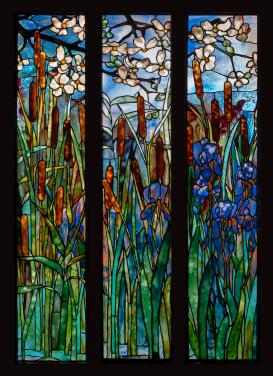
Tiffany Studios’ ‘Iris, Cattail and Dogwood’ Triptych

The ‘Iris, Cattail and Dogwood’ Triptych captures Louis Tiffany’s belief that all true art comes from nature. The work bears the unmistakable flourishes of Northrop, his longtime collaborator, who was responsible for much of the company’s landscape and floral designs. A smaller and simpler panel of cattails and irises from 1899 probably served as a model for Northrop to create this complex composition. The unique and exceptional triptych offered here, created for a private commission, brilliant in design and execution, epitomizes Tiffany’s love of the flower as well as his belief that all true art is derived from nature.

The three-panel design shows mottled blue irises, some with amber and red petals, which seem to rustle gently along a pond’s edge. A horizontal dogwood branch with yellow-centered, pink-tinged flowers above contrasts the vertical plants below, guiding the viewer’s eye across the panels. The flowers are surrounded by green foliage and slender streaked stems. An aquatic plant, cattails are often associated with peacefulness and prosperity and their inclusion adds to the vivid portrayal of a gentle spring day. Most likely designed as a “transparency” hung before an existing window, the triptych combines Tiffany’s exquisite vision with Northrop’s timeless skill.

Tiffany Studios’ ‘Poppy’ Table Lamp

Poppies have long captivated artists. Symbolizing peace and tranquility, Louis Tiffany admired the flower's beauty and cultivated beds of poppies at The Briars, his first Long Island estate. The shade offered here is especially remarkable, showing the skill of the glass selector. Mottled yellow and apricot blossoms are depicted from angled buds to fully opened flowers, while sitting above flowing green foliage. The flowers are set against a vibrant backdrop of violet, blue, teal, crimson, and amber-streaked glass. The patinated bronze base is comprised of a gently tiered circular foot holding a reticulated column of opaque green glass, echoing the shade’s colorful foliage.

Tiffany Studios’ ‘Poinsettia’ Chandelier

Poinsettias, which bloom between October and January, stand out with their vibrant red bracts (often confused for petals), star-shaped leaves, and deep green foliage. Louis Tiffany noted the flowers' increased popularity in the early 20th century and created several models of lamp shades. The ‘Poinsettia Chandelier’ seen here is the largest version model ever produced by the Tiffany Studios. The shade is covered in flowers of ruby, crimson, and scarlet tones, which are shown at various stages of bloom. Small central cyathias in amber and yellow provide striking contrast to red, while the background shifts from amber-yellow to green streaked with yellow to red-tinged blue, evoking the passage of light across a day. This shade stands as an remarkable example of Tiffany’s mastery.

20th Century Design Design Week

About the Author

More from Sotheby's

Stay informed with Sotheby’s top stories, videos, events & news.

Receive the best from Sotheby’s delivered to your inbox.

By subscribing you are agreeing to Sotheby’s Privacy Policy. You can unsubscribe from Sotheby’s emails at any time by clicking the “Manage your Subscriptions” link in any of your emails.

arrow Created with Sketch. Back To Top