Property from the Collection of Kenneth Rubin
Iris, Cattail and Dogwood Triptych Window
Live auction begins on:
December 11, 03:00 PM GMT
Estimate
400,000 - 600,000 USD
Bid
280,000 USD
Lot Details
Description
Property from the Collection of Kenneth Rubin
Tiffany Studios
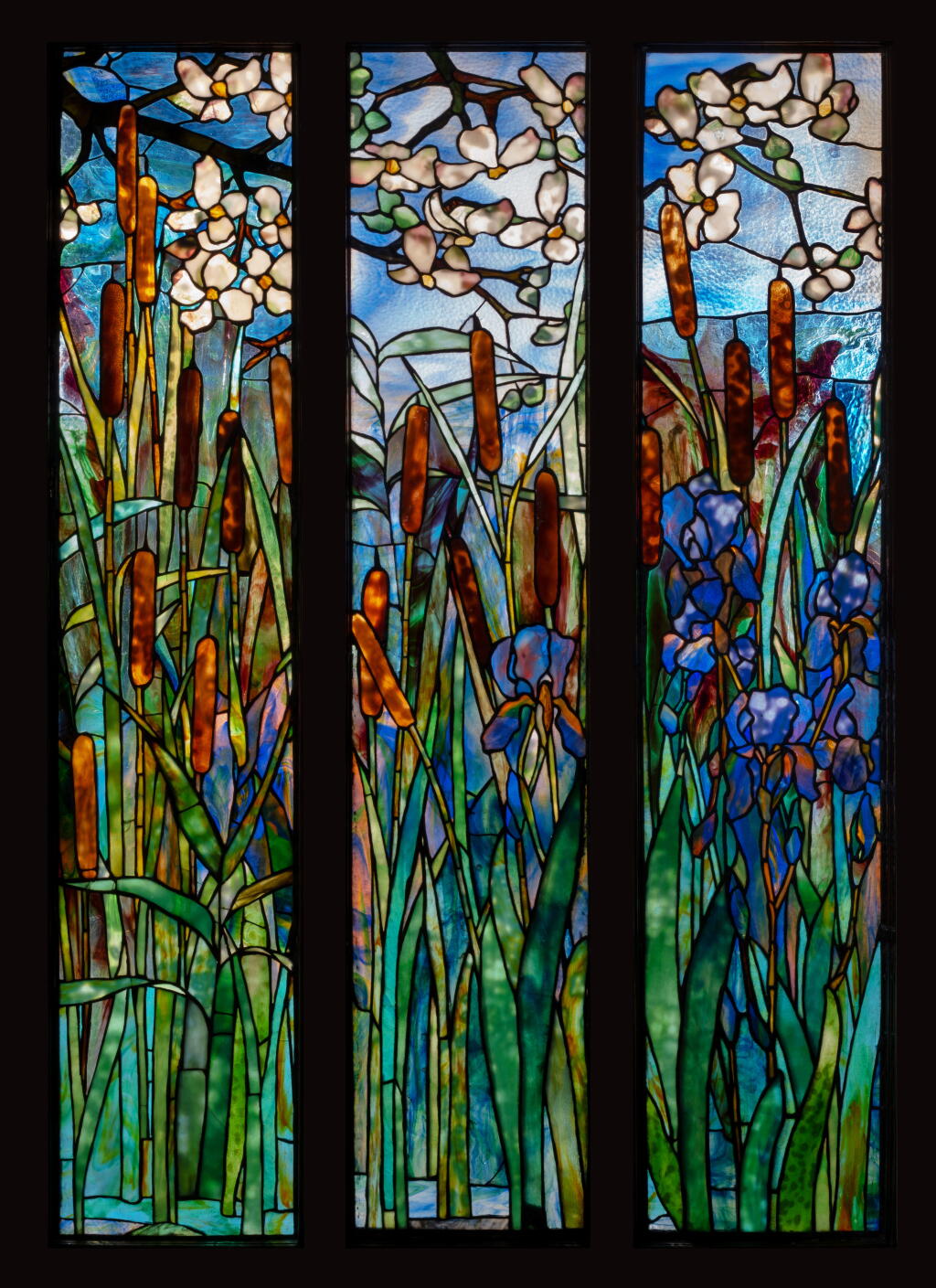
Iris, Cattail and Dogwood Triptych Window
circa 1906
design attributed to Agnes Northrop
Favrile glass, lead came, copper foil, with the original oak frames
53 ⅝ x 41 ⅝ x 1 ⅜ in., (136.2 x 105.7 x 3.5 cm), framed
Private Collection, New York
Acquired from the above by the present owner, circa 1970s
Louis Comfort Tiffany had an abiding love for irises and planted large clusters of numerous blue and purple varieties at his two Long Island mansions, first at The Briars and later at his Laurelton Hall estate. Tiffany featured them in his first important design commission, a drop-curtain created for the Madison Square Theater in 1881, that included “a deep blue river…from which spring the blue-flowered iris and other reeds.” He later highlighted the flower in several of his paintings and the iris, symbolic of hope, was frequently incorporated into numerous works in a wide variety of mediums that spanned Tiffany’s entire artistic career.
Not surprisingly, many of his firm’s leaded glass windows made for ecclesiastical commissions as well as mausoleums included swaths of irises. Tiffany even featured the plant in his famous The Bathers window, what many consider to be his greatest accomplishment in stained glass. The unique and exceptional triptych offered here, created for a private commission, brilliant in design and execution, epitomizes Tiffany’s love of the flower as well as his belief that all true art is derived from nature.
Although inspired by Tiffany, this set of windows beautifully exhibits the unmistakable hand of Agnes Northrop, his long-time employee who was largely responsible for the company’s landscape and floral compositions. A small, relatively simple panel featuring cattails and irises created in 1899 and credited to Louis Tiffany was likely Northrop’s inspiration for this larger and considerably more complex work.
The triptych displays a far greater conceptual intricacy and sophistication than Tiffany’s earlier effort created approximately 10 years previously. The mottled blue irises, with several of the petals tinged with amber-orange and red, are depicted at the edge of a pond from a variety of perspectives as if they were being rustled by a soft breeze. These flowers, with their additional variegated green foliage, are finely intermingled with mottled brown and chestnut cattails on slightly bending slender brown-streaked green stems. An aquatic plant, cattails are often associated with peacefulness and prosperity and their inclusion adds to the vivid portrayal of a gentle spring day. An upper horizontal branch of dogwood, replete with yellow-centered, green- and pink-blushed flowers set against a bright blue sky, completes the idyllic scene. The flowering branch is a distinct counterpoint to the verticality of the lower foliage as well as enticing the viewer’s focus to glide along each of the three panels.
An interesting aspect of the design is the uncanny resemblance that the irises in the window bear to the same flowers Tiffany Studios used in their exceedingly rare “Iris” lanterns that were made at about the same time. The glass selection is remarkably similar: the irises in both are situated among tapered angular green leafage and composed of mottled glass in various shades of blue. Furthermore, none of the irises in either object are repeated, each flower being presented from an entirely different viewpoint. Finally, both the leaded glass panels and the lanterns were formed using the copper-foil technique, a very unexpected similarity.
The aforementioned 1899 leaded glass window Tiffany designed was marketed as a “transparency,” intended to be hung in front of an existing window and requiring no special installation. The intimate scale of the triptych offered here seemingly indicates it was created with a similar intent. This helps to makes the suite highly desirable for today’s collectors, as does the fact that it was produced for a domestic commission. Above all, however, is their consummate artistry. Louis Tiffany said in 1913 that: “Art is a means of expression of infinitely delicate feelings.” With the inimitable assistance of the gifted Agnes Northrop, this triptych perfectly and exquisitely brings to life his artistic philosophy and mission.
– PAUL DOROS
You May Also Like