
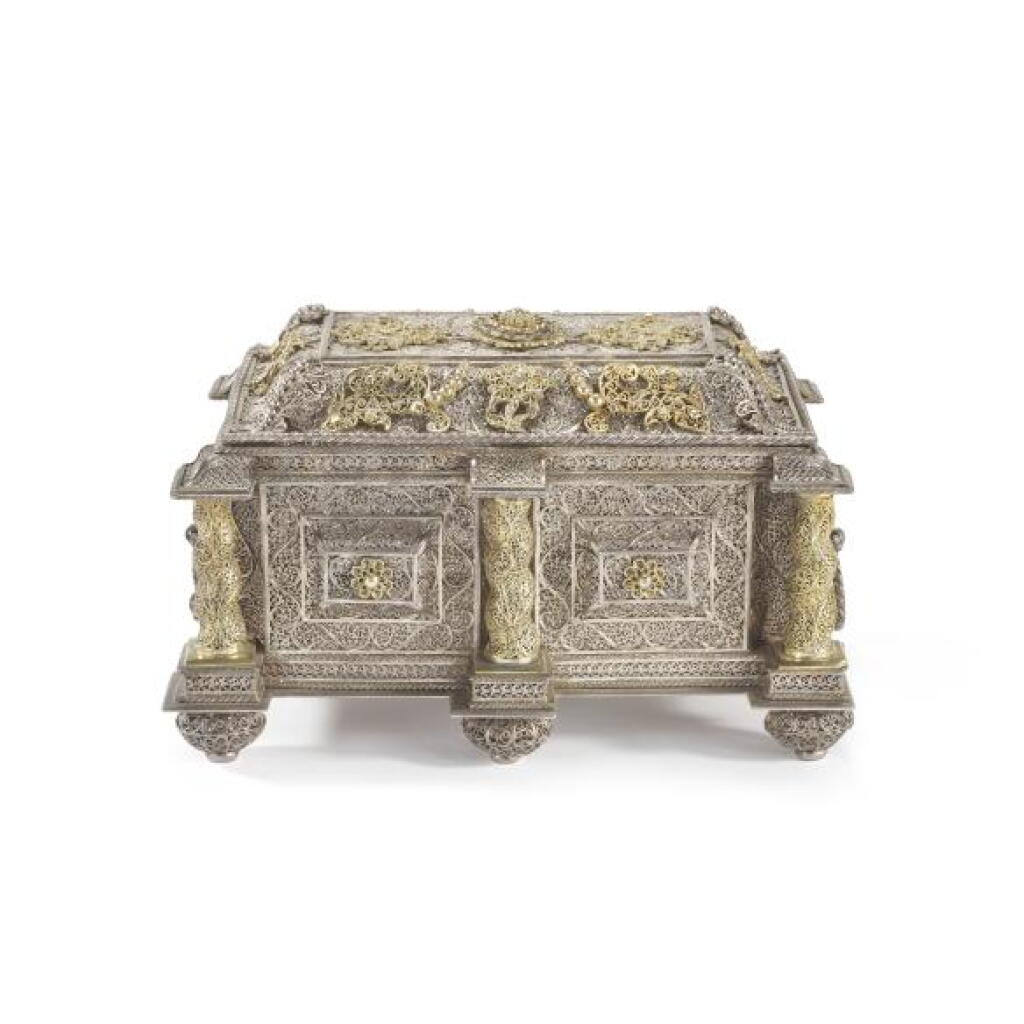
An Indian filigree parcel-gilt casket, Goa, circa 1650
This lot has been withdrawn
Lot Details
Description
the structure incorporating Solomonic columns, with a hinged cover
Height. 3 ¾ in, width. 6 ¼ in, depth. 4 ¼ in ; Haut. 9,5 cm, larg. 16 cm, prof. 11 cm
Kunstkammer Georg Laue, Germany.
Munich, Bayerisches Nationalmuseum, “Die Wittelsbacher und das Reich der Mitte. 400 jahre China und Bayern”, 26 March-26 June 2009.
Eikelmann, R. (ed.): Die Wittelsbacher und das Reich der Mitte. 400 China und Bayern, exhibition in the Bayerisches Nationalmuseum in Munich, Munich, 2009, pp.78-79, cat. n.33.
Seipel, W. (ed.): Exotica, catalogue d’exposition, Kunsthistorisches Museum Wien, Vienna, 2000, cat. n. 106, p.193.
Schutte, R.-A.: Die Silberkammer der Landgrafen von Hessen-Kassel, Cassel, 2003, p.364f., cat. n. 81.
L. Humphries, Silver. Wonder from the East. Filigree of the Tsars, Amsterdam, 2006.
A link between India and Italy
Our casket, with its fine silver and gold filigree, can be attributed to the work of the Goa area in India, a city renowned for its silverwork in this very special technique. Few Goa caskets have survived, but two of similar dimensions and decoration are comparable, decorated with six columns and a domed cover with the same handles. The first box is preserved in Cassel and is thought to have come from the cabinet of curiosities of the Landgraves of Hesse in Cassel. It is listed in the inventories of 1780 as ‘très beau coffres en ouvrage de filagraine orné de six-petites-colonnes torses...’ and again in an inventory of 1827 - unfortunately its location in the castle and its origin are not indicated.
The second is preserved in the collections of the Kunsthistorisches museum in Vienna and is known from the inventories of the imperial treasury of 1731 and 1750: ‘Ein goldenes schreibzeügl von filigran. Umb und umb garnit mit diamanten (...) obenauffünf perlen (...)’.
If the technique is Indian, the form is not. It copies Venetian silver-mounted rock crystal pieces. For example a silver-gilt mounted rock crystal, lacquered wood and casket made in Venice around 1600, now in the Museu National de Artes Antiguas in Lisbon, uses the same shape, with columns and compartments. It was then offered by the King of Ormuz to Dom Fei Aleixo de Menezes, Archbishop and Governor of Goa. It returned to Lisbon in 1610, where it was donated to the Augustinian convent of Graça. Another silver-gilt mounted rock crystal casket with similar decoration is in a private collection.
The shape of the twisted columns is also reminiscent of the Temple of Solomon and could indicate a religious function for this type of box.
Indian silversmiths thus achieved the perfect synthesis between a refined technique and a form that would appeal to enlightened European collectors and enthusiasts.
Filigree, a decoration favored by European courts
The filigree technique has been known in Europe since the Middle Ages. It involves pulling a silver thread from an ingot, first using a swing and then, during the Renaissance, a goldsmith's bench. The Musée d'Ecouen now houses one of the last known examples. Dating from 1565, this machine mechanically stretched metal wires using a die, a plate perforated with decreasing holes to obtain the desired diameter. Once the coil of silver wire was ready, the goldsmith could create objects of various sizes, from a small reliquary plate to a table or chair.
The filigree fashion developed in the Germanic countries and in Spain thanks to the Habsburgs, then flooded the whole of Europe from the 1620s to the 1630s, and Anne of Austria arrived in France with silver filigree furniture that greatly pleased her son Louis XIV, who drew inspiration from it to create the silver furniture for the Château de Versailles. Unfortunately, few large pieces have come down to us, but we can mention a table, a mirror and a pair of pedestal tables decorated with silver filigree on a wooden core, Paris, 1669, preserved at Resenborg Castle in Copenhagen. These pieces are privileged witnesses to an art that gradually went out of fashion, to be replaced by more massive objects with more material to dazzle the distinguished guests at the courts of Europe.
You May Also Like


