
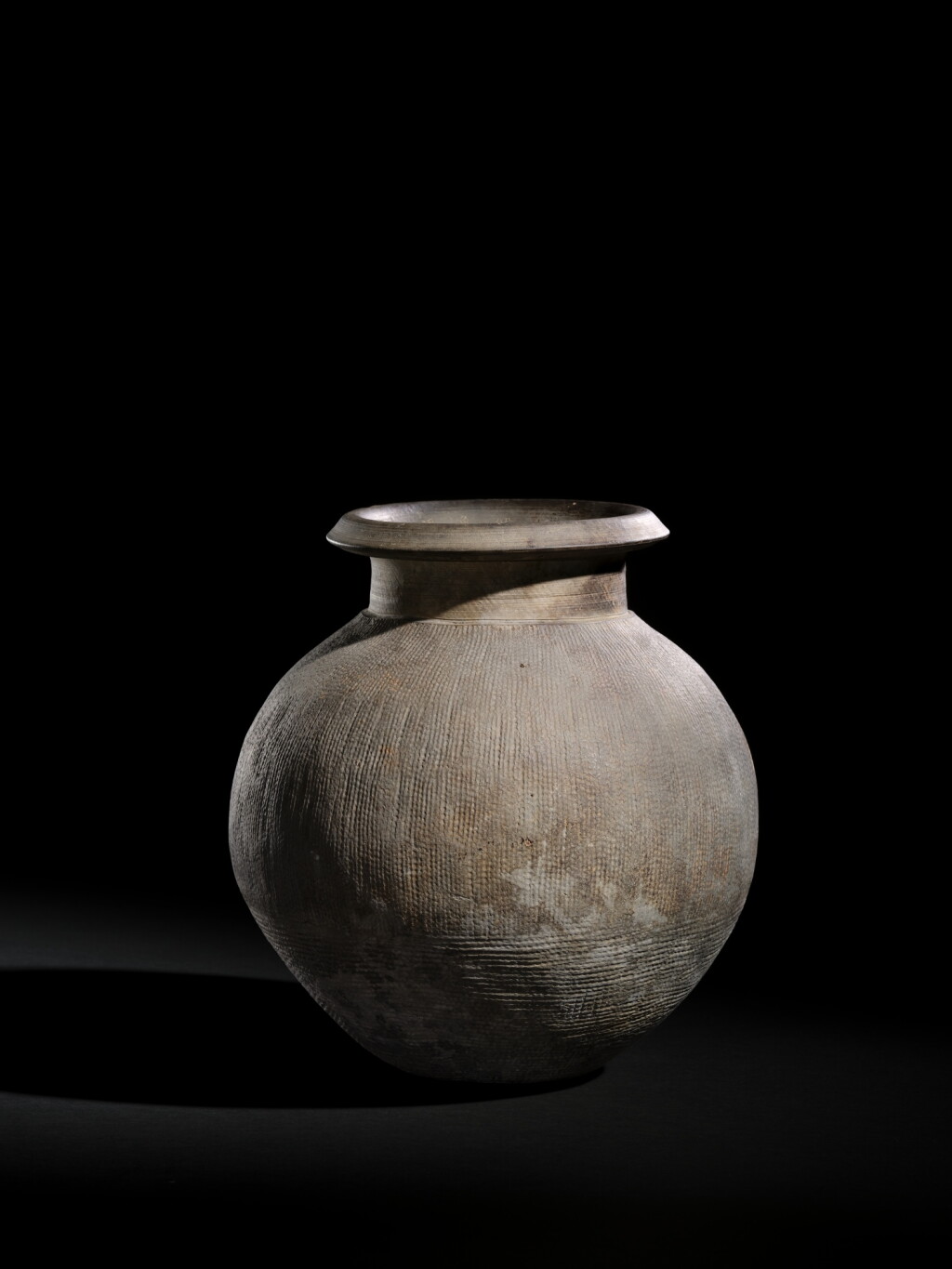
The Sir Percival David pottery jar, Zhou dynasty; imperially inscribed with Qianlong’s poem Yong Tao Zun (“Ode to a Pottery Zun”), very likely composed for this vessel and dated to the summer of the jichou year (1769) | 周 印紋灰陶尊 刻清高宗御製詩〈詠陶尊〉 《乾隆己丑夏御題》款 「德充符」印
Premium Lot
Estimate
6,000,000 - 12,000,000 HKD
Premium Lot
Lot Details
Description
26 cm
題刻清高宗乾隆帝御製詩〈詠陶尊〉:
陶土得成尊,何殊鑿地存。
豆籩古曾廁,耕稼此同原。
抔飲睪然望,象施且漫論。
祖丁將父乙,直可視兒孫。
乾隆己丑夏御題
「德充符」印
Collection of Sir Percival and Lady David.
Sotheby’s London, 5th December 1961, lot 25.
Bluett & Sons, London.
A European private collection.
Sotheby’s London, 7th November 2012, lot 211.
R.L. Hobson, A Catalogue of Chinese Pottery and Porcelain in the Collection of Sir Percival David, London, 1936, p. 181.
Nicolas Chow, The Literati Aesthetic, Hong Kong, 2018, no. 23 and cover.
來源
大維德爵士伉儷收藏
倫敦蘇富比1961年12月5日,編號25
Bluett & Sons,倫敦
歐洲私人收藏
倫敦蘇富比2012年11月7日,編號211
出版
R.L. Hobson,《A Catalogue of Chinese Pottery and Porcelain in the Collection of Sir Percival David》,倫敦,1936年,頁181
仇國仕,《無盡意》,香港,2018年,編號69及封面
A vestige of antiquity reborn through the admiration of an emperor, the present jar is a remarkable survivor. Tracing almost three thousand years of Chinese history in its rich patina, rope-twist surface, and voluptuous form, the jar stands as a testament to the enduring beauty of Chinese ceramics and the power of connoisseurship.
At first glance, the present jar appears understated. Fairly well attested in Zhou dynasty (c. 1046–771 BCE) contexts, used in everyday life and in burial, jars of this form are classic examples of the elegant yet fairly simplistic hand-coiled forms of early dynastic China. On closer inspection, however, one’s perceptions are transformed. Surrounding the interior rim, skillfully carved in a playful yet deliberate hand of kaishu calligraphy, the jar bears a 47-character inscription, which could be translated as follows:
This zun was formed from clay and earth,
No different from a hole cut in the ground.
In ancient times it was flanked by wood and bamboo vessels,
It shares its origins with agriculture itself.
Taking a drink from it, I gaze in contemplation,
But there is no need to expound endlessly on symbolism.
The Zu Ding and Fu Yi vessels,
It’s clear to see are this one’s descendants.
Composed by the Emperor in the jichou year of the Qianlong reign
Followed by a seal reading de chong fu (“The Seal of Complete Virtue”)
This elegant poem, entitled Yong tao zun (Ode to a Pottery Zun Wine Vessel), was composed by Qing Gaozong, the Qianlong Emperor (r. 1736–1795) himself, recorded in the third ji of his Yuzhi shiji [Imperial poetry compendium], juan 79. Pondering the elegant form before him and the antiquity of its patina as he pours himself a drink, the Emperor turns to the antique as a source of inspiration, a piece of history alive in his hands.
Throughout his illustrious sixty-year reign and well into his retirement, the Qianlong Emperor turned to the archaic objects in his vast collection as wells of inspiration from which to draw. Composing around a thousand poems on the subject of ceramics, porcelain, jade and other treasures presented to him as tribute or inherited from his predecessors, the Emperor frequently commissioned his jade-carvers to break from their typical projects and carve his compositions directly into the antiquities that inspired him. Far from an act of vandalism, this application of one layer of imperial meaning atop the preexisting beauty of the antique produced objects far greater than the sum of their parts — unique antiques reborn through the imperial gaze.
The present jar appears to be unique in its form and inscription, with no other comparable jars apparently published from the imperial collection. Indeed, while similar imperially inscribed wares are fairly well attested in the collections of the Beijing Palace Museum and the Taipei Palace Museum, the vast majority of these are ceramic pieces from the Song dynasty, which represent more than one hundred and fifty of the hundred and ninety poems on antiques recorded in the Yuzhu shiji; see Feng Xianming, Annotated Collection of Historical Documents on Ancient Chinese Ceramics, Taipei, 2000, p. 271ff. Two further Han pottery jars of more conventional baluster form are similarly attested in the Taipei Palace Museum (accession nos guci-2638 and guci-2645) bearing lengthy Qianlong poems dated to jimao and dingsi years respectively and illustrated on the Museum’s website; the latter – now broken into shards and possibly of later date – is inscribed like the present around the interior rim. Also compare a pottery vase of garlic-mouth form with a Qianlong poem, apparently never illustrated, sold alongside the present jar in 1961, lot 26.
The illustrious provenance of this jar extends beyond the walls of the Palace and into the twentieth century. By 1936, this magnificent blending of antiquity and imperial grandeur had arrived in the famed collection of Sir Percival and Lady David. Acquiring from sources directly in contact with the imperial collections and the leading British collectors of his day, primarily between 1914 and 1950, Percival David assembled an extraordinary collection of Chinese ceramics, which remains unquestionably one of the most important ever formed outside of the Palace. While the vast majority of the David Collection was preserved in the Percival David Foundation of Chinese Art, gifted in its entirely to the British Museum, London in 2024, a few scattered pieces were sold by Sir Percival, the Foundation and (after his passing) Lady David in the 1960s and 1970s, including the present jar as part of a group of fifteen lots sold in our London rooms, 5th December 1961.
As much a scholar as a collector, David appears to have developed a particular fascination with transhistorical pieces like the present and inscribed wares that ground ceramics in their historical contexts. For examples of David’s passion for the transtemporal, compare other holdings from the collection now preserved in the British Museum — most seemingly acquired directly from the imperial collection following the default of a collateralised loan — including twenty-three included in the illustrated Catalogue of Ru, Huan, Jun, Guangdong and Yixing Wares in the Percival David Foundation of Chinese Art, London, 1999, cat. nos 2, 3, 5, 8-10, 12-14, 16-19, 23, 64, 94, A28, A29, A32, A37, A42, A58 and A86.
本品承載上古遺風,後得帝王賞識而重獲新生,堪稱傳世珍品。全器包漿渾厚,罐身壓飾繩紋,器形飽滿豐潤,承載著近三千年之悠久歷史,不僅見證中國陶藝之美雋永無窮,更彰顯鑑賞品味之深遠影響。
初見本罐,或覺其樸實無華。此類陶罐於周代(約公元前1046–771年)考古遺存中屢見不鮮,既用諸日常生活,亦作喪葬明器,為中國早期王朝時代質樸雅致之泥條盤築陶器典例。然若仔細端詳,則覺別有乾坤。環繞罐口內緣,刻有楷書銘文四十七字,刀法精妙,字體靈動而不失法度,全文內容如下:
陶土得成尊 何殊鑿地存
豆籩古曾廁 耕稼此同原
抔飲睪然望 象施且漫論
祖丁將父乙 直可視兒孫
乾隆己丑夏御題
此首雅詩題為《詠陶尊》,乃清高宗乾隆皇帝(1736–1795年在位)親撰之御製詩,收錄於其《御製詩集》三集卷七十九。當乾隆皇帝把酒端視,凝望跟前優雅古器與古樸包漿時,遂以古物為靈感泉源,歷史長河之遺珍亦於其手中煥發勃勃生機。
在長達六十年輝煌之御宇生涯,乃至退位為太上皇期間,乾隆皇帝始終將其龐大收藏中之高古器物視作靈感泉源。他以宮廷所藏之陶器、瓷器、玉器,以及其他貢品或先帝遺珍為題,創作了近千首詩作;他更常命玉工暫緩日常雕琢營生,優先將御製詩直接鐫刻於激發其靈感之古物上。此舉絕非破壞之舉,反將宮廷意涵疊加於古物原有之美感上,賦予古物超越其本身之藝術價值,獨一無二之古董亦因帝王之品鑑而得以重生。
本罐形制與銘文之組合似為孤例,據文獻所載,清宮舊藏中並無其他可與本品媲美之陶罐。事實上,在北京故宮博物院及台北故宮博物院館藏中,帶有御題銘文之類近器物雖屢見不鮮,但其中絕大多數為兩宋陶瓷;《御製詩集》所載一百九十首詠古物詩中,題於宋代陶瓷之詩作即佔一百五十餘首(見馮先銘,《中國古陶瓷文獻集釋》,台北,2000年,頁271起)。參考台北故宮博物院藏兩件漢代陶罐(館藏編號:故瓷2638及故瓷2645),器形較為傳統,分別刻有乾隆皇帝作於己卯年及丁巳年之長篇御製詩,館方網頁載有其影像;後者現已破碎,年代或稍晚,其御題詩位置與本品相同,皆環繞罐口內緣。另可比較一陶蒜頭瓶,同樣題有乾隆御製詩,唯似未見圖版著錄,曾於1961年與本罐同場拍出,拍品編號26。
本罐來源顯赫,其傳承軌跡從清代宮牆延伸至二十世紀。至1936年,這件融和盎然古韻與帝王氣派之古陶瑰寶,已入藏著名的大維德爵士伉儷(Sir Percival and Lady David)雅蓄。大維德爵士主要於1914年至1950年間,積極透過直接接觸清宮舊藏及英國頂尖藏家之管道,蒐羅品質非凡之中國陶瓷精品,其珍藏無疑是宮廷以外舉足輕重之中國藝術收藏。雖然絕大部分大維德爵士藏品皆保存於大維德中國藝術基金會,並於2024年悉數捐贈予倫敦大英博物館,然於上世紀六十及七十年代,仍有少數精品經大維德爵士、大維德基金會(其身故後)及大維德爵士夫人之手釋出,本罐即為其中之一,為1961年12月5日倫敦蘇富比拍賣會上十五件拍品之一。
大維德爵士既是藏家,亦為學者,他對如本罐般跨越時空之器物情有獨鍾,亦特別迷戀能將陶瓷置於其歷史脈絡中之銘文器。欲了解大維德爵士對古器物跨越時空對話之熱愛,可參考現藏於大英博物館之其他基金會舊藏——其中大部分似為抵押貸款違約後,直接購自清宮舊藏之珍品——包括收錄於1999年倫敦出版《大維德基金會藏汝、官、鈞、廣鈞及宜興陶器圖錄》(Illustrated Catalogue of Ru, Guan, Jun, Guangdong and Yixing Wares in the Percival David Foundation of Chinese Art)中之二十三件藏品(圖錄編號2、3、5、8-10、12-14、16-19、23、64、94、A28、A29、A32、A37、A42、A58及A86)。
You May Also Like


