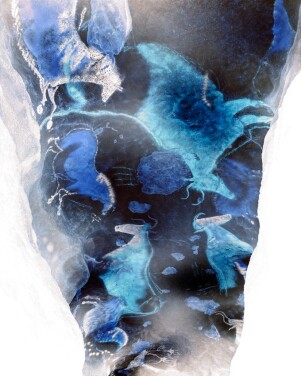
Selling Exhibition • 10 June–20 August 2026 • Hong Kong

D
omingo and I met ten years ago in London. From our first encounter, I was captivated by his epic landscapes of ancient sites, where architecture and civilization engage with nature. His work poses the age-old question of how man and landscape coexist, an inquiry that resonates ever so strongly today. Our meeting occurred just before Domingo embarked on a pilgrimage to the origins of art and humanity, culminating in the remarkable exhibition we present here. When I first saw his images of Paleolithic caves, they struck me with an intensity that transcended mere aesthetics; they opened a window into our collective past.
Since opening our Sotheby’s Hong Kong Maison, and our Grotto space on the ground floor, I have dreamed of showcasing Domingo’s work. I envisioned our space as an embodiment of nature, conceived as the interior of a rock that echoes the Chinese scholar’s rock, a metaphor for the Tao, while also alluding to the caves of early humankind, which serve as portals to the earliest images of man. When I encountered Domingo’s exploration of Paleolithic caves, a profound archaeology of self, I knew we would exhibit his work here. The resonance between our space and Domingo’s imagery is both powerful and transformative.
This exhibition invites us to reflect on the lasting impact of human expression. In 20,000 years, after the apocalypse, these works may still be all that remains of mankind, buried deep in the earth. They will tell stories of our hopes and fears, transcending time as a testament to our humanity. Even amid chaos, art serves as a vessel for meaning and beauty, reaching out to those who come after us.
Nicolas Chow
Chairman Asia
10 June–20 August 2026
Monday–Saturday | 11:00AM–7:00PM
Sunday & Public Holiday | 11:00AM–6:00PM
Sotheby's Maison, Hong Kong
G/F, Landmark Chater, 8 Connaught Road Central, Central


“Every child stands in front of a cave.”
— Aby Warburg
I n the summer of 2014 I went through a very deep emotional and creative crisis. I decided to shelter myself in a small flat alone on the shores of a forgotten village on the Ionian Sea, the very same place where I spent my childhood vacations. That summer I brought with me only two symbolic things, my large format camera, and an anniversary edition of the 1851 Moby Dick. In the hot mid-August, I could barely sleep more than two hours a night. The book, as if a talisman, stayed unopened on my night table during those stormy days. Same fate with my camera, I locked it in a closet as if in punishment. At that moment it was unimaginable to make a photograph whatsoever, ever again.
Photography had been my companion since I was 17 years old; it was the tool that allowed me to depart, travel the world, and go looking for my language, and for my adult self. I had fallen in love with the magic of the invention of Photography, the power to stop time, and the miraculous chance to travel through time.
What has happened today to this Magic? How does the digital world shelter the very same sacred gift of this invention?
I lost the present as an artist and as a person, and I had lost trust in a possible meaningful image of Time. This deep delusion, isolation, and pain allowed me to stop. Yes, I had lost the present, but for this exact reason, now I could walk away from the blinding lights of innovation, speed, and production. I could sit back on the ground of disillusion. On those suspended days and nights, I walked back to the mouth of a river, waiting for the flow to arrive from the mountain. There, where sweet water and salt water meet, gold minerals merge with silver lights. At these gates I would often encounter a dolphin or two, appearing and disappearing from the deep blue to a blinding sun. It is in this passage and silence that I could think to move again in Time.
Not the present, nor the past, still less the future. I found there was a Cave in me. The interior child I had forgotten was still there, standing at the entrance of the Cave. The treasure had been waiting.
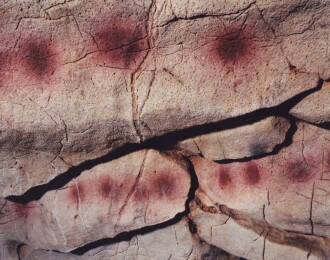
In March of 2016, only after a few months of intuitions and studies, the prodigious encounter with Roberto Ontañón Peredo and my old friend Benjamin Weil, brought us to the foot of El Castillo Mountain, where I entered for the first time the Cave of La Pasiega. I could not speak for hours after this experience; I called it “The washing machine of Time.” It is hard to describe a Cave that has been discovered, while remaining secret, sacred for more than 400 centuries. There I encountered a sense of death and survival, life beyond death, as if the creatures living there, as much as the human spirit had been killed to live again. All felt humid, confused, shaken, but pure. In the deep, spooky geologic labyrinth, after uncountable animals, signs, dots, rectangles, we stopped and turned off the lights. A tight passage seemed to be a blind alley. Not even the darkest of winter nights is as obscure as the bottom of a Cave. Why would they ever go so deep? Why that far? When Roberto turned the lights back on, after a timeless silence, he slowly showed me some enigmatic geometric shapes. A few rectangular ladder-like signs were rising on the side of a wall, upward into a space so narrow you could not even walk through. There, at the bottom of Time, where you could not go further, our ancestors shaped a liminal space between us and the other, the known and the unknown, the finite and the infinite.
After a few minutes of contemplation, before going away Roberto told me; “ From now on, Domingo, you have also been initiated into the Mystery of Caves”. Since then I have been Traveling Time, exploring with my Camera Obscura the dark chambers at the dawn of our imagination. Caves shelter the tale of origins and ending, somehow what I call Future Pasts.
Contrary to the digital present, that disappears every day into intangible clouds, these images in the earth have managed to stay after their extinction. Now I began to read Moby Dick for the first time, trying every day to listen to the song of the whale, the creature of the depths we have killed and killed again, and to whose mystery we are all connected…
Domingo Milella
Read Less


D
omingo Milella (Bari, 1981) studied photography at the School of Visual Arts in New York under the guidance of Stephen Shore. Thomas Struth was a key mentor. He currently lives between Bari and London.
His works have been exhibited at institutions such as the Biennale d'Arte, Rencontres d'Arles, Museo Nazionale Romano, Foam Museum, Tracy Williams Ltd and Fondazione Museo Pino Pascali, MAXXI and Marco in Rome. His works are part of numerous collections, such as the Museo Pecci in Prato, the Margulies Collection in Miami and Borusan Contemporary in Istanbul. His solo exhibitions include shows at Brancolini Grimaldi in London, Tracy Williams Ltd in New York and “Solitario” at Doppelgänger in Bari. In 2014 he published his first book with Steidl, “Domingo Milella”, and in 2015 he was among the curators of the exhibition Tempo al Tempo at the Roman Road Gallery in London.
Since 2015 Domingo has been researching Prehistory and the Origin of Art. The “Teatro del Tempo” at San Francesco della Scarpa in Lecce in 2021 dedicates the entire exhibition to the Deer Cave of Porto Badisco. He won the 2023 Bryan Robertson Trust Award at the Royal Academy of Arts in London. In the spring of 2024 he exhibits in Venice, at the Giancarlo Ligabue Foundation, his research on Prehistory during the Art Biennale. In 2025 in collaboration with the MiC Ministry of Culture and the Regione Puglia he has realized the second chapter of “Il Teatro del Tempo” a show in an abandoned Army Base in Italy dedicated entirely to a cycle of images from the most important Neolithic Cave of the Mediterranean.During the same year he shows his latest research named “Astrazione” in Rome at the Camilla Grimaldi Gallery.