

Private Sale
Domingo Milella
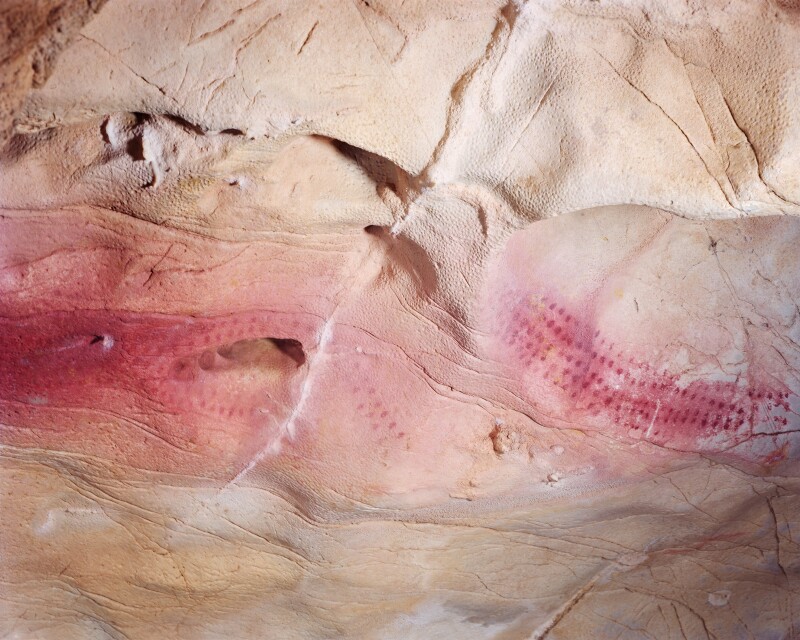
Chufin, Vulva, Spain 2016
Inkjet print mounted between Plexiglass and Dibond
Print 180 x 225 cm. 70 7/8 x 88 5/8 in.
Frame 186.5 x 231.5 cm. 73 3/8 x 91 1/8 in.
Edition 2 of 5 + 2 AP
Executed in 2016.
Price upon request
Taxes not included
VAT and other taxes are not reflected in the listed pricing. Read more
Details

Print 180 x 225 cm. 70 7/8 x 88 5/8 in.
Frame 186.5 x 231.5 cm. 73 3/8 x 91 1/8 in.
Edition 2 of 5 + 2 AP
Provenance
Directly from the artist studio
Exhibition
Sotheby's Maison, Hong Kong, Domingo Milella LIMINAL, 10 June – 20 August 2026
Early or Middle Upper Paleolithic (between 40,000 and 20,000 years ago)
The motifs consisting of rows of red dots applied using liquid or paste pigment with the fingertips—which characterize the parietal decoration of the Chufín Cave (Cantabria)—are magnificent examples of a “trend” that runs through Paleolithic cave art throughout its nearly 30,000-year history: that of constructing purely geometric patterns, with no apparent formal reference to the natural world. The group on the left side of the image surrounds a cavity in the ceiling, which some scholars identify as a vulvar representation—a motif present in various phases of the Paleolithic artistic cycle and constituting one of the few references to the human body in this prehistoric art.