
Property from an Important UK Private Collection
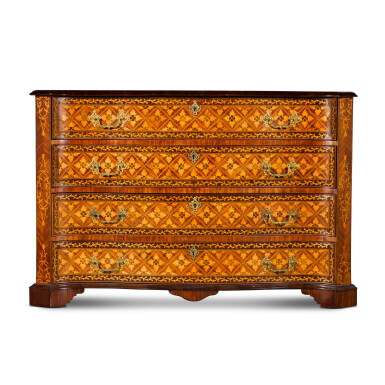
A Russian mounted stained sycamore, tulipwood, amaranth, marquetry and parquetry commode, circa 1780
Lot Closed
June 9, 02:39 PM GMT
Estimate
20,000 - 30,000 GBP
We may charge or debit your saved payment method subject to the terms set out in our Conditions of Business for Buyers.
Read more.Lot Details
Description
with a shaped top above four serpentine drawers with canted corners on bracket feet, the whole inlaid with trellis parquetry enclosing flower heads
86cm high, 129cm wide, 66cm deep;
33 ⅞ in., 50 ¾ in., 26in.
The eighteenth century marks the zenith of marquetry and parquetry work in Imperial Russia. The rapid building of St Petersburg brought woodworkers from Western Europe, creating a fruitful and symbiotic cultural exchange between local craftsmen and their European counterparts. However, traditional Russian craftsmanship remained distinct; unlike Western European marquetry furniture – where woods were cut with fine-tooth metal saws and copied across multiple pieces – Russian furniture of this period was almost always unique. Furthermore, Russian cabinetmakers could take advantage of the multitudes of indigenous woods in their designs, though this commode is veneered in part in imported amaranth.[1] Though later in the century there were guilds of furniture makers akin to those found in Europe, Russian furniture is very rarely stamped and attributing the work of a single maker is difficult. In the mid-eighteenth century, a nexus of furniture production was the region of Okhta near St Petersburg. Okhta shipbuilders would work as carpenters and the community became renowned for their technical acuity, eventually making pieces for Catherine the Great.[2]
This commode is an excellent example of Russian parquetry furniture, with flower heads encased within a delicate trellis, which is in turn is bordered by a scrolling vine tendrils. The flowers are particularly intricate, and it would have taken an immensely skilled artisan to repeat this form hundreds of times with only miniscule variation. Russian parquetry work was not limited just to furniture. In several of the newly built imperial palaces, elaborate parquet floors were commonplace. A very similar climbing vine design is found in the parquet floor in Paul I’s Drawing Room at the Pavlovsk Palace.[3] While there is clear influence from Western Europe, such as the arabesque motifs running the length of the canted corners, this commode demonstrates the sophistication of Russian parquetry designs. Russian cabinetmakers were also famed for their figurative work, combining elaborate parquetry designs with perspectival scenes, often architectural panoramic views: see a pair of commodes sold in these Rooms, 6 July 2021, lot 21.
[1] Jurij V. Fomin, Stanislav B. Zimnoch, The Art of Marquetry in Eighteenth Century Russia, Moscow: Sovietskaya Rossia Publishers, 1989, 28.
[2] Antione Chenevière, Russian Furniture: The Golden Age 1780-1840. London: Wiedenfeld & Nicholson, 1988, 31.
[3] Fomin and Zimnoch, 51.