
Property from the estate of the late Sir Simon Day (1935-2024)
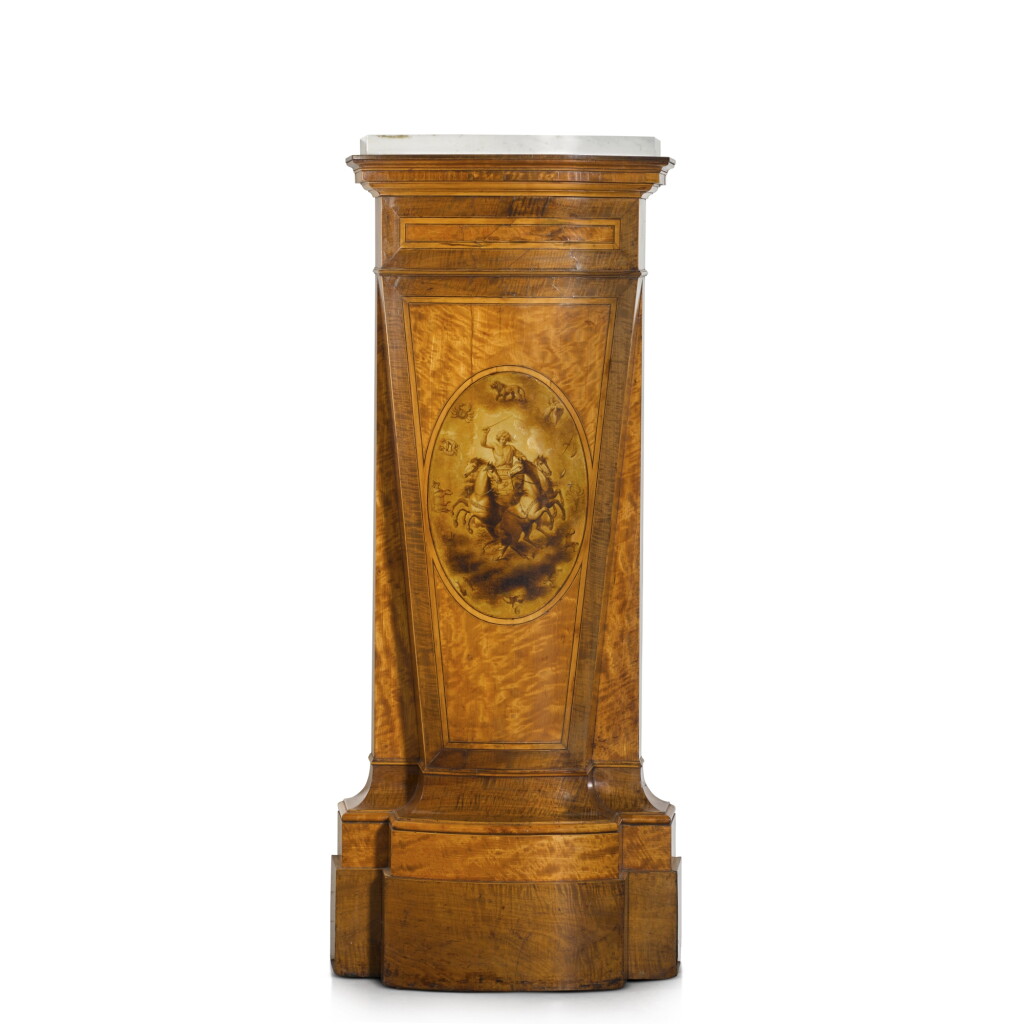
A George III satinwood, harewood and sycamore pedestal, circa 1790, by Thomas Brownley with painting by John Bromley
Lot Closed
June 9, 01:29 PM GMT
Estimate
18,000 - 25,000 GBP
We may charge or debit your saved payment method subject to the terms set out in our Conditions of Business for Buyers.
Read more.Lot Details
Description
the white marble top above a breakfront-form pedestal, the convex central section centred with a grisaille panel depicting Aurora with the signs of the Zodiac, on a moulded plinth base
130cm high, 55.5cm wide;
51 ⅛ in., 21 ⅞ in.
Related Literature
Maurice Tomlin, Catalogue of Adam Period Furniture, London, 1982, p. 116.
Roger Smith, ‘Benjamin Vulliamy’s painted satinwood clocks and pedestals,’ Apollo, June 1995, pp. 25-33.
This pilaster pedestal in veneered woods of East Indian satinwood and ebonised borders is decorated with an oval grisaille medallion of Apollo in the antique manner popular during the neoclassical period in the late eighteenth century. Originally designed as a case support for a luxurious biscuit porcelain and gilt-bronze clock by Benjamin Vulliamy (1747-1811), an almost identical example with its clock is in the collections of the Victoria & Albert Museum (W.16:1-1958) alongside a pair depicting Venus and her son Cupid (W.16:2-1958). Another, more complex clock attributed to Vulliamy, was commissioned for George IV at Carlton House on a tapering satinwood stand with a centre oval also decorated en grisaille with Apollo framed by the Zodiacs (RCIN 30044).
Vulliamy’s clocks represented the height of neoclassical design and innovation. These were opulent and highly prized possessions proudly displayed in main rooms. The supporting case was equally lavish, presently with exotic inlaid veneers expertly wrapping curving profiles and lively painted decoration done in a monochrome palette.
According to Vulliamy’s record books, which started in 1798, specialist work was outsourced to craftsmen for the veneered case and en grisaille painted decoration. A case recorded as ‘no. 315’ lists ‘Brownley as the maker of the inlaid satinwood case, seemingly Thomas Brownley of London whose firm continued to do work for Vulliamy throughout the early nineteenth century. The painter of the case is listed as ‘Bromley’. Of the two makers in London by that name, John Bromley was a decorative painter in the ‘Adam’ style as early as 1782.[i] As a coach painter, he would have been familiar with this technique on wood panels.
Though ‘no. 315’ is recorded later than the present pedestal, the recognizable description of ‘oval of appollo [sic] & 12 signs’, a ‘lyre upon the bottom’ and ‘4 snakes’, and long-standing working relationships preferred by Vulliamy suggests a sustained production of the neoclassical taste using known craftsman. He collected books on neoclassical architecture and antiquities, including Piranesi, Albertolli as well as Bernard de Montfaucon, the latter’s Antiquity Explained (London, 1721-22) illustrating the reference for the painted decoration of ancient intaglio of Apollo, as the passage of time, encircled by the twelve Zodiacs.[ii]
Other pedestals by Brownley and Bromley include a wider example in the medallion series made for the 1st Marquess of Buckingham in 1787 (sold Stowe Sale, Christies, 13 November 1848, lot 1667, later sold Christie’s London, 25th February 2008) and another with painted decoration depicting Roman trompe l’oeil carving relief. (Sotheby’s New York, 26 May 2000, lot 267).
[i] Roger Smith, ‘Benjamin Vulliamy’s painted satinwood clocks and pedestals,’ Apollo, June 1995, p. 29.
[ii] Bernard Montfaucon, Antiquity explained and represented in sculptures, Vol I, London, 1721-1722, pl. 32, fig. 9, p. 70.