
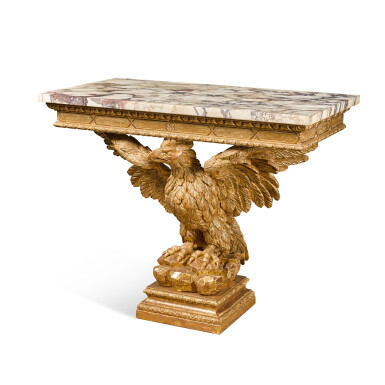
A George II carved giltwood eagle-form console table, circa 1740
Lot Closed
June 9, 01:34 PM GMT
Estimate
20,000 - 30,000 GBP
We may charge or debit your saved payment method subject to the terms set out in our Conditions of Business for Buyers.
Read more.Lot Details
Description
the associated marble top resting on a frieze with egg-and-dart moulding above hatched and punched gilt-gesso decoration, the base moulded as an eagle on rockwork, on a moulded plinth
80.3cm high, 101cm wide, 51.5cm deep;
31 ⅝ in., 39 ¾ in., 20 ¼ in.
Kentshire Galleries, New York;
Sotheby's New York, Kentshire, 18 October 2014, lot 254;
Apter-Fredericks, London;
Private collection, USA.
Apter Fredericks, Important English Furniture V, 2015, p. 51.
Tables with eagle supports have come to epitomized Kentian furniture, although only one published design by William Kent is recorded which has any relationship to this form, and there are no documented examples which can, with certainty, be attributed to him. Kent's design was used as tail-piece in Pope's edition of Homer's Odyssey, which was published 1725/6, and shows two fighting eagles with out-spread wings standing on a large pier table with a Greek-key ornamented frame above a solid shaped stand ornamented with Bacchic masks and garlands.
Nonetheless, other reputed makers from William Kent’s period are documented as supplying eagle tables. An interesting trade card, dated 1739, of Francis Brodie, the Edinburgh cabinetmaker, illustrates an interior with a group of furniture, including a related console table with an eagle support with outstretched wings. Brodie also supplied an eagle console for the Dukes of Hamilton and Gordon (‘A marble table supported by an Eagle guilt in Burnisht gold £16’) and for the Earl of Dumfries at Dumfries House in 1753 (To a Marble Slabe suported by an Eagle guilt in Burnisht gold’).
Another well-documented commission is the furniture supplied by William Bradshaw which included "2 Rich Carv'd and gilt Eagle Tables with Frames and Bracketts" for the Earl of Stanhope in 1737, today still in situ at Chevening House.