
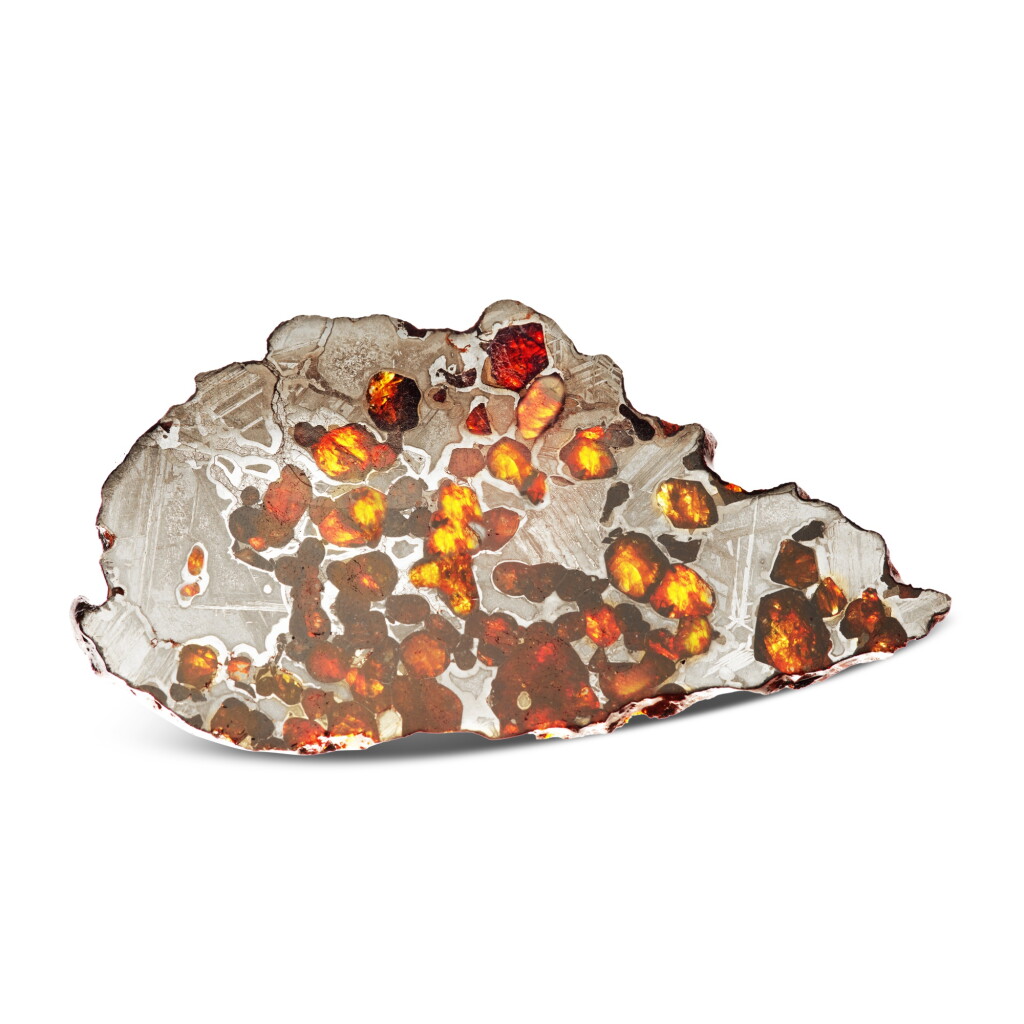
Complete Slice of Sterley
The Main Mass of a Rare Texas Pallasite
No reserve
Auction Closed
July 14, 07:13 PM GMT
Estimate
8,000 - 12,000 USD
Lot Details
Description
Complete Slice of Sterley — The Main Mass of a Rare Texas Pallasite
Pallasite – PMG
Floyd County, Texas, USA (34° 12' 36"N, 101° 23' 24"W)
120 x 58 x 3 mm (4¾ x 2¼ x ⅛ inches). 77.64 grams (.17 lb).
Included in the lot is the original meteorite classification letter, dated December 6, 1951, written by Chair of the Texas Tech Dept. of Geology, Dr. Raymond Sidwell, to finder Troy Ray, as well as the Sterley pallasite Catalog of Specimens, produced by meteorite collector and dealer Geoff Notkin after he cut the Sterley meteorite into 30 slices.
THE MAIN MASS OF AN EXCEEDINGLY RARE AND BEAUTIFUL AMERICAN PALLASITE, WITH THE ORIGINAL TEXAS TECH METEORITE CLASSIFICATION LETTER
Despite being just 77.64 grams, this slice represents the main mass – and thus the largest piece – of the highly sought after Sterley pallasite. As the Meteoritical Bulletin notes, Sterley was discovered in 1950 as a single 1,724.8 gram stone by a farmer, Troy Ray, while he plowed his field between Amarillo and Lubbock, Texas. Decades later, while watching the television show Meteorite Men, Troy Ray's son noticed that the stone his father had collected looked similar to the meteorites on the show and brought it to Arizona State University, where Dr. Laurence Garvie of the Center for Meteorite Studies "rediscovered" it as a meteorite.
This lot includes not only the main mass of the Sterley pallasite, but the original meteorite classification letter written to finder Troy Ray by the Chair of the Texas Tech Department of Geology, Dr. Raymond Sidwell, as well as the Sterley pallasite Catalog of Specimens, produced by meteorite collector and dealer Geoff Notkin after he cut the Sterley meteorite into 30 slices.
Pallasites represent just .2% of the meteorites ever found on Earth (that is, only 1 out of every 500 meteorites found on Earth). In addition to this, only 22 of the confirmed meteorites found in the United States are pallasites, thus making any piece exceedingly rare and incredibly desirable.
REFERENCES:

